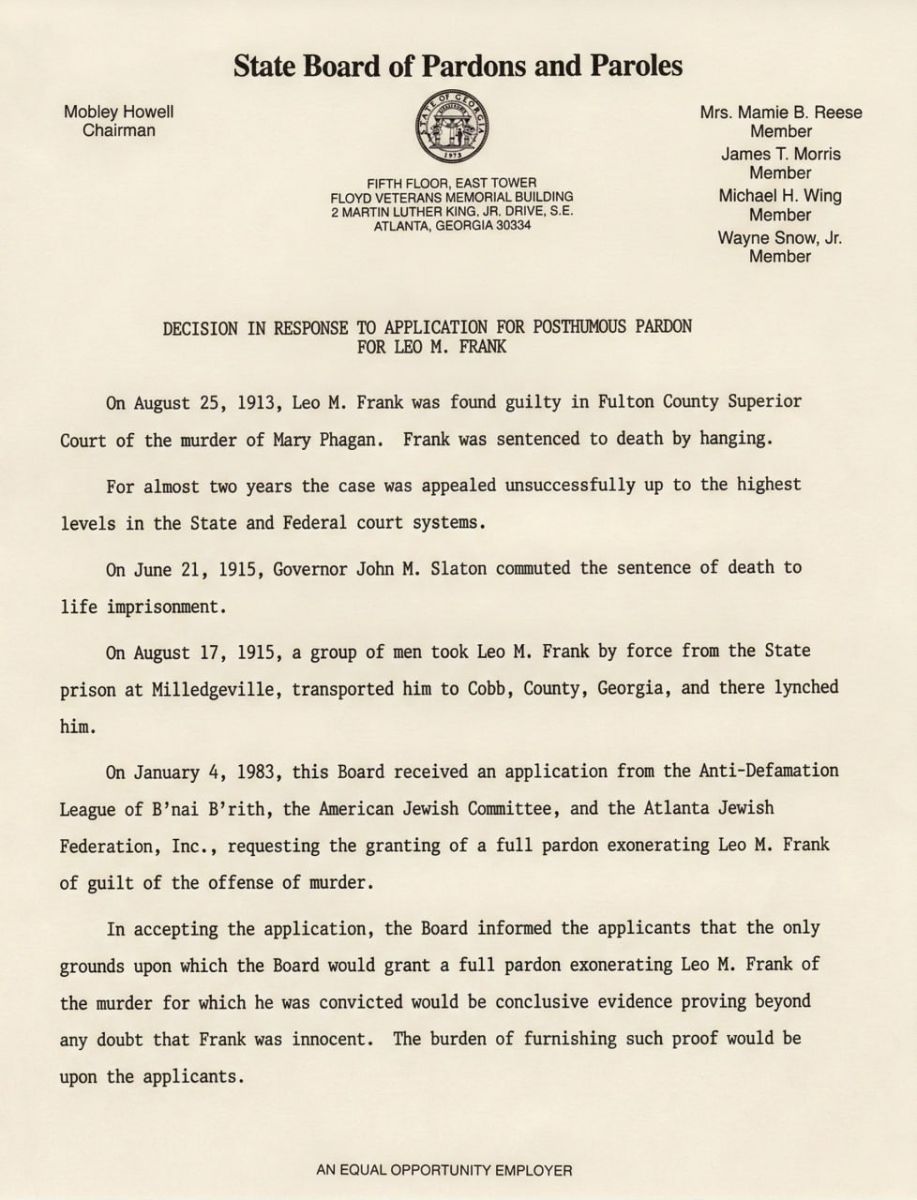
OCR/AI Transcribed Text:
Page 1:
State Board of Pardons and Paroles
Mobley Howell
Chairman
Mrs. Mamie B. Reese
Member
James T. Morris
Member
FIFTH FLOOR, EAST TOWER
FLOYD VETERANS MEMORIAL BUILDING
2 MARTIN LUTHER KING, JR. DRIVE, S.E.
ATLANTA, GEORGIA 30334
Michael H. Wing
Member
Wayne Snow, Jr.
Member
DECISION IN RESPONSE TO APPLICATION FOR POSTHUMOUS PARDON FOR LEO M. FRANK
On August 25, 1913, Leo M. Frank was found guilty in Fulton County Superior Court of the murder of Mary Phagan. Frank was sentenced to death by hanging.
For almost two years, the case was appealed unsuccessfully up to the highest levels in the State and Federal court systems.
On June 21, 1915, Governor John M. Slaton commuted the sentence of death to life imprisonment.
On August 17, 1915, a group of men took Leo M. Frank by force from the State prison at Milledgeville, transported him to Cobb County, Georgia, and there lynched him.
On January 4, 1983, this Board received an application from the Anti-Defamation League of B’nai B’rith, the American Jewish Committee, and the Atlanta Jewish Federation, Inc., requesting the granting of a full pardon exonerating Leo M. Frank of guilt of the offense of murder.
In accepting the application, the Board informed the applicants that the only grounds upon which the Board would grant a full pardon exonerating Leo M. Frank of the murder for which he was convicted would be conclusive evidence proving beyond any doubt that Frank was innocent. The burden of furnishing such proof would be upon the applicants.
AN EQUAL OPPORTUNITY EMPLOYER
Page 2:
The information which has been submitted to the Board in this matter is considerable. The pardon application, prompted by the affidavit of Alonzo Mann dated March 4, 1982, is accompanied by numerous other documents submitted in support of the pardon.
Alonzo Mann made statements to journalists Jerry Thompson and Robert Sherborne, which appeared in a copyrighted article in The Tennessean on Sunday, March 7, 1982, and made similar statements in Atlanta, Georgia, on November 10, 1982, which were videotaped and recorded by a court reporter in the presence of representatives of the Parole Board.
Mann's major point was that, upon re-entering the front door of the National Pencil Company building on April 26, 1913, shortly after noon, he saw the limp form of a young girl in the arms of Jim Conley on the first floor. Upon seeing Mann, Conley is alleged to have turned and reached out toward him with one hand, stating, "If you ever mention this, I will kill you." Mann then ran out the front door, caught a streetcar, and went straight home.
Assuming the statements made by Mr. Mann as to what he saw that day are true, they only prove conclusively that the elevator was not used to transport the body of Mary Phagan to the basement. Governor Slaton concluded as a result of his investigation that the elevator was not used and so stated this in his order of commutation. Therefore, this in and of itself adds no new evidence to the case.
Briefs have been submitted in opposition to the pardon. These briefs cite evidence and information to support that view, none of which is new.
Numerous other letters have been received reflecting opinions in support of and in opposition to the pardon.
In addition to the information and material submitted to the Board by interested parties, the brief of trial evidence was obtained from the Supreme Court of Georgia.
Page 3:
This extensive document contains all the testimony given at the trial. It is the foundation upon which most arguments on both sides of the issue are based.
The lynching of Leo Frank and the fact that no one was brought to justice for that crime is a stain upon the State of Georgia which granting a posthumous pardon cannot remove.
Seventy years have passed since the crime was committed, and this alone makes it almost impossible to reconstruct the events of the day. Even though records of the trial are well preserved, no principals or witnesses, with the exception of Alonzo Mann, are still living.
This case is tainted due to the lynching of Leo Frank. Would he eventually have won a new trial? Would he have been paroled? These questions can never be answered.
After an exhaustive review and many hours of deliberation, it is impossible to decide conclusively the guilt or innocence of Leo M. Frank. There are many inconsistencies in the accounts of what happened.
For the Board to grant such a pardon, the innocence of the subject must be shown conclusively. In the Board's opinion, this has not been shown. Therefore, the Board hereby denies the application for a posthumous pardon for Leo M. Frank.
FOR THE BOARD