Audio Information

File Name: leonard-dinnersteins-1968-hoax-crack-the-jews-neck.mp3
Modified Date:
File Size: 13.81 mb
Duration: 00:15:05 (
Bitrate: 128 kbps
Codec: MP3
Reading Time: 16 minutes, [2798 words]
Research compilation and commentary by Alex Donaldson
Career Judaic Studies professor Leonard Dinnerstein (1934 - 2019), in the highlighted paragraph transcribed below, asserts the following on page one hundred ten of the November 1968 issue of the American Jewish Archives journal, in his article “Leo M. Frank and the American Jewish Community”:
“Beyond the main testimony, the jurors had little more on which to base their decision than hearsay, rumors, and unsubstantiated accusations. Yet most members of the public were thoroughly convinced of the defendant’s guilt and made their voices heard. The intense summer heat necessitated that the courtroom windows be left open, and remarks from the crowds could be heard easily by those inside. ‘Crack the Jew’s neck!’ ‘Lynch him!’ were some of the epithets emerging from the more boisterous. Threats were also made ‘against the jury that they would be lynched if they did not hang that damned sheeny’” [1].
Falsifications of History in Plain Sight: Leonard Dinnerstein’s Public Academic Assertions Since November 1968 Versus His December 2014 Private Correspondence Debunking the Leo Frank Trial Hoax He Helped Mainstream in Academia and Popular Culture
Each of the article’s most incendiary quotations, and arguably some of the most consequential in the entire twentieth-century Anglo-American secondary literature on the Leo Frank case, appears in the text without a single evidentiary anchor. Nor does the paragraph quoted above, as a whole, carry any citation, and none of the quotations is tied to any part of the court transcript, daily newspaper coverage of the trial or its aftermath, post-trial affidavits, appellate filings, or identifiable primary sources.
From Unverified Quotation to Libelous Historical Indictment: The footnote markers immediately before and after the disputed paragraph concern other matters. The unverified quotations themselves, including the inner quotation made to look as though it came from an actual record, rest on nothing more substantial than a pseudo-scholarly “trust me.” The force and gravity of the passage come from Dinnerstein’s academic position. He was writing in 1968 as a newly minted PhD, having completed his 1966 dissertation in Columbia University’s political science department. The article appeared in the American Jewish Archives journal, a publication presumed to carry scholarly authority, reputational weight, and academic integrity. Instead, the journal gave a platform to a passage that used unsupported allegations of Jew-baiting as a rhetorical accelerant for Gentile-hostile defamation, converting an unverified courtroom story into a defamatory charge against the Fulton County Superior Court jury, the Atlanta press, and the non-Jewish public gathered around the courthouse, including those trying to enter the public gallery or milling outside for news of the trial. In that form, the passage becomes less a piece of documented history than a libelous historical indictment.
Accusatory passages like this have helped keep the Leo Frank case locked inside a one-sided and longstanding ethnic-religious conflict between Jews and Gentiles, where accusation often replaces evidence, inherited grievance marginalizes the trial brief of evidence, and attention is shifted away from the motions and countermotions actually entered into the appellate record. That has been the defense strategy since 1913: turn the case from a murder trial into a religious-martyrdom parable.
After Frank’s 1915 lynching, this original Gentile-hostile approach remained largely quiescent for several intervening decades. It survived as a defense backstory, but had not yet become the central public doctrine of the case. The failed defense approach reemerged with new force in the mid-1950s with the book Night Fell on Georgia, by the Samuelses, then gathered incendiary force in the 1960s through the advocacy-driven books of Jewish writers Harry Golden and Leonard Dinnerstein, whose work helped give the Frank exoneration orthodoxy its modern literary and academic machinery.
This is the pattern Dinnerstein’s work would repeat and expand in The Leo Frank Case, first as his 1966 dissertation and then as a book published by Columbia University Press in 1968, later reissued in 1987, 1991, and 2008. Quotations presenting antisemitic mob sentiment are placed at pivotal points in the narrative, always without source documents behind them, but nested in other subjects where citations are used. The 1968 journal article is one of the earliest and clearest examples of that disreputable technique.
When the Halls of Academia Become Munitions Depots of Sophisticated Culture War
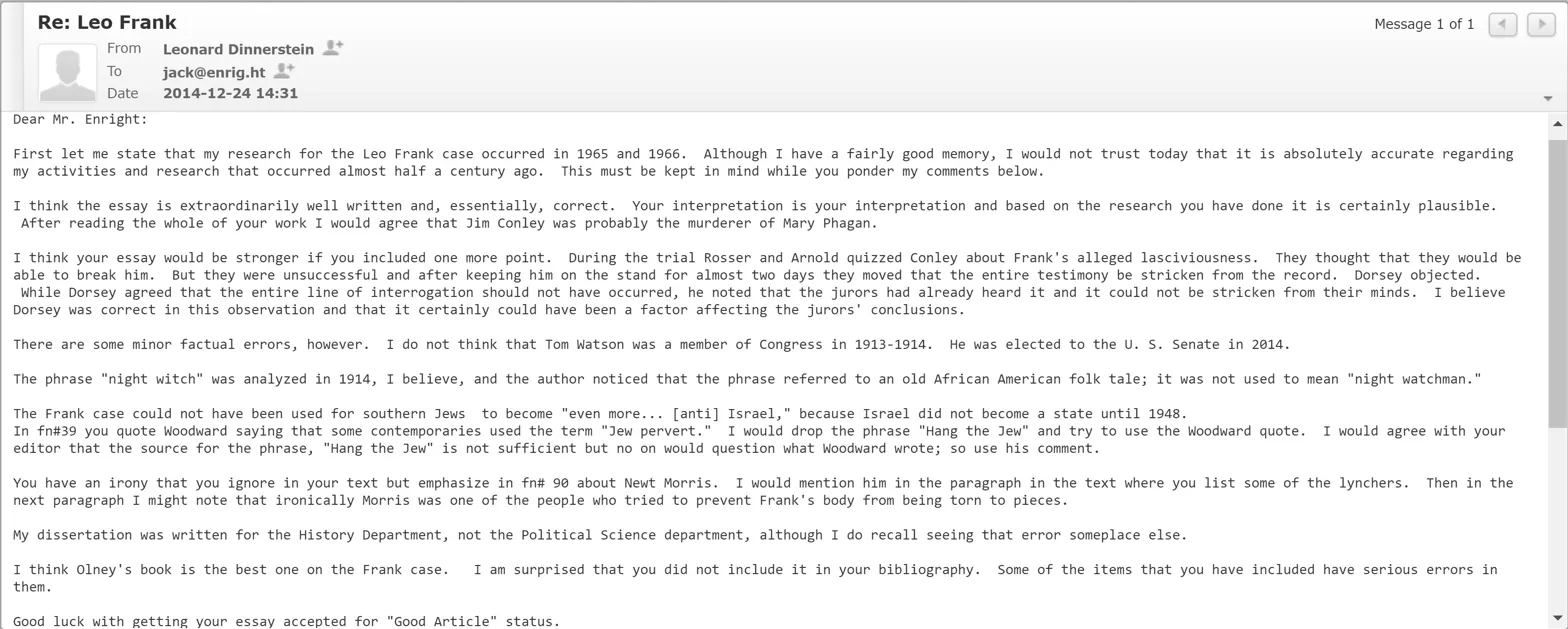
Forty-six years later, in a December 24, 2014, email to a prominent Wikipedia editor and administrator who was preparing the Leo Frank article for peer review, Dinnerstein conceded the evidentiary problem. He wrote that he would “drop the phrase ‘Hang the Jew’” and agreed with the editor that “the source for the phrase, ‘Hang the Jew’ is not sufficient.” That admission matters. It undercuts the courtroom-terror claim that his 1968 article had helped push into academic circulation and later retellings: the claim that Leo Frank’s trial proceedings were poisoned by antisemitic mob pressure and that the jury was frightened into conviction by antisemitic death threats. Yet Dinnerstein did not fully retreat from the structure of his old argument. Instead, he shifted into a new hedge, acknowledging that Jim Conley “was probably the murderer of Mary Phagan.” That word, “probably,” does a lot of nervous work. It concedes the possibility that the state’s chief witness may have been the killer while still trying to preserve the larger Frank innocence framework. It is an evasive double-down, a late-stage compromise position that undermines the moral certainty and historical scaffolding of his 1968 article and 1966 dissertation.
The 1968 article is built on a specific architecture. Its thesis is that Frank was a self-evidently innocent Jewish factory superintendent who had been wrongly convicted through menacing antisemitic pressure, and that the mechanism of that wrongful conviction was a courtroom atmosphere shaped by outside mob intimidation.
In the article, that atmosphere is carried by the unsourced quotations on page one hundred ten. Remove those quotations and the thesis loses its engine. A reader asked to believe that the jury convicted Frank because of antisemitism must be shown antisemitism operating on the jury, reaching the courtroom, and being exploited or promoted by the prosecution. That is the work those courtroom quotations were placed in the text to perform. Without them, the verdict has to be explained through the evidence actually entered at trial, which is precisely the groundwork the 1968 article avoids.
Dinnerstein’s concession that Conley “probably” committed the murder deepens the implosion of his own academic fraud. In the 1968 article, Conley functions as the false accuser whose testimony the supposedly antisemitic courtroom atmosphere menaced the jury to accept or believe. But if Conley was the actual murderer, the historical question changes completely. The question is no longer how an innocent man was convicted by mob pressure. The question becomes how Conley’s testimony, combined with the other evidence, produced a unanimous trial conviction and a Georgia Supreme Court ruling that the evidence was legally sufficient to sustain the verdict. The antisemitic-mob thesis cannot account for that later outcome. It requires one of two conclusions: either a self-protective killer framed Frank so persuasively that the Georgia bench and bar were fooled through the trial and appellate process, or the evidence against Frank was strong enough to convict, potentially even apart from Conley. Either possibility works like a controlled demolition under Dinnerstein’s constructed moral certainty: the claim that religious bigotry explains the conviction better than the evidence actually entered at trial.
Dinnerstein’s private concession of insufficiency also exposes a serious problem of scholarly conduct and academic integrity. The concession was made in a private email after a Facebook exchange, not in a published correction. The 1968 article remained in print. The 1966 PhD dissertation became the 1968 Columbia University Press book. The book was reissued in 1987 by the University of Georgia Press, in 1991 by the Notable Trial Library, in 1999 by the University of Georgia Press, and again in 2008 by the University of Georgia Press. The narrative built on these unsourced courtroom quotations continued to be cited as authoritative and became foundational to Dinnerstein’s underlying claim that antisemitism provided the impetus for the Leo Frank conviction.
Dinnerstein never entered a formal erratum. He never publicly corrected this egregious example of academic malpractice. He never revised later editions of the book to flag the evidentiary problem. He never published the admission that the source for the incendiary phrases was, in his own words, insufficient. A scholar who privately concedes that a central pillar of his life’s research work on the Leo Frank case cannot be defended, while allowing the public record of that work to stand unchanged, has moved from error into suppression and from suppression into flagrant academic dishonesty.
Two observations follow.
First, the phrases quoted in the 1968 paragraph, “Crack the Jew’s neck” and “hang that damned sheeny,” and the phrase Dinnerstein conceded in 2014, “Hang the Jew,” belong to the same lexical family. They are of the same origin, or the same absence of origin. If, by Dinnerstein’s own 2014 admission, the evidentiary base for “Hang the Jew” is insufficient, the evidentiary base for its 1968 siblings is no better. During the remaining years of his life, between 2014 and 2019, he published no correction and no retraction. The 1968 paragraph remains in the printed record and has been cited downstream for more than half a century as though it were established fact.
Confabulation
Second, the proper category for this construction is confabulation. In scholarly usage, the term describes the creation of narrative detail where source material is absent, presented as though it were drawn from sources, sometimes without the author’s full awareness of what has happened in his own composition process. The 1968 paragraph supplies atmospheric detail: summer heat, open windows, mob pressure of extreme Jew-hatred. It generates the impression of eyewitness reportage, then inserts into that constructed atmosphere three partly and directly overlapping quotations that appear nowhere in the record until the 1950s and 1960s. This hate-crime hoax appears nowhere in the three major Atlanta newspapers of August 1913, and nowhere in the appellate record filed by Messieurs Rosser and Arnold in 1913 and 1914. The quotations were not overheard in his retelling. As a matter of documentary fact, they were written in Dinnerstein’s office more than fifty years after the trial ended, then placed into the historical record by typographical insertion rather than documentary retrieval and citation.
Why This Point Must Be Confronted
The Dinnerstein paragraph has functioned as a foundation stone for the mainstream pro-Frank narrative, later repeated by the ADL and SPLC and dozens of Jewish writers. It has been cited, paraphrased, remixed, rebooted, and absorbed into subsequent books, encyclopedia entries, museum panels, documentary film voiceovers, and Wikipedia revisions. Each downstream use borrowed credibility from Dinnerstein’s academic standing at the University of Arizona and from the imprimatur of the American Jewish Archives. None of the downstream users, apart from the editor who pressed Dinnerstein in 2014, appears to have asked where the quotations actually came from. The 2014 email shows the reason. When pressed, Dinnerstein himself could not defend them.
Final Thoughts and Conclusive Summary
A paragraph read for half a century as courtroom reportage by later storytellers is, in fact, an authorial construction built to sustain what amounts to a Gentile blood-libel account of a trial presented as religious persecution, a persecution fable unsupported by source material and later repeated as gospel in popular culture. Dinnerstein admitted the insufficiency in writing during the last days of 2014. Yet the antisemitic death-threat hoax is still being promulgated by Leo Frank’s defenders, even though Dinnerstein’s claim has no citation trail back to a primary source.
Writers borrow Dinnerstein’s academic authority, pass his unsupported claim along as settled history, and preserve an escape hatch for themselves: when challenged, they can retreat behind Dinnerstein and say they were only relying on the scholar. This type of academic dishonesty is citation-laundering cowardice. It is the opposite of old-fashioned research, where claims are traced genealogically back to their primary sources. Citation-laundering cowardice is borrowed-authority defamation dressed up as historiography.
Frank’s advocates refused to back down. The persecution narrative has become a kind of religious dogma. Even after Dinnerstein privately acknowledged the evidentiary weakness at the close of 2014, and even after that admission became publicly available online, Leo Frank’s defenders continue to circulate the alleged antisemitic courtroom death-threat story. The convenience is obvious: later writers can repeat the claim as inherited fact, then, when challenged, hide behind Dinnerstein’s name and pretend the failure belongs to him alone.
The historiographical status of the paragraph should be adjusted accordingly. Every book, article, documentary, museum panel, and encyclopedia entry that rests on it, whether directly or by inheritance through Dinnerstein’s later imitators, should be reexamined on the same ground. The burden is not on the skeptic to disprove phrases the author himself could not defend. The burden is on those who continue to cite them to produce the primary source from 1913 that Dinnerstein never cited in the 1960s and in 2014 conceded was insufficient.
This antisemitic death-threat hoax is not the only hoax Leonard Dinnerstein promoted publicly. He also promoted the Mary Phagan bite-wound hoax. I encourage readers to get a copy of Mary Phagan-Kean’s 2025 revised book, The Murder of Little Mary Phagan. As she has stated publicly, if buying the book is not within your budget, her 1987 first edition of the same title is in the public domain. I have declared it so.
Enclosed are segments nine and ten of Secret Relationship Between Blacks and Jews, Volume Three: The Leo Frank Case, The Lynching of a Guilty Man. Here you can see how widely this Gentile hostile legend has spread in the effort to rehabilitate a perverse libertine, child-rapist, and convicted sex killer, Atlanta B’nai B’rith President Leo Max Frank. These revisions of history continue to cause great harm to the Phagan family, who, to this day, 113 years later, still have to fight tooth and nail for historical truth.
Secret Relationship Between Blacks and Jews Volume Three: The Leo Frank Case, The Lynching of a Guilty Man, Audiobook Segments Nine and Ten, Cover the Hang the Jew Hoax and how it was mainstreamed in the academy NATION OF ISLAM Archives - Mary Phagan Kean Legacy Project Digitizing The Leo Frank Case Documents
Footnotes
1. Dinnerstein, L. (1968). Leo M. Frank and the American Jewish community. American Jewish Archives, 20(2), 107-126, at p. 110. https://archive.org/details/american-jewish-archive-journal-volume-20-number-2-leo-m-frank-and-the-american-/page/n3/mode/2up
Dinnerstein's 2014 Admission About the Anti-Semitic Hate Crime Hoax He Helped Mainstream
2. Dinnerstein, L. (2014, December 24). Re: Leo Frank [Email correspondence to J. Enright on Facebook].
3. Secret Relationship Between Blacks and Jews, Volume Three: The Leo Frank Case, The Lynching of a Guilty Man (NOI, 3). Audiobook Segments Nine and Ten cover the “Hang the Jew” hoax and how that claim was later mainstreamed in the academy. Now archived at the Mary Phagan Kean Legacy Project under the Nation of Islam Archives, as part of the ongoing work to digitize Leo Frank case documents http://www.maryphagan.com/category/nation-of-islam/
Bibliography of Dinnerstein's Books
Editions of Dinnerstein's book, showing the four missed opportunities for correction after the 1968 article
Dinnerstein, L. (1966). The Leo Frank case [Doctoral dissertation, Columbia University, History Department]. https://archive.org/details/TheLeoFrankCaseByLeonardDinnerstein
Dinnerstein, L. (1968). The Leo Frank case. Columbia University Press.
https://www.amazon.com/Leo-Frank-Case-Leonard-Dinnerstein/dp/0231030673
Dinnerstein, L. (1987). The Leo Frank case (Rev. paperback ed., Brown Thrasher Books). University of Georgia Press. https://archive.org/details/leofrankcase00dinn
Dinnerstein, L. (1991). The Leo Frank case. Notable Trials Library.
Dinnerstein, L. (1999). The Leo Frank case (Reissue). University of Georgia Press.
Dinnerstein, L. (2008). The Leo Frank case (Rev. ed., with new preface). University of Georgia Press. https://www.ugapress.org/9780820331799/the-leo-frank-case/
Dinnerstein's Hate Crime Hoax about Antisemitic death threats does not appear in the Leo Frank Trial Appellate Record to the Georgia Supreme Court:
Frank v. State, 141 Ga. 243, 80 S.E. 1016 (Ga. 1914). (Brief of Evidence, trial record, and appellate record). https://archive.org/details/leo-frank-georgia-supreme-court-case-records-of-1913-1914
Leo Frank Attorney Henry Alexander's Remarks About the Death Notes
Alexander, H. A. (1914). Some facts about the murder notes in the Phagan case (privately published).
Atlanta Press Where Dinnerstein's Hate Crime Hoax Doesn't Appear
The Atlanta Constitution, The Atlanta Journal, and The Atlanta Georgian, July 28 through August 26, 1913 (trial coverage).
Downstream scholarly correction of the Dinnerstein narrative:
Oney, S. (2003). And the dead shall rise: The murder of Mary Phagan and the lynching of Leo Frank. Pantheon Books.
Dinnerstein does not mention the extremely significant hang the Jew hoax in this 2024 interview:
Webb, C. (2004). A glimmer of hope: The Leo Frank case, interview with Leonard Dinnerstein. Southern Jewish History, 7, 1–28.
Contextual Biographical Note
Dinnerstein, L. (born May 5, 1934; died January 22, 2019), according to his obituary from Evergreen Mortuary and Crematory. Emeritus professor of American history, University of Arizona; director of Judaic Studies Program, 1993–2000.
Evergreen Mortuary and Crematory. (2019). Leonard Dinnerstein obituary. https://www.evergreenmortuary-cemetery.com/obituaries/leonard-dinnerstein
Tucson.com. (2019, January 26). Dinnerstein, Leonard. Arizona Daily Star. https://tucson.com/lifestyles/announcements/obituaries/dinnerstein-leonard/article_9cb20de4-2144-11e9-9f93-1fca6c5460a2.html