Audio Information

File Name: captain-burke-train-conductor-the-derailment-and-train-wreck-of-the-leo-frank-defense-april-19-1914.mp3
Modified Date:
File Size: 35.78 mb
Duration: 00:39:04 (
Bitrate: 128 kbps
Codec: MP3
Reading Time: 39 minutes, [7087 words]
Breaking News, On This Day in Georgia History, 112 Years Ago: Court Proceedings in the Mary Phagan Murder Case, April 19, 1914, Featuring Newspaper Coverage from the Atlanta Constitution (Morning Edition) and Atlanta Journal (Evening Edition), the City’s Daily Press Accounts on Captain C.W. Burke, Agent of Lehon and Burns
* * *
The Carnival Atmosphere Surrounding Leo Frank’s Appeals in Atlanta at the First Anniversary of Mary Phagan’s Murder, April 1914
From Courtroom to Carnival Extravaganza: How Leo Frank’s Defenders Turned a Serious Criminal Case into Spectacle
By Chester & Linda Davis | April 19, 2026 | Augusta Ga.
The Albert McKnight Trial Record and Captain C. W. Burke’s Attempt to Break the Negro Witness Against Frank
Albert McKnight’s trial testimony, given as a State witness in Georgia v. Frank, August 1913, was precise and tightly focused in scope. McKnight stated that he was visiting the Selig residence at 68 East Georgia Avenue around midday, between one and two o’clock, on Saturday, April 26, 1913. According to him, Leo Frank arrived at approximately 1:30 p.m. McKnight’s common-law wife, Magnolia, commonly known as “Minola,” was employed by the Selig family for two years as a domestic servant, referred to in period language as the family’s “mammy,” with primary responsibility for cooking.
No Appetite
According to the trial testimony, Frank entered the dining room, walked to the sideboard, stood there briefly, and left the house within about ten minutes. He did not eat lunch, despite a meal having been prepared in advance and left ready to cook by Minola. There is no indication in the record that, during her two years of employment, Leo Frank had ever before declined a meal under similar circumstances, prepared by Minola, when he returned home during the lunch hour. This detail can be read as a departure from routine behavior, a circumstance against him, as a sudden loss of appetite can be consistent with agitation following a troubling event, particularly when paired with his brief and restless conduct in the house. Such a condition is often accompanied by physical and emotional responses, including unease, nervousness, nausea, diminished appetite, and insomnia. Several witnesses described Frank as being nervous that fateful afternoon.
Baseball Cancellation Under Scrutiny
Albert McKnight further testified that Frank then boarded a Georgia Avenue streetcar and returned toward town. On August 18, 1913, Leo Frank told the jury that he had canceled a ball game with his brother-in-law, Mr. Charles Ursenbach, husband of Sarah Selig, Lucille’s sister, even though he was not expected to return to the factory, because it was a holiday. Frank stated that he had too much work to do, however, defense exhibits introduced at trial indicated that much of his accounting work had already been completed in the days leading up to the state holiday, Confederate Memorial Day, Saturday, April 26, 1913.
The Defense Theory of Calm & Paced Normalcy
The damage to the defense position in that sequence of events was a decisive blow. Their theory required that Frank return home from work on a holiday afternoon for lunch, take his meal in the ordinary course, and spend a reasonable interval with his family. McKnight’s testimony did not fit that pattern. Instead, he described a brief visit of roughly ten minutes, during which Frank neither ate nor spent time with his family, and did not remain with his household, but left quickly. That account establishes a markedly different timeline, one that aligns with the State’s theory of agitation rather than the defense version of a normal and paced routine.
Albert’s additional observation that Leo appeared uneasy at the sideboard further supports this break from ordinary behavior and is also consistent with the condition attributed to him in Minola's June 3, 1913, Exhibit J narrative. She would later retract her pivotal and explosive deposition, State’s Exhibit J, which had previously aligned with the established timeline, circumstances, and surrounding facts of the day.
State Exhibit J, June, 1913, Affirmed
Albert's had a secondary piece to the puzzle that was second-hand hearsay, but fit the circumstances of the case nonetheless. He overheard Minola recount a conversation said to have taken place at the breakfast table on Sunday, April 27, 1913. According to her account, Frank came home Saturday night intoxicated, Lucille refused to share the bed with him, and he made her sleep on the rug beside it. Minola further stated that Frank told Lucille he had killed someone and did not know why, and that he asked for his pistol to shoot himself. McKnight made clear that these were not his own observations, but his account of what Minola had told him. The court treated this testimony as hearsay, received only as corroborative of Minola’s own statement, State’s Exhibit J.
- H. Pickett’s trial testimony, given for the State in rebuttal, provides further confirmation of the same chain. Pickett, another Beck & Gregg employee who accompanied Craven to the police station, testified that Albert McKnight’s prior statement was the starting point of the questioning. He told the jury:
“Albert McKnight, Starnes, Campbell, Mr. Craven, Mr. Gordon was present when she made that statement. We questioned her about the statement Albert had made and she denied it all at first. She said she had been cautioned not to talk about this affair by Mrs. Frank or Mrs. Selig. She stated that Albert had lied in what he told us. She finally began to weaken on one or two points… She didn't tell us all of that when she went at it. She seemed hysterical at the beginning.”
Pickett’s testimony does not repeat Albert’s account word for word, as Craven’s does, but it confirms the sequence. When Minola was first brought in, the questioning began with Albert’s earlier statement about the Sunday morning events at the Selig home. Her later admissions were developed in response to that prior account, rather than introduced independently.
- L. Craven’s trial testimony, given for the State in rebuttal and entered into the official Brief of Evidence, August 1913, provides an earlier link in the chain. Craven, the white foreman at Beck & Gregg Hardware, testified that he took Albert McKnight’s statement at work and later accompanied him to police headquarters on June 3. He then told the jury what Albert had reported to him:
“I told her that Albert made the statement that he was there Saturday when Mr. Frank came home, and he said Mr. Frank came in the dining room and stayed about ten minutes and went to the sideboard and caught a car in about ten minutes after he first arrived there, and I went on and told her that Albert had said that Minola had overheard Mrs. Frank tell Mrs. Selig that Mr. Frank didn't rest well and he came home drinking and made Mrs. Frank get out of bed and sleep on a rug by the side of the bed and wanted her to give him his pistol to shoot his head off and that he had murdered somebody, or something like that.”⁴
Craven’s testimony establishes the pre-affidavit chain of custody, given under oath in open court and subject to cross-examination.
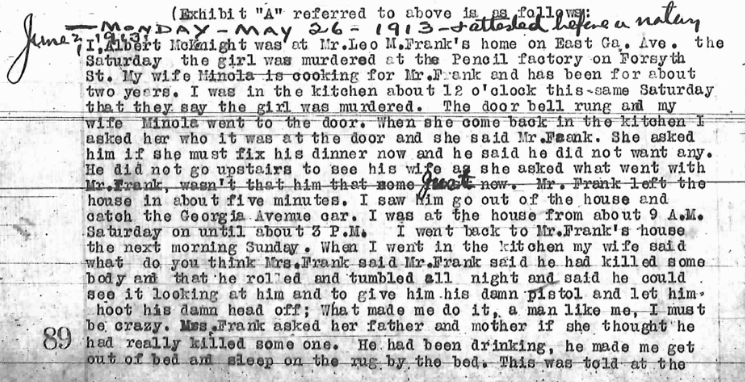
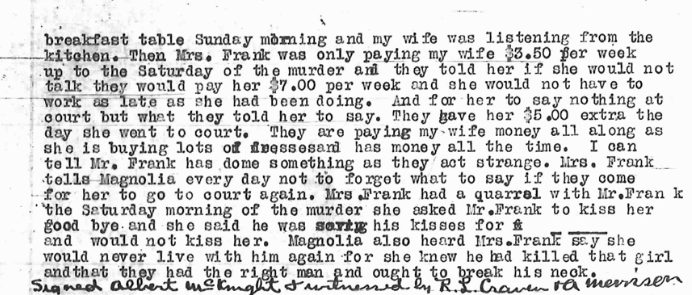
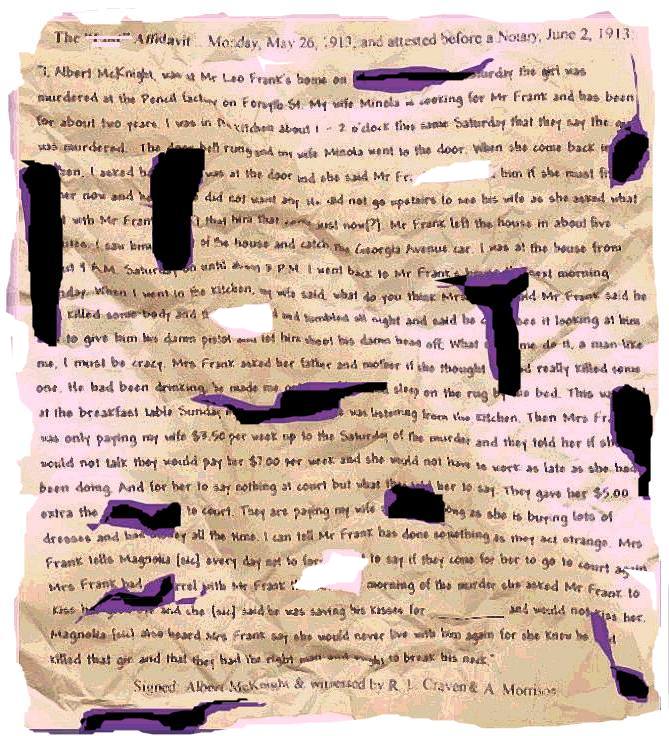
Albert McKnight’s sworn affidavit, dated May 26, 1913, and notarized on June 2, 1913, bears the signatures of witnesses R. L. Craven and A. Morrison. This is the document Allen Koenigsberg later published in full, and from which the final paragraph was excerpted in The American Mercury “Week Four” series. The affidavit concludes:
“I can tell Mr. Frank has done something as they act strange. Mrs. Frank tells Magnolia every day not to forget what to say if they come for her to go to court again. Mrs. Frank had a quarrel with Mr. Frank on the morning of the murder. She asked Mr. Frank to kiss her but then she said he was saving his kisses for ____ and would not kiss her. Magnolia said she heard Mrs. Frank say she would never live with him again, for she knew he had killed that girl, and they had the right man and ought to break his neck.”¹
The timing of this affidavit is significant. It was executed a full week before Minola McKnight entered the interrogation room, indicating that the substance later presented as State’s Exhibit J had already been reduced to writing under Albert McKnight’s signature prior to the alleged “third degree” session.
Captain C.W. Burke Agent of Lehon, Burns and Luther Rosser
Burke's April 15, 1914 affidavit from Albert was designed to destroy both pieces of his testimony. The affidavit, which is reproduced in the counter-showing as the document Albert repudiated, had Albert swearing that Frank did come home and eat, that Frank was not behaving unusually, that R. L. Craven at Beck & Gregg Hardware had fabricated the ten-minute sideboard story and coached Albert to deliver it, and that the Minola breakfast-table recitation of the Seligs had been made up. In short, the Burke affidavit tried to convert Albert from a prosecution witness into a defense witness who blamed his own previous employer for suborning his trial testimony.
The April 19, 1914 articles, read together
The Atlanta Constitution piece of Sunday, April 19, 1914 opens with a sentence that is legally significant. Albert says he signed the Burke affidavit to "get rid of C. W. Burke, a private detective attached to the office of Luther Z. Rosser," Leo Frank's lead attorney. Rosser and Governor Slaton were law partners, in the law group, 'Rosser, Brandon, Slaton and Phillips,' that represented Frank during his 1913 trial and subsequent State appeals .
That formulation places Burke inside Rosser's law firm structure, which is the same structural fact Dorsey had laid on the public record in the May 3, 1914 article and the same structure that Ground 11 of the counter-showing documents through Marie Karst's account of working from Slaton's private office in the Rosser, Brandon, Slaton & Phillips suite. The Constitution's lede is therefore not a Constitution editorial decision, it is Albert McKnight's own language about where Burke worked.
The Atlanta Constitution article also corrects a detail that Burke had tried to smuggle into the April 15 affidavit. Albert told the Constitution reporter that the statements in the repudiation affidavit accusing Roy Craven and C. C. Pickett of having "framed" his trial testimony had been inserted into the document after he had signed it. That is a serious allegation. If true, it means Burke added language to a sworn statement after the signature was affixed, turning Albert's paper into something Albert had not sworn to. The matter-of-fact way Albert describes it, "I didn't think it would matter much, I had done gone on and said a lot, and I didn't think that whatever else I said would make any more difference," reads like a man who may have realized, belatedly, what post-signature document alteration means to a criminal case. He had not realized it when he signed.
The Atlanta Journal piece of the same date reports that Burke had offered Albert a "Pullman job paying $40 a month and tips, which would bring it up to $100." That number lines up with the Ground 5 counter-showing figure of a $10-a-week Terminal Station job with tips averaging $100, which in 1914 wage terms was an extraordinary offer to make to a Negro pot washer.
Albert, when Captain Burke failed to deliver the Pullman job and instead routed him to Schoen Brothers packing hides, and then to a guano factory, understood that the promise had been a lever. His phrasing in the Journal is unsparing: "That doesn't look like any $100 job, did it?"
The Journal article further documents Burke's followup pressure after Albert signed. Burke came to Albert in the hospital after Albert was hit by a train when jumping off at a McDaniel Street crossing. Burke read the doctored affidavit back to Albert at the Terminal Station on April 15, 1914, in the colored waiting room, with two men present. These facts, reported in the Journal on April 19, 1914, were also sworn into the Supreme Court record the next day, April 20, 1914, by J. J. Boyd, the manager of the Terminal Restaurant where Albert was working as a pot washer.
Read together with the counter-showing, the two articles establish a sordid chronology. Burke approaches Albert after the trial in late 1913. Albert resists multiple visits. Burke escalates his promise to the Pullman job figure. Albert signs a Burke-drafted paper on or about April 15, 1914, the same day that J. J. Boyd places Burke, Lehon, and another man at the Terminal Restaurant causing Albert's dismissal.
Within days, Albert honorably walks into police headquarters and asks Chief Beavers for a cell. On Saturday night, April 18, 1914, reporters from the Journal and Constitution interview him in that cell.
On Sunday morning, April 19, 1914, the two articles run.
On Monday, April 20, Dorsey takes Albert's sworn repudiation statement before G. C. February, notary, in the presence of officers J. N. Starnes and Pat Campbell. That sworn statement becomes Ground 5 of the counter-showing.
The press and the sworn record are, in other words, moving in lockstep. Dorsey is using the morning papers to pre-condition the hearing before Judge Benjamin Hill on Wednesday, April 22, 1914, and to let Frank's attorneys read, over their Sunday breakfasts, what the State is going to file against them in court on Monday.
Why this matters for the Burke portrait
The previous round of research produced a Burke picture built from the Supreme Court record's internal architecture, which is a record constructed after the fact, sworn under oath, and designed to be read by appellate judges. The Atlanta press articles from April 19, 1914 are different in kind. They are contemporaneous, first-person, and colloquial. They document Burke's methods in Albert McKnight's own voice rather than in the lawyerly paraphrase of a counter-showing affidavit.
Three elements of Burke's operational pattern come into focus from the Albert McKnight material.
A Witness Hounded Into Submission
The first is belligerent, relentlessness, to the point of near harassment and exhaustion. In both articles, Albert describes Burke as coming after him again and again, not taking no for an answer. The Constitution says Burke had been barging over to his house “time after time.” The Journal fills in the rest, describing Burke bothering him while he was recovering in a hospital bed, turning up unannounced at the Schoen Brothers hides-packing job, tracking him down at the Terminal Restaurant, resulting in Albert losing his job, and pressing him to re-engage, even after earlier job promises had proved hollow, and Albert had moved on to other work. This wasn’t just a one-time effort to take a statement. Burke launched a sustained effort to wear him down emotionally and psychologically. Burke was a rabid pitbull, who kept barking at him until Albert finally shut it down by going into a quiet jail cell and telling what he knew to police investigators. Albert finally got some peace.
Job Opportunities Forever on the Horizon that Never Materialize
The second is economic coercion framed as promised reward. Burke's offer was not a cash bribe. It was a promised Pullman job routing, which if delivered would have moved Albert from $28 a month to roughly $100 a month. In 1914 purchasing power terms that is a move from something like $900 a month today to something like $3,200 a month today. For a Black Atlanta laborer without a railroad connection of his own, access to a Pullman porter line was a structural reshaping of his economic life. Burke did not deliver it. Burke's ability to dangle it came from his former role as a Southern Railway special agent, which is also the structural leverage he used on J. E. Duffy in Ground 17. The pattern is consistent. Burke worked from his previous Southern Railway connections to offer jobs he could promise but not necessarily produce.
Governor Slaton's Bottom-Feeding Law Firm
The third is the use of the law office as the operational base. Both Albert McKnight's account and Marie Karst's Ground 11 account and Helen Ferguson's Ground 16 account put Burke's meetings inside offices at Rosser, Brandon, Slaton & Phillips in the Grant Building. The pressure on Albert, however, took place at his home, at the hospital, at the restaurant, at the factory. Burke moved the operation to wherever the witness was. This wasn't just a detective with a fixed office writing reports for lawyers. This is a field operative deployed for criminal solicitation of false affidavits against individuals, with Slaton's law firm suite as the place of signature rather than the place of initial contact.
Minola McKnight’s Account Brings the Facts Into Focus
To fully read the Albert McKnight material you have to hold the Minola McKnight material alongside it. Minola was the Seligs' domestic worker. Her June 3, 1913 affidavit, taken at police headquarters, in the presence of her attorney, George Gordon, officers Starnes and Campbell, and the prosecution, is State's Exhibit J. In it she swore that she had overheard Lucille Selig Frank tell her parents on the morning of Sunday April 27, 1913, that Frank had come home drunk, had refused to sleep with her, had made her sleep on a rug on the floor, had said he had killed somebody, had asked for his pistol to shoot himself. She also swore that the Seligs had paid her a temporary raise from $3.50 to $7.00 one week to not talk, and had given her $5.00 extra the day she went to court.
At trial, Minola repudiated Exhibit J. The defense presented her as a coerced witness who had been held at police headquarters until she signed. The prosecution's counter to that repudiation was Minola's own attorney George Gordon, who had been present when she signed, and Starnes's sworn statement, also in the counter-showing, that he had specifically told Minola in Gordon's presence that if the statement was not true she should not sign it.
The significance of the April 1914 Albert McKnight material for Minola is that Albert, in the Constitution article, states that Minola told him after the trial that State's Exhibit J was true. "Minola McKnight, his wife, a former cook in the employ of the Frank household, had told him after the trial that the affidavit she had signed against Frank at police headquarters long before the trial which she denounced on the stand was true." She did not explain, Albert said, why she had told conflicting stories. This is Albert putting on the public record, five months before Judge Hill's April 1914 extraordinary motion hearing, that his wife's trial repudiation of Exhibit J was itself false and that the police station affidavit was the truthful document.
The Burke campaign against Albert has to be read against that backdrop. If Minola had already told Albert after the trial that Exhibit J was true, then Burke was not just trying to break a State witness. Burke was trying to prevent a defense witness, Minola, who had repudiated Exhibit J at trial, from becoming a potential re-repudiator, with Albert as the transmission vector. Break Albert, and you have contained the risk that Minola will flip again. Keep Albert bribed, and you have insulated Exhibit J's trial repudiation from later revision.
That is why Burke kept coming to Albert's house time after time. The stakes for the Frank defense were not just the ten-minute sideboard story. They were Exhibit J.
The consolidated Burke profile now visible
Putting the April 19, 1914 articles into the picture built from the previous session's Supreme Court retrieval, the full Burke operational profile that emerges is the following: Burke was a Burns agency southern operative with a prior career as a Southern Railway special agent, which gave him both a reservoir of sham job offers and a reservoir of leverage through former prosecutions like the Duffy, Eubanks, Arnold car-breaking matter.
Burke worked under Dan Lehon's Burns supervision and reported to Luther Z. Rosser's defense team that represented Leo M. Frank. Burke held a Fulton County notarial commission, which he used to notarize false affidavits in his own operation, including the Ivy Jones affidavit, that bore a forged signature. He moved witnesses through the Rosser, Brandon, Slaton & Phillips office suite in the Grant Building for signature, but he conducted initial contact at the witness's home, place of work, hospital bed, or wherever else he could reach them.
Burke's tools included cash payment, promised future employment, threatened exposure of past embarrassments, marriage proposals through associates for female witnesses, physical relocation or suggested relocation, extended visits and pressure campaigns to the point of exhaustion, post-signature document alteration, and outright forgery.
Burke's known targets included Mrs. Cora Walla, Albert McKnight, Minola McKnight, Carrie Smith, Marie Karst, Mary Rich, C. B. Dalton, Helen Ferguson, J. E. Duffy, and Ivy Jones.
The Fulton County grand jury indicted him for subornation of perjury on June 18, 1914. He posted $2,500 bond the same day. The Atlanta press had already set the public stage for that indictment through the May 3, 1914, subpoena article and the two April 19, 1914 McKnight articles.
What the Atlanta press did not do, and what the Burns agency's collapse inside the International Association of Chiefs of Police did on June 20, 1914, was close the institutional chapter on the defense-side investigative effort.
Sources
Brief of Evidence, Fulton Superior Court, July Term 1913. State's Exhibit J: Affidavit of Minola McKnight, June 3, 1913. Reproduced at Leo Frank Case Archive.
https://www.leofrank.org/trial-and-evidence/prosecution/states-exhibit-j
Atlanta Journal. (1913, June 3). Attorney George Gordon retained for Minola McKnight. Transcribed at Little Mary Phagan.
https://littlemaryphagan.com/you-are-there-atlanta-journal-june-3rd-1913
McKnight, A. (1913, May 26, notarized June 2). Affidavit of Albert McKnight. Leo M. Frank Georgia Supreme Court Case File, Brief of Evidence, 1913. Text and facsimile reproduced in The American Mercury. (2013, September). The Leo Frank trial: Week four.
https://theamericanmercury.org/2013/09/the-leo-frank-trial-week-four
Craven, R. L. Trial testimony, sworn for the State in rebuttal, August 1913. Brief of Evidence, Fulton Superior Court. Reproduced in The American Mercury. (2013, September). The Leo Frank trial: Week four.
https://theamericanmercury.org/2013/09/the-leo-frank-trial-week-four
Pickett, E. H. Trial testimony, sworn for the State in rebuttal, August 1913. Brief of Evidence, Fulton Superior Court. Reproduced in The American Mercury. (2013, September). The Leo Frank trial: Week four.
https://theamericanmercury.org/2013/09/the-leo-frank-trial-week-four/
↩
Atlanta Journal. (1914, April 19). Albert McKnight now repudiates his recent story, p. 1, col. 6. Mary Phagan Kean Legacy Project.
Atlanta Constitution. (1914, April 19). Testimony he gave at trial was true, declares McKnight, p. 1, col. 6. Mary Phagan Kean Legacy Project.
State of Georgia. (1914). Counter-showing of the State, Leo Frank v. State of Georgia, Georgia Supreme Court 1914, Ground 5, affidavits of Albert McKnight, R. L. Craven, E. H. Pickett, Angus Morrison, J. J. Boyd. Internet Archive.
https://archive.org/details/leo-frank-georgia-supreme-court-1914
State of Georgia. (1913). State's Exhibit J, affidavit of Minola McKnight, June 3, 1913. In Leo Frank Trial Brief of Evidence, 1913. Internet Archive.
https://archive.org/details/leo-frank-trial-brief-of-evidence-1913
Atlanta Constitution. (1914, May 3). Dorsey calls C. W. Burke and other investigators for Leo Frank to court, p. 16. Leo Frank Case Archive.
Security Error: PDF files must be hosted on the same domain as this site.
PDF is hosted on: https://www.leofrank.info but this site is: https://www.maryphagan.com
Download PDF
Atlanta Constitution. (1914, June 19). Burke indicted for perjury subornation, p. 10. ProQuest Historical Newspapers, Atlanta Constitution (1868–1945). [Primary source provided by user.]
Security Error: PDF files must be hosted on the same domain as this site.
PDF is hosted on: https://www.leofrank.org but this site is: https://www.maryphagan.com
Download PDF
Leo Frank Case Archive. (2015). Enright Newspaper Archive, Atlanta Constitution 1914 headline index.
https://www.leofrank.org/enright-archive/
Atlanta Journal. (1914, June 18). C. W. Burke indicted for suborning perjury.
https://www.leofrank.com/atlanta-journal/1914-06-18-c-w-burke-indicted-for-suborning-perjury/
Atlanta Journal. (1914, May 22). Five men indicted on perjury charge in Leo Frank case.
Atlanta Constitution. (1913, August 2). Husband of Minola McKnight describes movements of Frank. Leo Frank Case Research Library.
https://leofrank.info/tag/albert-mcknight/
Atlanta Journal. (1913, August 2). Physician testifies at Frank trial that Mary Phagan met death half hour after lunch. Leo Frank Case Research Library.
https://leofrank.info/tag/albert-mcknight
* * *
Appendix A: Article Transcription
Albert Mcknight Now Repudiates His Recent Story
The Atlanta Journal,
Sunday, 19th April 1914,
PAGE 1, COLUMN 6.
Captain Burke of the Frank Defense promised Albert Mc Knight a $100 a month job to say he swore falsely. Mc Knight, a vacillating witness in the case against Leo M. Frank, has reverted to his original story given on the stand at the trial. He now declares that Captain C. W. Burke, of the Frank defense, induced him by promises of reward to swear to the affidavit repudiating his first story. In this affidavit, he swore that R. L. Craven, his boss, framed the first story he told at the trial for him.
Mc Knight is now a guest of the municipality, residing at police headquarters. He is locked in a cell in the state ward, a solitary cell, but he says that he is there of his own volition. He sought refuge at headquarters because he "didn't know what was going on," he says. Chief of Detectives, Newport Lanford, says the Negro came to him in fear and sought protection, which he is giving him. Mc Knight appears to take much pride in his position as a guest of the city, and proudly declares that he could get out "this minute" if he so desired.
Mc Knight smiles just as blandly when he says that he perjured himself when he gave the affidavit repudiating his testimony at the trial to Captain Burke, as he did when a few months ago, reporters read over that affidavit to him; and he declared that it was correct, and told a long story in which he charged R. L. Craven with framing his story for the trial. He said that it was in the hope of reward that he made the first statement. It was also in the hope of reward that he says he made the second statement.
This is the story the Negro told a reporter at police headquarters Saturday night: "Captain Burke came to me after the trial, and asked me if I didn't want a Pullman job paying $40 a month and tips, which would bring it up to $100. That was the way he got around me. I told him of course it was better than $28 a month and no tips. He came to me two or three times and I made that affidavit, saying Mr. Craven told me what to say. That was the affidavit you read to me and I said was right. Reporters had Mc Knight confirm the affidavit repudiating his testimony, before it was published."
"I told Captain Burke that Mr. Craven didn't get me to tell the first story. But he said that I was all right and I wanted the $100 job, so I swore to the affidavit."
"Then he told me, it would not be necessary to quit the job I had right away, and I kept on working."
"Then you gentlemen talked to me and the affidavit was put in the papers. I didn't go back to work next Monday morning, and Captain Burke met me, and then I went to the country to see my people. I came back, and had been here a little while, and was going out to Pittsburgh when I got hurt by the train."
"Before I left the hospital Captain Burke came to me and asked if I didn't want a job and I told him I did. I was not well enough, but I wanted to work. Then he told me to go down here to Schoen Brothers and I did. The man told me that I was hired extra, but he wouldn't have anything for me until Wednesday."
"But Monday, I got a job at the Terminal station restaurant as a pot washer. I stayed two days, and Wednesday Captain Burke came to see me. He says: 'Albert, this is not the kind of a job I want you to have,' and I told him he didn't get me another and I told him the man had wanted to wait until Wednesday to put me to work."
"Then he told me he would get me a job in a guano factory. I told him I didn't want it."
"That doesn't look like any $100 job, did it?"
"Then he told me two men wanted to see me, and I went out and talked with them and they read me an affidavit that I gave Captain Burke about Mr. Craven. And I said, 'yes it was my affidavit,' and then told me to sign it. I signed it but didn't read it myself."
"Then I went back and the chief told me Mr. Boyd, the manager, had told him to get another man in my place."
"Then before I left Mr. Starnes and Campbell, the detectives, came to see me and asked if I would go to the solicitor's office. I said I would and we went down there. I didn't see Mr. Dorsey, but another man. And then I left there, and came to the station house and asked them to let me stay."
"Did the city detective accompany you here?" he was asked.
"No sir."
"Did they suggest that you come down here?"
"No sir, I didn't know what was going on, and thought I had better come here."
It has been known for some time that several of the State's witnesses had repudiated their repudiations, but that Mc Knight was one of them, was not known until Saturday night.
With Detective William J. Burns expected to arrive in Atlanta the early part of the week and the prospect of him making a report on his investigation of the Frank case, at that time both the prosecution and defense were busily at work Saturday preparing for Wednesday's hearing on both the extraordinary motion for a new trial, filed by Attorneys Arnold and Rosser, and the motion to have the verdict of guilty set aside on constitutional grounds, filed by Tye, Peeples, and Jordan.
Local agents of Burns would have nothing to say Saturday pending the arrival of their chief. Dan Lehon, who is in charge during Burns' absence, declared Burns would not arrive in Atlanta before Monday morning.
Mr. Lehon stated the agency's report on the Frank case had not been completed. He could not say whether it would be used by the defense in the hearing on the new trial motion, he said.
It became known Saturday that Solicitor Dorsey would probably be aided by associate counsel at the hearing. Mr. Dorsey had no comment to make on this matter, nor would he discuss the matter.
That several affidavits bearing on the alleged action of Frank and his counsel in waiving his presence in court when the verdict was rendered, will be submitted to Judge Ben Hill when the motion is heard, was rumored Saturday.
It is said such affidavits have been obtained both by Tye, Peeples, and Jordan, and by Solicitor Dorsey.
Source: (
)
* * *
Appendix B: Article Transcription
Testimony He Gave At Trial Was True, Declares McKnight
The Atlanta Constitution,
Sunday, 19th April 1914,
PAGE 1, COLUMN 6.
Negro Witness for Prosecution Now Repudiates Affidavit He Gave to Leo M. Frank's Attorneys
Albert McKnight, a state witness in the Frank case, now repudiates his repudiation. He says that his testimony on the stand is true, and that his denial of it was false. He declares he signed his repudiation affidavit in order to "get rid of C. W. Burke, a private detective attached to the office of Luther Z. Rosser, senior member of the Leo Frank case."
Mc Knight is in police headquarters, occupying an entire corridor of cells, and has a special cot. His principal occupation is eating, sleeping, and awaiting developments. Last Wednesday he appeared at headquarters and asked Chief Beavers if the chief wouldn't put him in a cell so that he could enjoy the peace and tranquility that naturally accompany imprisonment.
He told the chief that he had been "pestered unmercifully" since having signed the repudiating document, and that he was so tired of it all that he was perfectly willing to go to jail and stay indefinitely. Last night he talked to reporters.
"I signed that affidavit that Mr. Burke brought me just because I wanted to get rid of him," the negro told a Constitution Reporter. "He had been coming around to my house time after time, and I finally put my name to the paper. I didn't think it meant as much as it really did. I'm sorry now, and I say it ain't true. What I said on the stand was the truth."
Mc Knight also admitted that the statements in the affidavit which pertain to alleged unfair methods on the part of Roy Craven and C. C. Pickett, the Beck & Gregg employees who brought Mc Knight in the case as a witness, were inserted in the affidavit after he had signed his name to it.
"I didn't think it would matter much," he explained. "I had done gone on and said a lot, and I didn't think that whatever else I said would make any more difference."
He was asked why he had asked protection from the police. "Folks were pestering me," he answered. "Mr. Burke commenced coming around again and I just got tired of it. I wanted to get away from it all, and the only safe place I knew of was the police station. Just as long as they'll feed me and protect me, I'll stay with 'em."
Mc Knight also stated that Minola Mc Knight, his wife, a former cook in the employ of the Frank household, had told him after the trial that the affidavit she had signed against Frank at police headquarters long before the trial which she denounced on the stand was true. She never explained, he stated, however, why she had told conflicting stories.
The negro witness declared to newspaper men that he had not been coerced into making the repudiating document and that he was not offered money nor given any for it. He declared that no offer whatever was made him.
"But I felt pretty sure, though," he supplemented, "that I'd get a better job after I had signed the thing. I didn't, though."
He likewise said that he had not disappeared when the last affidavit was made public. He declared that he had been in the vicinity of Atlanta all the while, and that he was working with a man who travelled for a patent medicine concern.
Mc Knight is the negro witness who testified for the prosecution that he was in the kitchen of the Frank home, on East Georgia Avenue, at noon on the day of the Mary Phagan murder, and that he had seen Frank come home at lunch time, go into the dining room and to the sideboard and presumably take a drink. He testified that Frank had not eaten lunch at home, as was stated by Frank and various members of his family, but had remained only a short while in the house, after which he departed, going to Washington street, where he caught a Washington street trolley car for town.
In February of this year, he made an affidavit to C. W. Burke, which repudiated his testimony, and which branded it false. The affidavit also accused Pickett and Craven of having framed the story which the negro told on the witness stand.
Chief Beavers stated to a Constitution Reporter last night that Mc Knight could remain at police headquarters just as long as the negro felt that he needed protection. Early last night, George Gordon, attorney for Mc Knight's wife, Minola, came to headquarters and asked for Mc Knight. This was the first that newspaper men knew of the witness's imprisonment.
Gordon interviewed the negro and asked him if he cared to leave the police station. Mc Knight answered that he was comfortably situated, and that he was satisfied with the life and protection of prison.
Solicitor General Hugh M. Dorsey is preparing to vigorously combat the fight of Leo Frank's defense to gain a new trial which will be waged before Judge Ben Hill next Wednesday morning at 10 o'clock. Wide speculation has been caused by rumors of evidence to contradict a number of the grounds of Frank's counsel, which is said to have been supplied the solicitor general by detectives from police headquarters, who have been at work on the case since the defense began its retrial battle.
Mr. Dorsey will not commit himself on the subject one way or the other. He will neither deny nor affirm the rumors of such evidence. Starnes and Campbell, two of Chief Lanford's star men, who were named as prosecutors of the convicted man, have been in charge of the investigation promoted by police headquarters.
Dan Lehon, lieutenant of the William J. Burns forces, stated last night that Burns would not return before Monday or Tuesday. His report will probably be submitted Tuesday night or early Wednesday morning. Mystery still surrounds this journey. Officials of his service have stated that his reason for not divulging the destination of his present trip is to avoid publicity and to prevent complications arising in the important angle on which he is working while out of the city.
Burns men denied, too, the report that he would not return to Atlanta. They declared positively that he would be back in time for the hearing before Judge Ben Hill Wednesday, and that his report would be submitted by that time if not before.
If Detective William J. Burns returns to Atlanta today as expected, it is likely that his report on the investigation of the Frank case will be submitted tonight and published Sunday morning. Nothing has been given out yet of the detective's mysterious out-of-town trip. Officials of his organization said yesterday, however, that he was expected back at any time Saturday.
Source: (
) State’s Exhibit J
Leo Frank Trial Brief of Evidence, 1913
Affidavit of Minola McKnight
Executed June 3, 1913 Fulton County, Georgia
State of Georgia, County of Fulton
Personally appeared before me, a notary public in and for the above state and county, Minola McKnight, who resides in the rear of 351 Pulliam Street, Atlanta, Georgia. Being duly sworn, she deposes and states:
Saturday, April 26, 1913
On Saturday morning, April 26, 1913, Mr. Leo Frank left home at approximately 8:00 a.m. My husband, Albert McKnight, was present that day. He arrived around 1:15 p.m. and was there when Mr. Frank returned for dinner, which was about 1:30 p.m.
Mr. Frank did not eat. He remained about ten minutes and left around 1:40 p.m.
Mr. Frank returned again that evening at approximately 7:00 p.m. Albert had gone home earlier but returned before Mr. Frank arrived. Mr. Frank ate supper around 7:00 p.m. When I left at about 8:00 p.m., Mr. Frank was still there.
Sunday Morning, April 27, 1913
I arrived around 8:00 a.m. There was an automobile in front of the house. I saw a man pour water into it but paid little attention.
Mrs. Lucille Frank was downstairs. Mr. Emil Selig and Mrs. Josephine Selig were upstairs. Albert McKnight was also present, though I do not recall his exact arrival time.
I called them to breakfast at about 8:30 a.m. and learned that Mr. Frank was not there.
Mr. and Mrs. Selig ate breakfast. Mrs. Frank did not eat until Mr. Frank returned, and then they ate together. I did not hear any conversation at the breakfast table.
Later, after dinner, I heard it said that a girl and Mr. Frank had been caught at the office on Saturday. I do not know who made the statement. Present were Mrs. Frank, Mr. and Mrs. Selig, and Mr. Frank. I understood them to say the girl was Jewish.
Statements Attributed to Leo Frank
On Tuesday, Mr. Frank said to me:
“It is mighty bad, Minola. I might have to go to jail about this girl, and I don’t know anything about it.”
Statements Attributed to Lucille Frank
On Sunday, Mrs. Frank told Mrs. Selig that Mr. Frank had not rested well Saturday night. She said he was drunk and would not allow her to sleep with him. She said she slept on the floor on a rug beside the bed because he had been drinking.
Mrs. Frank also stated that Mr. Frank told her he was in trouble and did not know why he would murder. She said he asked her to get his pistol so he could kill himself.
I heard Mrs. Frank say this to Mrs. Selig. Mrs. Selig appeared greatly distressed and did not know what to think. I do not know whether Mrs. Frank believed the statement.
Mrs. Frank did not visit her husband for some time after his arrest, perhaps two weeks. She would say to me:
“Minola, I don’t know what I am going to do.”
Payments and Instructions
When I left home to go to the solicitor general’s office, I was told to be careful how I spoke.
My usual pay was $3.50 per week. After the murder, my wages varied. One week I was paid $6.50. Another time I received $4.00. On one occasion, Mrs. Selig gave me $5.00, not as wages, but without explanation. I understood it to be a payment to keep quiet.
They repeatedly told me to be careful how I talked. Mrs. Frank also gave me a hat.
Examination
Question: Is that the reason you did not tell the solicitor everything before, because you were told not to speak about what happened at the house? Answer: Yes, sir.
Question: Is that true? Answer: Yes, sir.
Question: Is that why you preferred to be locked up rather than tell? Answer: Yes, sir.
Question: Have Mr. Pickett, Mr. Craven, Mr. Campbell, or I influenced or threatened you in any way to make this statement? Answer: No, sir.
Question: Are you making this statement freely, in the presence of your attorney, Mr. Gordon? Answer: Yes, sir.
Signed: Minola McKnight Sworn and subscribed: June 3, 1913 Notary Public: G. C. February, Fulton County, Georgia
Torture and Coercion Claim
Leo Frank’s defenders, both at the time and afterward, have argued that Minola McKnight was coerced into making this statement.
In evaluating that claim, it is useful to consider other evidence in the record, including State’s Exhibit B and the timeline of Leo Frank’s movements on April 26, 1913. According to that record, Frank purchased a box of chocolates at Jacobs Pharmacy at approximately 6:15 p.m. before taking a 6:20 p.m. trolley to his in-laws’ residence at 68 East Georgia Avenue, where he stated he arrived at about 6:30 p.m.
One thought on “Captain Burke, Train Conductor: The Derailment and Train Wreck of the Leo Frank Defense, April 19, 1914”
Comments are closed.