Reading Time: 38 minutes, [6891 words]
 Albert McKnight: The Affidavit That Led to State’s Exhibit J and the Fight Over the Selig Home
Albert McKnight is easy to overlook in accounts of the Leo Frank case because attention usually falls on his wife, Minola McKnight, whose June 3, 1913 affidavit became State’s Exhibit J. Albert, however, entered the story first.
Before State’s Exhibit J existed, Albert had already given an account of what he said happened inside the Frank-Selig home at 68 East Georgia Avenue on Saturday, April 26, 1913, and of what Minola allegedly told him the following morning. His story passed from employees of Beck & Gregg Hardware Company to investigators, led to Minola being confronted and detained, helped produce State’s Exhibit J, became the subject of a bitter newspaper exchange between Lucille Selig Frank and Solicitor General Hugh M. Dorsey, appeared before the jury during Frank’s trial, and returned again during the extraordinary motion for a new trial in 1914.
Albert McKnight was therefore far more than Minola McKnight’s husband. His first statement was one of the events that opened an entirely new line of investigation into what had happened inside the Selig household after Mary Phagan was murdered.
Who Was Albert McKnight?
Albert was the husband of Minola McKnight, the cook employed in the home of Emil and Josephine Selig at 68 East Georgia Avenue. Leo Frank and his wife, Lucille Selig Frank, also lived there.
By 1914 Albert described himself as 21 years old, living at the rear of No. 17 Georgia Avenue, and employed at Beck & Gregg Hardware Company. Contemporary newspapers described him as a porter there. Minola had worked for the Selig household for approximately two years (Atlanta Georgian, 15).
Albert’s employment created several connections that later became part of the story. R. L. Craven and E. H. Pickett were also connected with Beck & Gregg. The Atlanta Constitution, Wednesday, June 4, 1913, page 1, specifically identified Craven and Pickett as Beck & Gregg employees and Albert as a porter for the company. L. H. Beck, head of the concern, had served as foreman of the grand jury that indicted Leo Frank. The newspaper itself called attention to these connections while reporting Minola’s detention and questioning (Atlanta Constitution, 9).
The surviving sources examined here do not establish Albert’s exact birth or death dates. The February 1914 affidavit gives the clearest contemporary age marker, 21 years old.
How Albert McKnight’s Story Was First Obtained
The most useful explanation appears more than a year later in the State’s Counter-Showing to Leo Frank’s extraordinary motion for a new trial.
On Georgia Supreme Court record sheet 1601, R. L. Graham testified for the State that he had known Albert for more than a year but had not known that Albert’s wife worked in the Frank-Selig household. Graham said he happened to overhear Albert making a remark to another Black man concerning Frank and began asking him questions.
Albert then told Graham that he had been at the Selig home when Frank returned at lunchtime.
Graham said Albert described Frank entering the dining room, going to the sideboard, remaining only a few minutes, and leaving. Albert also repeated what he said Minola had told him about conversations inside the household following the murder (McKnight Affidavit, 1).
Graham explained on sheet 1602 that he told E. H. Pickett and Angus Morrison what Albert had related.
He then did something quite deliberate.
Graham said:
“Albert told me his tale and I wrote it down.”
He arranged for Angus Morrison to stand where Morrison could hear Albert repeat the story without Albert knowing that Morrison was listening. Graham said Albert repeated essentially the same account. Graham then slowly read the written statement back to Albert so he could understand what had been put on paper.
According to Graham:
“He said what I had written was all true.”
Graham continued that Albert later swore to the same paper, which was attached to the State’s showing as Exhibit “A” (McKnight Affidavit, 1).
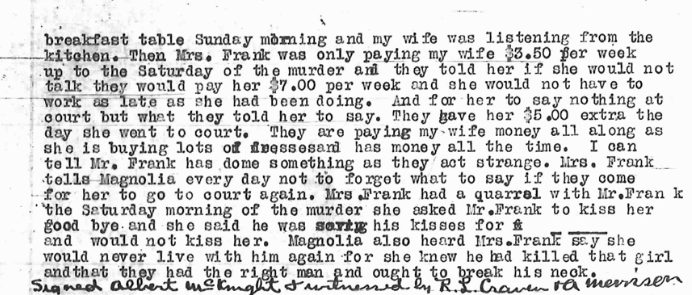
The surviving facsimile itself carries a handwritten notation at the bottom identifying Albert McKnight and referring to R. L. Craven and A. Morrison as witnesses. This should be read alongside Graham’s later sworn explanation of how he originally wrote Albert’s account and arranged for Morrison to hear Albert repeat it.
Where the Albert McKnight Affidavit Can Be Found
Albert’s early statement survives in the primary Georgia Supreme Court record associated with Leo Frank’s 1914 extraordinary motion for a new trial.
The exact trail is:
Georgia Supreme Court record sheet 1601 begins R. L. Graham’s explanation of how he first heard Albert’s story.
Sheet 1602 continues Graham’s statement and identifies the written Albert McKnight statement as Exhibit “A.”
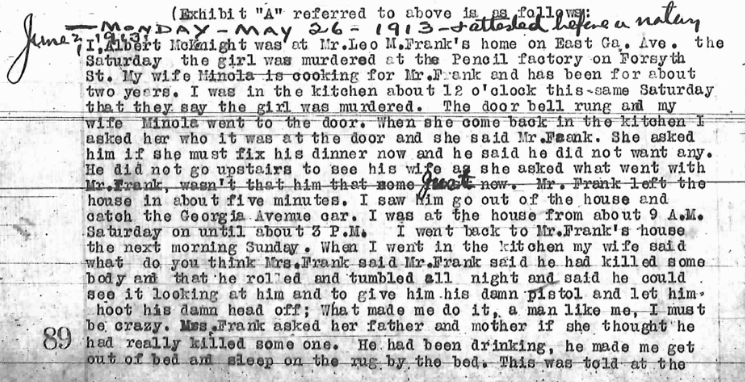
Sheet 1603, printed page 89, expressly introduces the document:
“Exhibit ‘A’ referred to above is as follows:”
The Albert McKnight statement then begins and continues onto sheet 1604 (McKnight Affidavit, 1).
For research purposes, the safest citation is:
Albert McKnight statement, Exhibit A to the State’s Counter-Showing, Leo M. Frank v. State of Georgia, Extraordinary Motion for New Trial, Georgia Supreme Court record, sheets 1603-1604, beginning on printed page 89.
The online machine transcription of these sheets contains several obvious errors. The photographic image of the actual document should control whenever its wording can be read.
What Albert McKnight Said
The clearer surviving image begins:
“I Albert McKnight was at Mr. Leo M. Frank’s home on East Ga. Ave. the Saturday the girl was murdered at the Pencil factory on Forsyth St.”
Albert said Minola had been cooking for the household for about two years.
He then placed himself inside the house:
“I was in the kitchen about 12 o’clock this same Saturday that they say the girl was murdered.”
According to Albert, the doorbell rang and Minola answered it. When she returned to the kitchen, he asked who had arrived.
She told him it was Frank.
Albert continued:
“She asked him if she must fix his dinner now and he said he did not want any.”
The surviving statement says Frank did not go upstairs to see his wife. A portion immediately following that sentence is crossed out or overwritten and should not be silently reconstructed.
Albert then stated:
“Mr. Frank left the house in about five minutes. I saw him go out of the house and catch the Georgia Avenue car.”
He also gave a much wider window for his own presence in the house:
“I was at the house from about 9 A.M. Saturday on until about 3 P.M.”
This is useful when considering the discrepancy between the “about 12 o’clock” wording in the early statement and the later 1:30 timing he gave at trial. Albert claimed that he was at the house for roughly six hours, so his claim of being present did not depend on a short visit centered on one precise minute (McKnight Affidavit, 1).
What Albert Said Minola Told Him About Sunday Morning
Albert’s statement then changes character.
His description of Frank’s Saturday visit was presented as something he personally witnessed. The Sunday material came from what Albert said Minola had told him.
Albert wrote that he returned to the Frank-Selig house the following morning. According to him, Minola told him that Lucille Frank had discussed Frank’s behavior during the previous night at the Sunday breakfast table.
The document attributes to Minola the statement that Frank had “rolled and tumbled all night,” had spoken as though he could see something looking at him, and had asked for his pistol.
It then contains the extraordinary language:
“What made me do it, a man like me, I must be crazy.”
Albert also said Minola told him that Lucille asked her parents whether they believed Frank had “really killed some one,” that Frank had been drinking, and that Lucille had been made to leave the bed and sleep on a rug.
Again, Albert was reporting what he said Minola told him. He was not claiming to have heard the bedroom conversation himself (McKnight Affidavit, 1).
The Money and Instructions Allegations
The second page of Albert’s statement contains another group of accusations.
Albert said Minola had been earning $3.50 per week before the murder. He alleged that she was then promised $7 per week if she did not talk and would be permitted to work shorter hours.
The document further says:
“They gave her $5.00 extra the day she went to court.”
Albert claimed Minola was receiving money, purchasing dresses, and being repeatedly reminded what to say if she was called back to court.
He added:
“I can tell Mr. Frank has done something as they act strange.”
The statement closes with allegations concerning a quarrel between Leo and Lucille Frank and with Albert saying Minola heard Lucille declare that she would never live with Frank again because she believed he had killed Mary Phagan.
These were accusations attributed to Albert and, through him, to Minola. They later became fiercely contested.
Albert’s Story Leads Investigators to Minola
The physical Exhibit A is useful, but the real effect came from Albert’s story being passed to others.
The Atlanta Georgian, Wednesday, June 4, 1913, page 1, reported that Albert had told Pickett and Craven that Minola had confided information to him concerning Frank’s visit home. Pickett and Craven informed investigators, and, according to the newspaper, “as a result the woman was arrested” (Atlanta Georgian, 10).
This is the clearest contemporary description of the causal chain.
Albert spoke.
His account reached Pickett, Craven and others.
Investigators then turned their attention directly to Minola.
On Monday, June 2, 1913, Minola was taken into custody and questioned.
The Atlanta Constitution, Wednesday, June 4, 1913, page 1, ran the headline:
“SERVANT OF FRANK IS LIBERATED AFTER LONG EXAMINATION.”
The subhead was equally direct:
“FACED BY HUSBAND, SHE CONTRADICTS HIM.”
The newspaper reported that Albert was also taken to police headquarters and was present while Minola was confronted with the statements attributed to her. She initially denied his version (Atlanta Constitution, 9).
Who Was Present During the Minola McKnight Questioning?
The June 4 Constitution account and the later Brief of Evidence allow much of the room to be reconstructed.
Minola McKnight was the person being questioned.
Albert McKnight was there and confronted her with what he said she had previously told him.
Detectives J. N. Starnes and Pat Campbell conducted much of the questioning.
R. L. Craven and E. H. Pickett participated.
G. C. Febuary, secretary to Chief Newport Lanford, was called in to record or handle the formal statement.
George Gordon represented Minola as her attorney.
Gordon was outside the interrogation room during part of the questioning and objected to her detention. The Atlanta Constitution, Wednesday, June 4, 1913, page 1, reported that he threatened habeas corpus proceedings. The later trial record shows that Gordon was present when the finished affidavit was read and signed (Atlanta Constitution, 9) (Brief of Evidence, 2).
The circumstances became one of the disputes surrounding State’s Exhibit J.
Minola later said she had been held for hours, pressured and frightened. The State’s witnesses denied that she had been forced to swear falsely. Her signed affidavit itself contains questions in which she denied being threatened and said she was giving the statement voluntarily in the presence of her attorney.
Those competing accounts went before the jury (Brief of Evidence, 2) (State’s Exhibit J, 3).
State’s Exhibit J, June 3, 1913
On Tuesday, June 3, 1913, Minola McKnight signed the affidavit that became State’s Exhibit J.
Her statement agreed with Albert on several central points.
She placed Albert at the Selig residence when Frank returned home.
She placed Frank’s arrival at approximately 1:30.
She said Frank did not eat dinner.
She said he remained about ten minutes before leaving (State’s Exhibit J, 3).
Her affidavit then gave her own version of the Sunday household conversations Albert had previously attributed to her. It included accusations involving Frank’s drinking, sleeplessness, statements about being in trouble, talk about a pistol, unusual payments to Minola, warnings concerning what she said, and the $5 payment she understood as a “tip” to keep quiet.
State’s Exhibit J therefore did not arise in isolation.
Albert’s earlier account supplied the lead. Investigators confronted Minola with that account. After hours of questioning and repeated denials, she signed a statement containing many of the same allegations.
That connection was later made explicit in the Brief of Evidence.
R. L. Craven testified:
“We questioned her first as to the statements Albert had given me.”
E. H. Pickett similarly testified:
“We questioned her about the statement Albert had made and she denied it all at first.”
The sequence is therefore preserved in the trial record itself (Brief of Evidence, 2).
The McKnight Affair Starts a Newspaper War
The treatment of Minola and publication of her affidavit produced an immediate public reaction from Lucille Selig Frank.
The Atlanta Georgian, Thursday, June 5, 1913, page 2, published Lucille’s first public statement under the headline:
“‘I KNOW MY HUSBAND IS INNOCENT,’ ASSERTS WIFE OF LEO M. FRANK.”
Lucille addressed her statement directly to the editor.
Her opening complaint concerned Minola:
“The action of the Solicitor General in arresting and imprisoning our family cook…”
Lucille accused Dorsey and the detectives of trying to obtain a false statement through coercive questioning. She defended her husband’s conduct at home, denied stories of marital trouble, and declared repeatedly that she knew Frank was innocent (Atlanta Georgian, 11).
Thus the Albert McKnight lead had already produced much more than a second affidavit. Within days it had drawn Frank’s wife into the newspapers for the first time.
Dorsey Answers Lucille Frank
Solicitor General Hugh M. Dorsey responded publicly.
The Atlanta Constitution, Friday, June 6, 1913, page 1, continuing on page 2, published:
“DORSEY REPLIES TO THE CHARGES OF MRS. L. FRANK.”
Dorsey’s response was a signed letter for publication.
He wrote that the wife of an accused man would naturally be among the last people to believe or admit her husband’s guilt. He said his duty required him to pursue the prosecution without allowing sympathy for innocent family members to interfere.
He also wrote:
“I welcome all evidence from any source…”
Dorsey said that the evidence would ultimately have to be placed before an impartial jury and that guilt or innocence should be decided there (Atlanta Constitution, 12).
The same June 6 Constitution article made clear that the argument between Lucille and Dorsey centered heavily on Minola McKnight, her detention, and the affidavit attributed to her.
Lucille Frank Answers Dorsey Again
Lucille did not let Dorsey’s response stand unanswered.
The Atlanta Journal, Saturday, June 7, 1913, page 1, continuing on page 13, published her second card under the headline:
“TORTURE CHAMBER METHODS CHARGED IN GETTING EVIDENCE.”
The subhead read:
“WE ARE SUFFERING NOW, BUT WHO WILL BE NEXT?”
Lucille explicitly referred to “Mr. Dorsey’s position as stated by him in his card in the Constitution of June 6.”
She seized upon Dorsey’s statement that he welcomed evidence “from any source” and argued that he was defending the use of evidence produced through the kind of questioning Minola had undergone.
Lucille again argued that Minola had been arrested even though she was accused of no crime and charged that the police had used what she called “torture chamber” methods (Atlanta Journal, 13).
The Atlanta Constitution, Sunday, June 8, 1913, page A3, continued the newspaper exchange with “Mrs. Frank Writes About Phagan Case” (Atlanta Constitution, 21).
Within less than a week, Albert McKnight’s story had therefore helped produce Minola’s arrest, State’s Exhibit J, Lucille Frank’s first public defense of her husband, Dorsey’s signed newspaper reply, and Lucille’s second public card attacking the methods used to obtain evidence.
Albert McKnight Takes the Stand
Albert later testified for the State at Frank’s trial.
The Atlanta Constitution, Saturday, August 2, 1913, page 5, devoted a separate article to him under the headline:
“HUSBAND OF MINOLA M’KNIGHT DESCRIBES MOVEMENTS OF FRANK.”
Albert told the jury that he was at the Selig home, saw Frank, and saw him go to the dining-room sideboard.
Asked how long Frank remained, Albert answered:
“Five or ten minutes.”
He said he was in the kitchen and explained that he could see into the dining room through the sideboard mirror. He also said he followed Frank from the house and saw him board a Georgia Avenue streetcar at Pulliam Street (Atlanta Constitution, 14).
The Brief of Evidence gives the timing more precisely:
“Between 1 and 2 o’clock on Memorial Day I was at the home of Mr. Frank to see my wife. He came in close to 1:30.”
Albert testified that Frank did not eat dinner, went to the sideboard, remained a few minutes and left.
He insisted:
“I certainly saw Mr. Frank that day, from the kitchen where I was sitting.”
This creates a real discrepancy with Albert’s early Exhibit A.
Exhibit A says he was “in the kitchen about 12 o’clock.”
His trial testimony places Frank’s arrival “close to 1:30.”
Minola’s State’s Exhibit J also uses approximately 1:30.
The discrepancy should remain visible. At the same time, Exhibit A says Albert was at the house from approximately 9 A.M. until 3 P.M., so both versions place him there during the 1:30 period (Brief of Evidence, 2).
The Defense Attacks Albert’s Line of Sight
Frank’s defense attempted to disprove Albert’s claim through the physical layout of the Selig home.
Photographs were taken. Blueprints and diagrams were introduced. Witnesses were questioned about the kitchen, dining room, doors, sideboard and mirror.
The defense position was that Albert could not have seen Frank in the dining room from the place he claimed to have occupied in the kitchen.
This brought the case back to the sideboard itself.
“It Ain’t Now Where It Was Then”
Albert was recalled during rebuttal.
The Atlanta Constitution, Wednesday, August 20, 1913, page 3, published:
“SIDEBOARD IN LEO FRANK’S HOME MOVED, ASSERTS HUSBAND OF COOK.”
Prosecutor Frank Hooper told the court:
“I want to show by this witness that since that day the sideboard in the Selig home has been moved.”
Luther Rosser asked Albert:
“Did you see anybody move it?”
Albert replied:
“No, but it ain’t now where it was then.”
Rosser asked whether he was simply relying on the defense plat.
Albert answered:
“I’m going by where you say it is” (Atlanta Constitution, 4).
The Atlanta Georgian, Wednesday, August 20, 1913, page 4, reported the same exchange. Hooper told Judge Leonard Roan that he wanted to show that the sideboard had been moved “so as to change the angle of vision.”
Albert answered:
“It has been pushed around” (Atlanta Georgian, 5).
The Atlanta Journal, Wednesday, August 20, 1913, page 5, supplied the useful qualification that Albert’s objection centered on the angle shown in the defense plat rather than a completely different location for the sideboard (Atlanta Journal, 6).
The Brief of Evidence records Albert’s more restrained wording:
“This sideboard (Defendant’s Exhibit 63) sets more this way than it was at the time I was there.”
On cross-examination he said:
“I don’t know if the sideboard was changed, but it wasn’t setting like that is in the corner.”
Albert never claimed that he had watched someone deliberately rearrange the furniture. His testimony was that the defense representation showed the sideboard at a different angle from the one he remembered (Brief of Evidence, 2).
Mrs. Selig testified that the sideboard stood on rollers and could be moved when the room was thoroughly cleaned, although she said it was put back afterward.
That left the jury with a simple physical question. Could a photograph or plat prepared months later prove what Albert could see on April 26 if the angle of the mirror was disputed?
Dorsey Uses Albert in His Closing Argument
Solicitor Dorsey returned to Albert during his summation.
The Atlanta Journal, Saturday, August 23, 1913, page 1, reported Dorsey arguing that the defense had:
“sent out Julius Fisher and a photographer to try to prove that Albert lied.”
Dorsey used the fact that the sideboard was movable to attack the certainty of the defense reconstruction (Dorsey Argument, 7).
Albert’s line of sight therefore became an issue argued directly to the jury.
Albert Changes His Story in 1914
Albert’s history did not end with the verdict.
The Atlanta Georgian, Sunday, February 22, 1914, Fourth Edition, page 1, column 7, continuing on page 2, carried a sensational new headline:
“PLOT TO HANG FRANK, SWEARS WITNESS WHO CONFESSES TO PERJURY.”
Albert was identified as 21 years old, living at the rear of No. 17 Georgia Avenue and working at Beck & Gregg.
In this new affidavit, obtained through C. W. Burke, who was working with the Frank defense, Albert repudiated his trial testimony.
He now claimed that he had not seen Frank at the Selig house on April 26 and alleged that his earlier story had been prepared or coached for him. He accused Craven and others of drawing him into a false account and said the mirror detail had been added to make the story appear possible.
This was a direct attack on his own trial testimony (Atlanta Georgian, 15).
Any account of Albert McKnight that stops with his 1913 testimony therefore leaves out a major part of his history.
Albert McKnight Reported Missing
The following day brought another newspaper story.
The Atlanta Georgian, Monday, February 23, 1914, page 1, published the headline:
“NEGRO WHO ACCUSED FRANK MISSING.”
The newspaper reported that Albert had not returned to work and could not be located at his usual places.
R. L. Craven and a Beck & Gregg manager said they intended to find him and confront him with his new allegations. Craven denied coercing Albert and threatened perjury proceedings.
The same newspaper contrasted Albert’s original account, in which he said he saw Frank at approximately 1:30 and said Frank did not eat lunch, with the newly published repudiation in which Albert denied seeing Frank at all (Atlanta Georgian, 16).
Albert Is Badly Injured
Albert returned to the news a few weeks later under very different circumstances.
The Atlanta Constitution, Sunday, March 15, 1914, page 1, published the headline:
“M’KNIGHT BADLY INJURED TRYING TO SLIP INTO CITY UNNOTICED BY DETECTIVES.”
The newspaper reported that Albert had fallen from a passenger train while attempting to get off at Roseland Station and was badly injured.
His condition became serious enough that later interviews involving Frank investigators took place while Albert was recovering in the hospital (Atlanta Constitution, 17).
The later Georgia appellate record contains affidavits from people associated with Frank’s investigation saying Albert reaffirmed his February recantation during this period, including statements attributed to him during and after his hospital stay. Those affidavits form part of the defense answer to the State’s later claims about Albert (Georgia Appellate Record, 20).
Albert Repudiates His Repudiation
Then Albert changed his story again.
The Atlanta Constitution, Sunday, April 19, 1914, page 1, column 6, published:
“TESTIMONY HE GAVE AT TRIAL WAS TRUE, DECLARES M’KNIGHT.”
The opening sentence summed it up:
“Albert McKnight, a state witness in the Frank case, now repudiates his repudiation.”
Albert now said his trial testimony had been true and the defense affidavit false.
He claimed C. W. Burke had repeatedly approached him and that he signed the repudiating affidavit in order to get Burke to leave him alone.
Albert was staying voluntarily at police headquarters. He told reporters that he had been “pestered unmercifully” and wanted police protection (Atlanta Constitution, 18).
The Atlanta Journal, Sunday, April 19, 1914, page 1, column 6, ran its own account:
“ALBERT M’KNIGHT NOW REPUDIATES HIS RECENT STORY.”
The Journal reported Albert saying Burke had discussed getting him a Pullman job which, with tips, might pay around $100 a month. Albert claimed the prospect of better employment helped induce him to sign the defense affidavit.
He once again declared that the story he had originally told at Frank’s trial was true (Atlanta Journal, 19).
The State then used Albert’s latest account in opposing Frank’s extraordinary motion for a new trial.
The 1914 Affidavit Battle Went Both Ways
The 1914 record should be read from both sides.
The State filed Albert’s return to his original story and statements from Graham, Craven, Pickett, Morrison and others supporting the claim that Albert’s first account had been freely given.
Frank’s side filed affidavits from C. W. Burke, Dan S. Lehon, Dan McIntyre Jr., Fred Lynn, Dr. Thomas H. Hancock and others saying Albert had repeatedly affirmed the truth of his recanting affidavit and denied that Burke had improperly induced him.
The Georgia Supreme Court appellate sheets in the 1743-1749 range preserve much of that defense response (Georgia Appellate Record, 20).
Albert therefore became a witness claimed by both sides at different times.
In 1913 he supported the State.
In early 1914 he repudiated his State testimony.
In April 1914 he repudiated that repudiation and returned to his trial account.
The State and defense then produced competing witnesses over how each affidavit had been obtained.
Anyone using Albert McKnight as historical evidence has to show all three stages.
Minola McKnight’s Later Attack
There is one more episode connected with the McKnight family.
The Atlanta Journal, Monday, June 15, 1914, page 4, published:
“CUTTING OF FRANK CASE WITNESS PUZZLES POLICE.”
The newspaper identified Minola as the former Selig cook and “one of the important figures in the Frank case.”
Police found her being treated for a cut approximately five inches long across her face. The attack had occurred Sunday night, June 14.
According to the newspaper, Minola refused to identify the person who cut her (Atlanta Journal, 8).
The attack occurred 376 days after Minola signed State’s Exhibit J on June 3, 1913.
The timing invites the question of retaliation, especially because she apparently knew the attacker’s identity and would not disclose it. The June 15 article gives no motive, and it does not quote Minola connecting the assault with State’s Exhibit J. Revenge therefore remains an unanswered possibility rather than an established fact.
Albert McKnight’s Place in the Case
Albert McKnight’s role can be followed unusually well because the paper trail survives.
He was a young working man employed around the Beck & Gregg Hardware Company, married to the cook inside the household where Leo and Lucille Frank lived.
He began talking about what he said he had seen at the Selig home and what Minola had told him.
R. L. Graham said he heard Albert, questioned him, wrote his story down, arranged for Angus Morrison to hear Albert repeat it, read it back to Albert and later had the statement sworn.
That paper survives as Exhibit A in the Georgia Supreme Court record.
Albert’s story then reached Pickett, Craven and investigators.
Minola was taken into custody.
Albert confronted her.
She denied his story at first.
After prolonged questioning she signed State’s Exhibit J.
Lucille Frank responded publicly to Minola’s detention.
Dorsey answered Lucille.
Lucille answered Dorsey again.
Albert testified at the trial.
The defense tried to disprove his line of sight with photographs and a blueprint of the Selig home.
Albert said the sideboard was shown at the wrong angle.
Dorsey used the dispute in his closing argument.
Months later Albert repudiated his testimony.
He then repudiated the repudiation.
Both sides produced affidavits accusing the other side of influencing him.
That history makes Albert a difficult witness, but it also makes his earliest statement especially useful. Exhibit A allows the reader to see what had been attributed to him before the trial, before the defense photographs, before the moved-sideboard dispute and before the 1914 fight over his changing affidavits.
His earliest statement also helps explain the impetus of where the breaking State’s Exhibit J came from and how it took shape.
State’s Exhibit J did not suddenly appear on June 3, 1913, out of open interrogation and questioning. Investigators were already pursuing a story that Albert McKnight had told concerning the Frank-Selig home on the day of the murder and the post-murder aftermath. They confronted Minola with that story, and the resulting affidavit became one of the most hotly disputed exhibits in the Leo Frank case.
That dispute spilled directly into Atlanta’s newspapers, into Frank’s trial, and eventually into the enormous Georgia appellate record where Albert’s original Exhibit A can still be read today.
References
01: McKnight Affidavit and State’s Counter-Showing. State of Georgia. (1914). State’s Counter-Showing, Leo M. Frank v. State of Georgia, Extraordinary Motion for New Trial. Georgia Supreme Court appellate record, sheets 1601–1604. Sheets 1601–1602 contain the sworn statement of R. L. Graham. Sheet 1603 begins Exhibit A concerning Albert McKnight, and sheet 1604 continues the exhibit and related evidentiary material. The section begins around printed page 89 of the counter-showing. Mary Phagan Kean Legacy Project, Georgia Supreme Court record scans and transcriptions.
Sheet 1601:
https://www.maryphagan.com/1601-slide-georgia-supreme-court-leo-frank-appeals-documents-1913-1914/
Sheet 1602:
https://www.maryphagan.com/1602-slide-georgia-supreme-court-leo-frank-appeals-documents-1913-1914/
Sheet 1603:
https://www.maryphagan.com/1603-slide-georgia-supreme-court-leo-frank-appeals-documents-1913-1914/
Sheet 1604:
https://www.maryphagan.com/1604-slide-georgia-supreme-court-leo-frank-appeals-documents-1913-1914/
02: Brief of Evidence. State of Georgia. (1913). Leo M. Frank, Plaintiff in Error v. State of Georgia: Brief of Evidence. Trial testimony and evidentiary record from the 1913 prosecution of Leo M. Frank. Relevant testimony includes Albert McKnight, Minola McKnight, R. L. Craven, E. H. Pickett, members of the Selig household, and other State and defense witnesses. The Mary Phagan Kean Legacy Project provides a serialized transcription of the Brief of Evidence, organized by witness, along with an introduction and witness index.
Introduction to the Brief of Evidence:
https://www.maryphagan.com/000-introduction-to-leo-frank-trial-brief/
Complete serialized Brief of Evidence archive:
https://www.maryphagan.com/category/leo-frank-trial-sworn-statements/
03: State’s Exhibit J, Affidavit of Minola McKnight. McKnight, Minola. (Tuesday, June 3, 1913). Affidavit of Minola McKnight. Introduced during the Leo Frank trial as State’s Exhibit J. The Georgia Supreme Court record identifies the document as “STATE’S EXHIBIT J. Affidavit executed by Minola McKnight for Solicitor Dorsey.” The exhibit begins on appellate sheet 1288 and continues on sheet 1289. Mary Phagan Kean Legacy Project, original appellate record scans and transcriptions.
Sheet 1288, beginning of State’s Exhibit J:
https://www.maryphagan.com/1288-slide-georgia-supreme-court-leo-frank-appeals-documents-1913-1914/
Sheet 1289, continuation of Minola McKnight affidavit:
https://www.maryphagan.com/1289-slide-georgia-supreme-court-leo-frank-appeals-documents-1913-1914/
04: The Atlanta Constitution. (Wednesday, August 20, 1913). “Sideboard in Leo Frank’s Home Moved, Asserts Husband of Cook.” The Atlanta Constitution, p. 3. Report on Albert McKnight’s rebuttal testimony concerning the location and position of the sideboard in the Selig home and the dispute over the defense depiction of the room. Mary Phagan Kean Legacy Project, newspaper transcription and archived page.
05: The Atlanta Georgian. (Wednesday, August 20, 1913). “State Closes Frank Case; Near Jury; Defense Begins Its Sur-Rebuttal.” The Atlanta Georgian, relevant McKnight rebuttal testimony, p. 4. Albert McKnight was recalled and questioned using the blueprint or diagram of the Selig residence, including the location of the sideboard and mirror and his claimed view from the kitchen area. Mary Phagan Kean Legacy Project, complete issue transcription and newspaper images.
06: The Atlanta Journal. (Wednesday, August 20, 1913). “Testimony May Close Wednesday.” The Atlanta Journal. Lead trial coverage begins on p. 1, col. 6, with relevant McKnight rebuttal material appearing later in the issue, including p. 5. Coverage includes Albert McKnight, Minola McKnight, E. H. Pickett, R. L. Craven, and the controversy over the defense plat and position of the sideboard in the Selig home. Mary Phagan Kean Legacy Project, newspaper transcription and archived issue.
https://www.maryphagan.com/1913-08-20-testimony-may-close-wednesday-the-atlanta-journal/
07: Dorsey Closing Argument. Dorsey, Hugh M. (Saturday, August 23, 1913). Closing argument in State v. Leo M. Frank, reported under “Frank Trial Adjourned Until Monday Morning With Solicitor Hugh Dorsey in Midst of Impassioned Speech.” The Atlanta Journal, p. 1. The Journal reported Dorsey’s closing address in extensive detail and presented his argument as continuing when court adjourned. The newspaper reported he had spoken for six hours and ten minutes by the Saturday adjournment. Mary Phagan Kean Legacy Project, complete newspaper transcription.
08: The Atlanta Journal. (Monday, June 15, 1914). “Cutting of Frank Case Witness Puzzles Police.” The Atlanta Journal, p. 4. Contemporary report concerning the cutting of a witness associated with the Frank case and the police investigation surrounding the episode.
Security Error: PDF files must be hosted on the same domain as this site.
PDF is hosted on: https://www.leofrank.tv but this site is: https://www.maryphagan.com
Download PDF
09: The Atlanta Constitution. (Wednesday, June 4, 1913). “Servant of Frank Is Liberated After Long Examination.” The Atlanta Constitution, p. 1. Contemporary report on the detention and lengthy examination of Minola McKnight, the cook in the Selig household. The article discusses her questioning, her husband Albert McKnight, the affidavit attributed to her, and her release following intervention by an attorney and the prospect of habeas corpus proceedings. Mary Phagan Kean Legacy Project, newspaper transcription and archived page.
10: The Atlanta Georgian. (Wednesday, June 4, 1913). “Frank’s Cook Was Counted Upon as Defense Witness.” The Atlanta Georgian, p. 1. Report on Minola McKnight’s importance to the investigation, her arrest and questioning, and statements attributed to her husband, Albert McKnight. The article also identifies investigators E. H. Pickett and R. L. Craven and describes their role in obtaining information from Albert concerning statements he said his wife had made. Mary Phagan Kean Legacy Project, newspaper transcription and archived issue.
11: The Atlanta Georgian. (Thursday, June 5, 1913). “‘I Know My Husband Is Innocent,’ Asserts Wife of Leo M. Frank.” The Atlanta Georgian, p. 2. Contemporary publication of Lucille Selig Frank’s defense of her husband following the controversy surrounding Minola McKnight’s interrogation. The article records Mrs. Frank’s objections to investigative methods being used in the case. Mary Phagan Kean Legacy Project, newspaper transcription and original page image.
12: Dorsey, Hugh M. (Friday, June 6, 1913). “Dorsey Replies to the Charges of Mrs. L. Frank.” The Atlanta Constitution, p. 1, continued p. 2. Solicitor General Hugh M. Dorsey’s published response to Lucille Selig Frank’s accusations concerning investigative methods used in gathering evidence. The newspaper coverage reproduces Dorsey’s signed statement and places it alongside the public controversy generated by Mrs. Frank’s statements. Mary Phagan Kean Legacy Project, newspaper transcription and archived issue.
13: Frank, Lucille Selig. (Saturday, June 7, 1913). “Torture Chamber Methods Charged in Getting Evidence.” The Atlanta Journal, p. 1, continued p. 13. Published statement by Lucille Selig Frank accusing investigators of coercive methods in their effort to obtain evidence, with particular attention to the treatment and questioning of Minola McKnight. Mary Phagan Kean Legacy Project, newspaper transcription and archived issue.
https://www.maryphagan.com/1913-06-07-torture-chamber-methods-charged-in-getting-evidence/
14: The Atlanta Constitution. (Saturday, August 2, 1913). “Husband of Minola McKnight Describes Movements of Frank.” The Atlanta Constitution, p. 5. Trial report covering Albert McKnight’s sworn testimony concerning Leo Frank’s movements at the Selig residence, his observations from the kitchen and dining areas, the sideboard and mirror, and related events described to the jury. Mary Phagan Kean Legacy Project, newspaper transcription and archived page.
15: The Atlanta Georgian. (Sunday, February 22, 1914). “Plot to Hang Frank, Swears Witness Who Confesses to Perjury.” The Atlanta Georgian, Fourth Edition, p. 1, col. 7, continued p. 2. Report on Albert McKnight’s post-trial recantation, his claim of perjury, and allegations involving efforts to change or discredit testimony connected with the Frank prosecution. The article became an important part of the later controversy over McKnight’s successive statements. Mary Phagan Kean Legacy Project, newspaper transcription and archived issue.
16: The Atlanta Georgian. (Monday, February 23, 1914). “Frank Accuser Is Missing.” The Atlanta Georgian, p. 1. Follow-up report concerning Albert McKnight following publication of his recantation story and the effort to locate him. Mary Phagan Kean Legacy Project, newspaper transcription and archived issue.
https://www.maryphagan.com/1914-02-23-frank-accuser-is-missing-the-atlanta-georgian/
17: The Atlanta Constitution. (Sunday, March 15, 1914). “M’Knight Badly Injured Trying to Slip Into City Unnoticed by Detectives.” The Atlanta Constitution, p. 1, col. 6. Contemporary report on Albert McKnight’s injuries after jumping from a train near Atlanta and his subsequent treatment. The report belongs to the post-trial chronology surrounding efforts to locate, interview, and obtain further statements from McKnight. Mary Phagan Kean Legacy Project, newspaper transcription and archived page.
18: The Atlanta Constitution. (Sunday, April 19, 1914). “Testimony He Gave at Trial Was True, Declares M’Knight.” The Atlanta Constitution, p. 1, col. 6. Report on Albert McKnight’s later repudiation of his February recantation and his renewed assertion supporting the truth of his original trial testimony. The article is useful for comparing McKnight’s trial testimony, February recantation, and April reversal. Mary Phagan Kean Legacy Project, newspaper transcription and archived page.
19: The Atlanta Journal. (Sunday, April 19, 1914). “Albert M’Knight Now Repudiates His Recent Story.” The Atlanta Journal, p. 1, col. 6. Contemporary report on McKnight’s repudiation of his post-trial recantation. The article discusses his renewed support for his original testimony and his allegations concerning C. W. Burke and the circumstances surrounding the preparation of his earlier recanting statement. Mary Phagan Kean Legacy Project, newspaper transcription and archived page.
20: Georgia Supreme Court Appellate Record, McKnight Investigation and Defense Affidavits. State of Georgia. (1914). Leo M. Frank v. State of Georgia, Extraordinary Motion for New Trial and State’s Counter-Showing, Georgia Supreme Court appellate record, sheets 1743–1749. These pages contain a concentrated group of affidavits and exhibits concerning Albert McKnight, C. W. Burke, Dan S. Lehon, William J. Burns, D. L. McIntyre Jr., Fred Lynn, Joe Thompson, Dr. Thomas H. Hancock, H. J. Haas, newspaper reporters, and the circumstances surrounding McKnight’s successive statements. Sheets 1748–1749 contain Albert McKnight’s Exhibit A and related reporter testimony. Mary Phagan Kean Legacy Project, individual Georgia Supreme Court record scans and transcriptions.
Sheet 1743, D. L. McIntyre Jr. affidavit and McKnight contacts:
https://www.maryphagan.com/1743-slide-georgia-supreme-court-leo-frank-appeals-documents-1913-1914/
Sheet 1744, Fred Lynn affidavit and William J. Burns material:
https://www.maryphagan.com/1744-slide-georgia-supreme-court-leo-frank-appeals-documents-1913-1914/
Sheet 1745, additional McKnight material and Joe Thompson affidavit:
https://www.maryphagan.com/1745-slide-georgia-supreme-court-leo-frank-appeals-documents-1913-1914/
Sheet 1746, Dr. Thomas H. Hancock affidavit concerning McKnight statements:
https://www.maryphagan.com/1746-slide-georgia-supreme-court-leo-frank-appeals-documents-1913-1914/
Sheet 1747, H. J. Haas affidavit and related evidence:
https://www.maryphagan.com/1747-slide-georgia-supreme-court-leo-frank-appeals-documents-1913-1914/
Sheet 1748, reporter affidavit and beginning of Albert McKnight Exhibit A:
https://www.maryphagan.com/1748-slide-georgia-supreme-court-leo-frank-appeals-documents-1913-1914/
Sheet 1749, continuation of Albert McKnight Exhibit A and Charles T. Phillips Jr. affidavit:
https://www.maryphagan.com/1749-slide-georgia-supreme-court-leo-frank-appeals-documents-1913-1914/
21: The Atlanta Journal. (Sunday, June 8, 1913). “Solicitor Makes No Reply to Mrs. Frank.” The Atlanta Journal. Contemporary report following Lucille Selig Frank’s published charges concerning investigative methods used in the Phagan case. The article reports Solicitor General Hugh M. Dorsey declined to issue a further reply to Mrs. Frank’s published statement. It summarizes her accusations concerning the treatment of witnesses and places the exchange within preparations for Leo Frank’s upcoming murder trial. Mary Phagan Kean Legacy Project, newspaper transcription and archived issue.
https://www.maryphagan.com/1913-06-08-solicitor-makes-no-reply-to-mrs-frank-the-atlanta-journal/
APPENDIX
(Exhibit “A” referred to above is as follows:)
[Handwritten:] MONDAY - MAY 26 - 1913 - attested before a notary
[Handwritten at left:] June 2
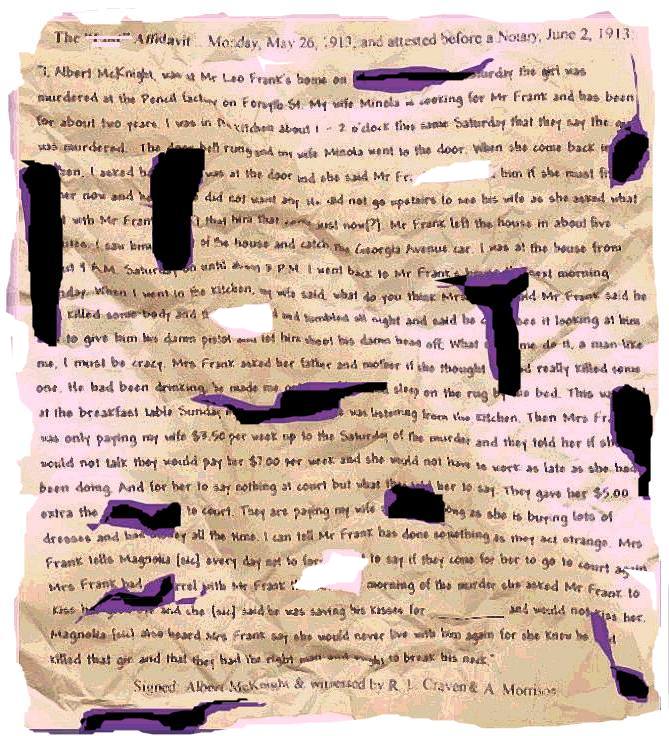
I, Albert McKnight was at Mr. Leo M. Frank’s home on East Ga. Ave. the Saturday the girl was murdered at the Pencil factory on Forsyth St. My wife Minola is cooking for Mr. Frank and has been for about two years. I was in the kitchen about 12 o’clock this same Saturday that they say the girl was murdered. The door bell rung and my wife Minola went to the door. When she come back in the kitchen I asked her who it was at the door and she said Mr. Frank. She asked him if she must fix his dinner now and he said he did not want any.
He did not go upstairs to see his wife as she asked what went with [crossed-out passage, partly illegible]. Mr. Frank left the house in about five minutes. I saw him go out of the house and catch the Georgia Avenue car. I was at the house from about 9 A.M. Saturday on until about 3 P.M.
I went back to Mr. Frank’s house the next morning Sunday. When I went in the kitchen my wife said what do you think Mrs. Frank said Mr. Frank said he had killed somebody and that he rolled and tumbled all night and said he could see it looking at him and to give him his damn pistol and let him shoot his damn head off; What made me do it, a man like me, I must be crazy.
Mrs. Frank asked her father and mother if she thought he had really killed some one. He had been drinking, he made me get out of bed an sleep on the rug by the bed. This was told at the breakfast table Sunday morning and my wife was listening from the kitchen.
Then Mrs. Frank was only paying my wife $3.50 per week up to the Saturday of the murder and they told her if she would not talk they would pay her $7.00 per week and she would not have to work as late as she had been doing. And for her to say nothing at court but what they told her to say. They gave her $5.00 extra the day she went to court.
They are paying my wife money all along as she is buying lots of dresses and has money all the time. I can tell Mr. Frank has done something as they act strange. Mrs. Frank tells Magnolia every day not to forget what to say if they come for her to go to court again.
Mrs Frank had a quarrel with Mr. Frank the Saturday morning of the murder she asked Mr. Frank to kiss her good bye. and she said he was saving his kisses for [illegible/crossed-out word or name] and would not kiss her.
Magnolia also heard Mrs Frank say she would never live with him again for she knew he had killed that girl and that they had the right man and ought to break his neck.
[Handwritten:] Signed Albert McKnight & witnessed by R. L. Craven & Angus Morrison