Reading Time: 19 minutes, [3370 words]
The Great Antisemitic-Adjudication Hoax Behind Leo Frank's 1913 Atlanta Trial: Dismantled
By Matt Johnson, Raleigh N.C.
Jun 24, 2026
Those Pesky Jewish Law Partners: Footnoted Facts That Disturb the Legend of the Leo Frank "Persecution-Prosecution"
One of the most revealing omissions in many later partisan retellings of the Leo Frank affair is how quickly inconvenient professional facts are erased, minimized, or relegated to the footnotes. Solicitor General Hugh Manson Dorsey is often presented as though he belonged naturally inside a crude drama of anti-Jewish prosecution, yet his own legal world complicates this caricature. His firm included Arthur Heyman, a Jewish attorney, and Frank Arthur Hooper, who assisted Dorsey in the prosecution, joined the firm of Little, Powell, Hooper & Goldstein in July 1913 alongside his law partner, Max F. Goldstein, a Jewish attorney. These Jewish-Gentile legal associations do not settle every question about public prejudice in Atlanta, but they do disturb the later moral scripting in which the prosecution is presented as having been propelled by antisemitism from the start.
Leo Frank’s postmortem factionalists need Dorsey and Hooper stereotyped into symbols of anti-Jewish prejudice, so details which humanize their legal and social circles are treated as marginal, accidental, or irrelevant. The result is a selective memory system in which every fact useful to the persecution-prosecution story is enlarged, while every fact complicating the “hatred of the Hebrew” thesis is made to disappear.
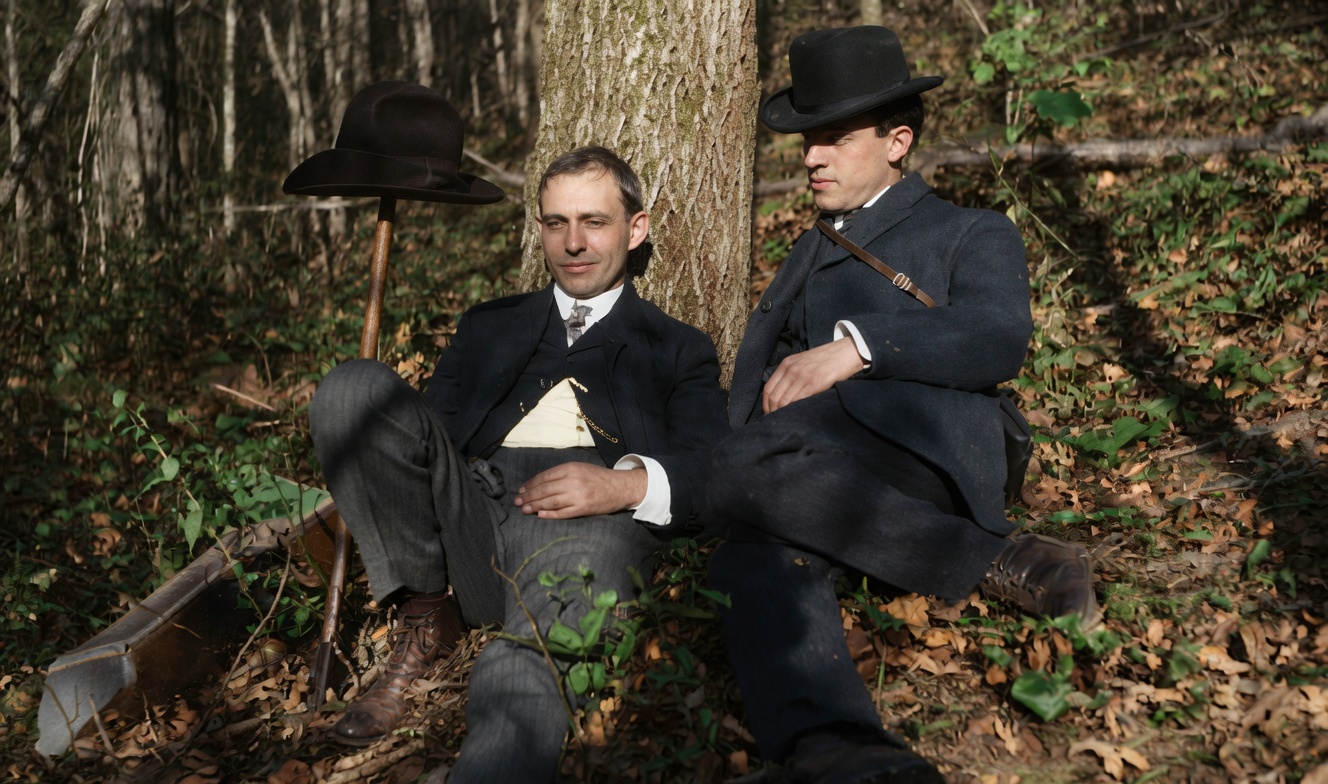
Future prosecutor, judge, and Georgia governor Hugh Manson Dorsey, pictured during his law school years with his Jewish roommate and lifelong friend, Henry Aaron Alexander. Years later, the two men would stand on opposite sides during the Leo Frank appeals, with Dorsey defending the conviction and Alexander taking part in Frank’s legal fight.
The Passion Play That Ate a Murder Trial: Leo Frank and the Vanishing Legal Record
A persistent problem in modern retellings of the Mary Phagan case is how thoroughly the courtroom has been emptied to make room for the Leo Frank eulogy. What was tried in Fulton County Superior Court as a prosecution for homicide by strangulation, now reaches us as something closer to a Jewish soap opera and maudlin passion play. Frank is typecast as a crucified messiah, the innocent led to the cross, while Dorsey is remade into a dark, twisted Pontius Pilate and Jim Conley demonized into a figurative Barabbas, the guilty murderer who walks free in the condemned man’s place. The Atlanta public becomes the crowd at the foot of Pilate's balcony pronouncements and later at the cross, shaking its fists and drowning the proceedings in raucous noise. The State’s evidence survives only as a murmur lost beneath the conjured hysteria, a Roman judgment overwhelmed by the roar of the blood thirsty mob against the diminutive Jew outsider.
This modern Leo Frank passion play largely ignores the machinery of the 1913 trial itself: the disputed chain of events, the tangible exhibits, the clash of witnesses, and the credibility battles which consumed four weeks in the Atlanta heat. In its place, the record is emotionalized into a storm of indignant feeling. Old Testament sympathy and Talmudism for the tribe now do the work once reserved for due process of law and evidentiary argument in reaching some semblance of truth. What results reads less like history recovered than a verdict felt in advance, while the case the prosecution actually built in 1913 disappears beneath the devotional theater of hagiographical melodrama.
Dead Rituals
This later version often takes on the sanctimonious tone of a courtroom melodrama. It avoids simply arguing that Frank may have been wrongly convicted. It transforms the entire prosecution into a moral indictment against Gentile society. The prosecutors are portrayed as unscrupulous schemers, the jurors as weak men frightened into conviction, the outside spectators as a throng inflamed by hostility toward the Hebrew, Judge Roan as ineffectual, and the broader Southern community as stained by collective blood guilt and backward treatment toward a Jew on trial. Under this nightmarish reading, the evidence against Frank is not carefully answered. It is moved out of view, stage left. The trial record gives way to a tear-drenched martyrology in which the accusation of society-wide "hating on the Hebrews" rehabilitates Frank by discrediting all the men who investigated, prosecuted, judged, and affirmed the case before the State’s evidence is ever seriously examined.
The Leo Frank Anachronism: A Modern Rally Passed Off as Original Sin
An anachronism is a chronological misplacement, a foreign element inserted into an era where it does not belong. A smartphone sitting on a lawyer’s table during a 1913 murder trial would be an obvious example. A political legend from a subsequent era fastened onto an early twentieth-century courtroom is a subtler form of the same distortion and error. In the Leo Frank affair, the question of whether anti-Jewish prejudice existed somewhere in the wider culture, or whether it stood at the center of the public climate, is only one part of the dispute. The deeper fault line lies in the way some later authors enthroned “hatred of the Hebrews” as the governing premise for the State’s prosecution and the social atmosphere of Fulton County. Jewish leaders in New York and Georgia even spread this accusation across the nation. The ADL under Abraham Foxman described the case as part of “the rampant antisemitism of the time,” while Rabbi Lebow and others wrote, “A trial fueled by societal tensions and antisemitism resulted in a guilty verdict in 1913.” From there, the premise is carried retroactively and laid over the original adjudication like a template cut to fit a verdict already reached.
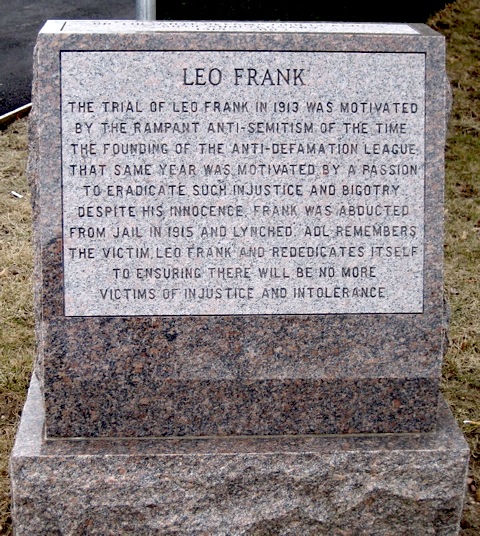
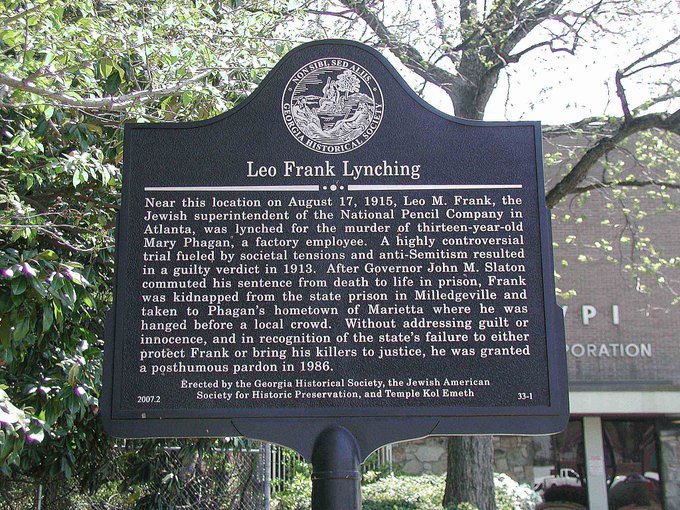
What later scholarship produced, especially from the 1950s and 1960s onward, was a post-World War II, “Jews versus Nazis” interpretation masquerading as fact native to 1913. A claim once sitting among several possible explanations, including allegations of ethnic and religious conflict, regional resentment of South versus North, class hostility toward a factory superintendent, the realpolitik of commutation, and the ordinary heated rhetoric of courtroom kerfuffle, was elevated into the controlling meaning of the Leo Frank affair. Everything was distorted through the interpretive scheme of Hitler’s Mein Kampf and Karl Marx’s Das Kapital.
Modern Jewish History Hitlerized and Marxed-Up
Older legal controversies, which appellate courts had found unsubstantiated, were increasingly reprocessed through a postwar ideological furnace. From Marx came the appetite for class antagonism: factory superintendent against worker, capital against labor, bourgeois authority against the supposed victim of industrial power. From Hitler’s shadow came the darker moral vocabulary of European Jewish persecution under National Socialist Germany: racial hatred, collective guilt, anti-Jewish menace, and the permanent accusation of White Gentile complicity.
The Canonized Bigotry: Anti-Black Racism
Prejudice existed in the period at the margins between religious denominations, as it does in every culture where there is spiritual diversity, but the racial hierarchy in the South was Black and White. It was not White Jew against White Christian. Yet the later retelling made this conjured-up ethnic conflict into a sovereign truth to be taken for granted, even though it had little basis in the archive of the social or political atmosphere.
The result of this new-age Leo Frank theology is a grievance liturgy lacquered as historiography, a later emphasis crowned as the original meaning of 1913.
With the Leo Frank case, the result is a sociological admixture of ethnic conflict theory and theological reductionism, glazed with anachronism and promoted as jurisprudence. A later emotional gloss is back-propagated onto a 1913 courthouse and then treated as though it had been there from the opening gavel by the judicial system itself. The sworn dialogue, the disputed minutes, the 3D factory model exhibition, the witness contradictions, and the doubts over whom to believe all recede into the backdrop of Leo Frank theological dogma. In their place rises an ongoing, developing pseudo-messianic gospel, gilded by ritualized, ceaseless recitation and shielded by institutional prestige, a canon in which Leo Frank becomes the only figure who suffers and Jewish grieving is the only thing worth mentioning. No empathy for the Goyim.
Dead Motormouths Tell No Damning Tales
The posthumous Leo Frank of later memory is sacred, burnished, and untouchable. The dead Leo Frank is an altar made from his coffin. But the living Frank of 1913 was far less convenient, a talkative defendant, awkward before reporters, careless in his statements, and frequently his own worst witness. Frank's lawyers told him repeatedly to shut his mouth, but he loved the attention too much. The legend needs a sanctified sufferer. The contemporary interviews give us a man who kept putting his foot in his own mouth. His Class of 1906 Cornell yearbook profile describes him as a gas jet that can talk all day long and say nothing. In 1913, all he could do is incriminate himself every time he flapped his gums to the press.
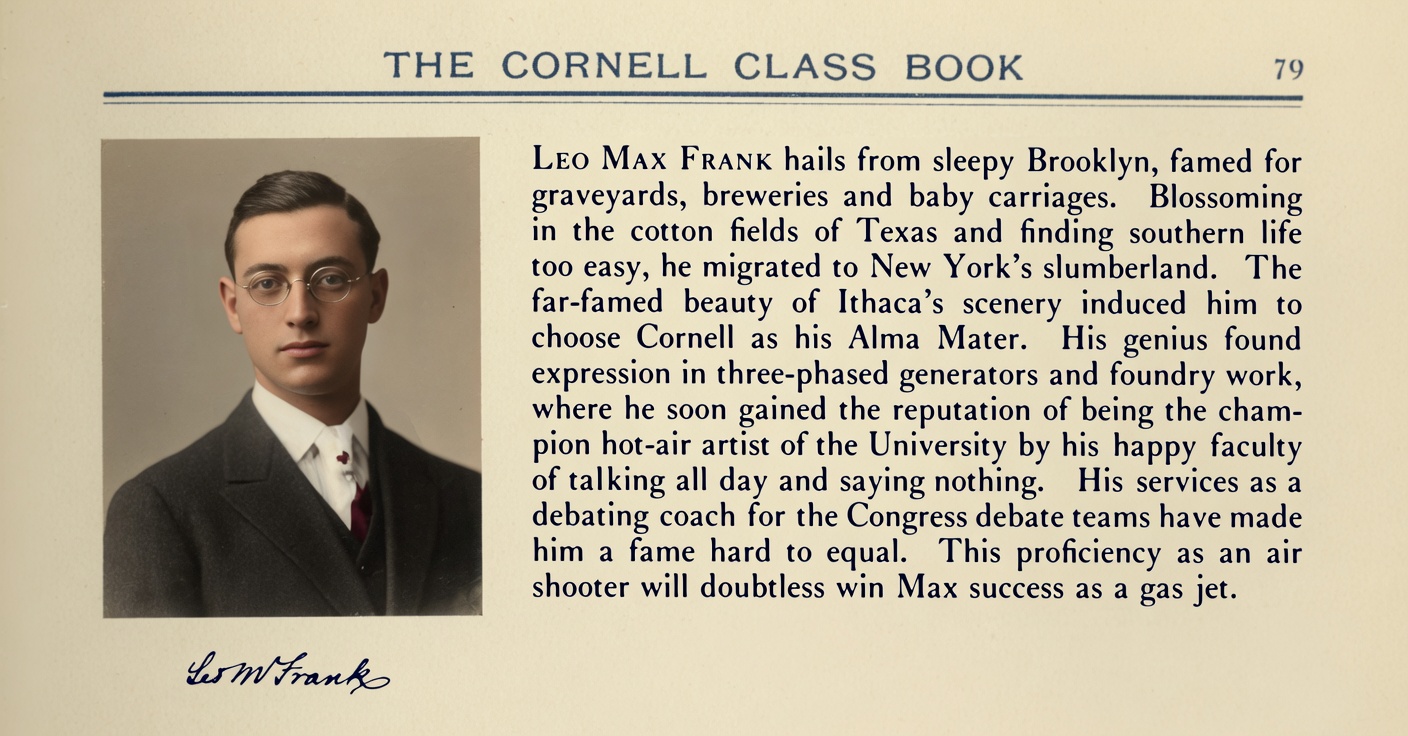
LEO FRANK THE CORNELL CLASS BOOK 1906 PAGE 79
Leo Max Frank hails from sleepy Brooklyn, famed for graveyards, breweries and baby carriages. Blossoming in the cotton fields of Texas and finding southern life too easy, he migrated to New York’s slumberland. The far-famed beauty of Ithaca’s scenery induced him to choose Cornell as his Alma Mater. His genius found expression in three-phased generators and foundry work, where he soon gained the reputation of being the champion hot-air artist of the University by his happy faculty of talking all day and saying nothing. His services as a debating coach for the Congress debate teams have made him a fame hard to equal. This proficiency as an air shooter will doubtless win Max success as a gas jet. Signature: Leo M. Frank (image upscaled, denoised and colorized with AI assisted tools)
Little Mary Not Forgotten? The Forgotten Child Victim: While Frank is lifted out of the courtroom and installed inside a passion drama, Mary Phagan, her kin, her friends, her community, and the Georgia that loved her are pushed into shadow. She was a thirteen-year-old factory girl who traveled to the pencil plant on a Saturday to collect a dollar and twenty cents in wages, then was assaulted, violated, strangled. She was mourned, and buried before the legal machinery had fully begun to turn. Yet in the inherited telling, she dwindles into an accessory to someone else’s legend: a name in the title, a body in the basement, a pretext for the drama rather than its center. The man a Fulton County jury convicted of killing her stands in the limelight, sanctified by the majority of retellings, while Mary Phagan recedes into the periphery of her own tragedy. She's just a shiksa, "rotting meat."
This explanatory scheme runs amok, almost like an inherited reflex inside the modern Frank legend. It is atavistic, as though every retelling were bound to repeat the same liturgy: Frank as martyr, the prosecution as prejudice, the jury as a peer-pressured mob or as terrorized cowards, the courtroom as a dark horse arena of ethnic hatred. Yet the scheme is itself an anachronism. It was later elevated into historical truth by the postwar pro-Frank memory industry: sympathetic authors, scholarly interpreters, circles of ethnic activists, communal advocates, institutional commemorators, journalists, bards, songwriters, Hollywood producers, Broadway librettists, and other culture-makers who turned one interpretive claim into the controlling meaning of the case.
Demolishing Anti-Prosecution Jewish Folklore: Dorsey as the Unscrupulous Jew Hunter, Refuted
The reflex survives, in part, by leaving out what complicates it. Here is the challenge: in all the post-WW2 books that suggest Leo Frank was innocent and unjustly tried, find these broader assertions of bigotry and wrongful prosecution, and what extenuating circumstances are left out. Hugh Manson Dorsey, recast in the legend as the unscrupulous rogue prosecutor who hunted a Jew, had spent his career as a partner in the Atlanta firm of Dorsey, Brewster, Howell, and Heyman, the last name belonging to Arthur Heyman, a prominent Jewish attorney.[1][2] Dorsey's co-counsel, Frank Arthur Hooper, had, only weeks before the trial, joined a new partnership that took in a junior lawyer named Goldstein, a Jewish attorney.[3] These are not Hanukkah decorations. They are the kind of facts a thesis of monolithic anti-Jewish conspiracy has to push behind the curtain of its hate-filled Gentile-contempt theater to keep the victimology narrative in shape. The renditions and reworkings oblige: whatever does not serve the passion's ladder is cut from the script. The Jewish partnerships are struck from the cast, or kept behind the rood screen where the congregation cannot see them, or sung so quietly in a footnote that no one in the pews looks up, because the drama needs its martyr unobstructed, and a fact that complicates the suffering is a fact the liturgy cannot afford.
Sympathy for the Devil
Alchemy of the Leo Frank Religion
This is how a homicide prosecution is lowered into the furnace and raised back up as the black liturgy of the Leo Frank religion. The defendant is washed clean by turning the entire legal world around him into a court of devils. The investigators become Hell’s errand boys. The prosecutors are marked with brimstone. The jurors become instruments of damnation. The judges are made priests of an infernal sentence. The appellate courts are pulled into the same pit of contamination.
Before a single affidavit, exhibit, timeline, or sworn contradiction is faced, the whole machinery of 1913 justice is consigned to the underworld. Every accuser becomes a demon. Every legal ruling becomes a curse. Every conviction becomes a satanic rite. In this inverted gospel, Leo Frank is saved by damning everyone who touched the case.
The Appellate Court of Hindsight Revisionism:
The result is devotional pageantry passing for history, a pious chronicle with citations attached to movement loyalists, a mourning-house version in which the petulant emotional demands of later authors overrun the legal archive. In this strange new conclave, crackpot professors and pamphleteering journalists sit above the judges, rewriting the verdict from the lecture hall and the newsroom. The men who heard the evidence with their ears and saw the evidence with their own eyes are demoted beneath later mythmakers who inherit the case from the safety of subjective hindsight, then pronounce judgment as though memory outranks law. Modern Leo Frank agitators, never elected to a judgeship, never appointed to any judicial office, now presume to outrank the judges and justices who actually heard and reviewed the case, setting a century-late verdict of sentimentalism above the Fulton County Superior Court, the Georgia Supreme Court, and the United States Supreme Court.
References
[1] Hugh Dorsey. (2025). Wikipedia.
https://en.wikipedia.org/wiki/Hugh_Dorsey
[2] New Georgia Encyclopedia. (2026). Hugh M. Dorsey (1871–1948).
https://www.georgiaencyclopedia.org/articles/government-politics/hugh-m-dorsey-1871-1948/
[3] For the Hooper partnership, your own source: The Atlanta Journal, June 28, 1913, "Hooper and Goldstein Join Little and Powell."
[4] Leo M. Frank, plaintiff in error, vs. State of Georgia, defendant in error: In error from Fulton Superior Court at the July term, 1913: Brief of the evidence. (1913). Testimony of Dr. H. F. Harris, pp. 48–50. Fulton Superior Court, Atlanta, Georgia.
Transcript
Hooper and Goldstein Join Little and Powell
The Atlanta Journal
Saturday, June 28, 1913
Former Solicitor of Southwestern Circuit and Popular Atlantan Join Firm
Frank A. Hooper, who is to assist the solicitor general in the prosecution in the Mary Phagan case, and M.F. Goldstein, a well known young attorney, will join the law firm of Little & Powell on July 1.
The senior members of the firm are John D. Little and Judge Arthur Powell. After July 1 the firm will be styled Little, Powell, Hooper & Goldstein.
Mr. Hooper served in the southwestern circuit for twelve years as solicitor general, but removed from Americus to Atlanta a few years ago to become general counsel for the Empire Life Insurance company.
In connection with the formation of the new firm, Mr. Hooper states that his new association will in no way affect his connection with the Phagan case, and he will continue to personally assist the solicitor general in the prosecution, while his firm will have no connection with the case.
Mr. Goldstein, the junior member of the new firm, is a graduate of the University of Georgia and of Yale. In four years' practice here he has established an enviable record at the local bar.