Audio Information

File Name: 1914-05-27-burns-agent-here-is-fined-and-bound-over-the-atlanta-journal.mp3
Modified Date:
File Size: 5.65 mb
Duration: 00:06:10 (
Bitrate: 128 kbps
Codec: MP3
Streaming/Embedded Video Information

Modified Date:
Resolution: 640 x 1136
File size: 54.27 MB
Bitrate: 1224 kbps
Duration: 00:06:10 (
Video codec: h.264/mpeg-4 H.264
Audio codec: ISO/IEC 14496-3 AAC
Download Video Information
Modified Date: 2026-07-31 17:49:17
Resolution: 1080 x 1920
File size: 94.96 MB
Bitrate: 2146 kbps
Duration: 00:06:10
Video codec: h.264/mpeg-4 H.264
Audio codec: ISO/IEC 14496-3 AAC
The Atlanta Journal,
Wednesday, 27th May 1914,
PAGE 2, COLUMN 1.
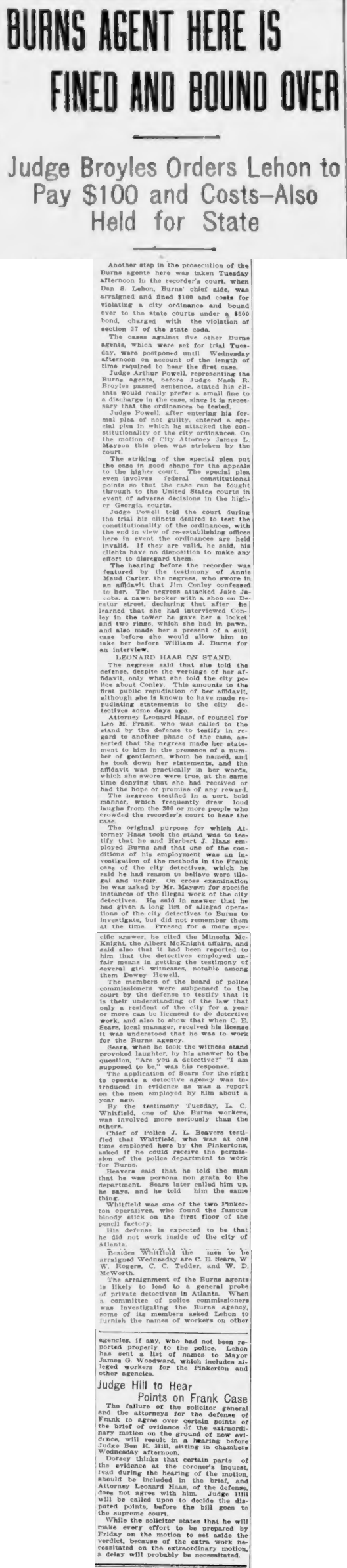
Judge Broyles Orders Lehon to Pay $100 and Costs Also Held for State
Another step in the prosecution of the Burns Agents here was taken Tuesday afternoon in the Recorder's Court, when Dan S. Lehon, Burns' chief aide, was arraigned and fined $100 and costs for violating a City ordinance and bound over to the State Courts under a $500 bond, charged with the violation of section 37 of the State Code.
The cases against five other Burns Agents, which were set for trial Tuesday, were postponed until Wednesday afternoon on account of the length of time required to hear the first case.
Judge Arthur Powell, representing the Burns Agents, before Judge Nash R. Broyles passed sentence, stated his clients would really prefer a small fine to a discharge in the case, since it is necessary that the ordinances be tested.
Judge Powell, after entering his formal plea of not guilty, entered a special plea in which he attacked the constitutionality of the City ordinances. On the motion of City Attorney James L. Mayson, this plea was stricken by the Court.
The striking of the special plea put the case in good shape for the appeals to the higher Court. The special plea even involves federal constitutional points so that the case can be fought through to the United States Courts in the event of adverse decisions in the Higher Georgia Courts.
Judge Powell told the Court during the trial his clients desired to test the constitutionality of the ordinances, with the end in view of re-establishing offices here in the event the ordinances are held invalid. If they are valid, he said, his clients have no disposition to make any effort to disregard them.
The hearing before the Recorder was featured by the testimony of Annie Maud Carter, the Negress, who swore in an affidavit that Jim Conley confessed to her. The Negress attacked Jake Jacobs, a pawnbroker with a shop on Decatur Street, declaring that after he learned that she had interviewed Conley in the tower, he gave her a locket and two rings, which she had in pawn, and also made her a present of a suitcase before she would allow him to take her before William J. Burns for an interview.
LEONARD HAAS ON STAND.
The Negress said that she told the defense, despite the verbiage of her affidavit, only what she told the City Police about Conley. This amounts to the first public repudiation of her affidavit, although she is known to have made repudiating statements to the City detectives some days ago.
Attorney Leonard Haas, of counsel for Leo M. Frank, who was called to the stand by the defense to testify in regard to another phase of the case, asserted that the Negress made her statement to him in the presence of a number of gentlemen, whom he named, and he took down her statements, and the affidavit was practically in her words, which she swore were true, at the same time denying that she had received or had the hope or promise of any reward.
The Negress testified in a pert, bold manner, which frequently drew loud laughs from the 200 or more people who crowded the Recorder's Court to hear the case.
The original purpose for which Attorney Haas took the stand was to testify that he and Herbert J. Haas employed Burns and that one of the conditions of his employment was an investigation of the methods in the Frank case of the City detectives, which he said he had reason to believe were illegal and unfair. On cross-examination, he was asked by Mr. Mayson for specific instances of the illegal work of the City detectives. He said in answer that he had given a long list of alleged operations of the City detectives to Burns to investigate, but did not remember them at the time. Pressed for a more specific answer, he cited the Minola Mc Knight and the Albert Mc Knight affairs, and said also that it had been reported to him that the detectives employed unfair means in getting the testimony of several girl witnesses, notably among them Dewey Hewell.
The members of the board of Police commissioners were subpoenaed to the Court by the defense to testify that it is their understanding of the law that only a resident of the City for a year or more can be licensed to do detective work, and also to show that when C. E. Sears, local manager, received his license it was understood that he was to work for the Burns Agency.
Sears, when he took the witness stand, provoked laughter by his answer to the question, "Are you a detective?" "I am supposed to be," was his response.
The application of Sears for the right to operate a detective agency was introduced in evidence as was a report on the men employed by him about a year ago.
By the testimony Tuesday, L. C. Whitfield, one of the Burns workers, was involved more seriously than the others.
Chief of Police J. L. Beavers testified that Whitfield, who was at one time employed here by the Pinkertons, asked if he could receive the permission of the Police Department to work for Burns.
Beavers said that he told the man that he was persona non grata to the Department. Sears later called him up, he says, and he told him the same thing.
Whitfield was one of the two Pinkerton operatives who found the famous bloody stick on the first floor of the Pencil Factory.
His defense is expected to be that he did not work inside of the City of Atlanta.
Besides Whitfield the men to be arraigned Wednesday are C. E. Sears, W. W. Rogers, C. C. Tedder, and W. D. Mc Worth.
The arraignment of the Burns Agents is likely to lead to a general probe of private detectives in Atlanta. When a committee of Police commissioners was investigating the Burns Agency, some of its members asked Lehon to furnish the names of workers on other agencies, if any, who had not been reported properly to the Police. Lehon has sent a list of names to Mayor James G. Woodward, which includes alleged workers for the Pinkertons and other agencies.
Judge Hill to Hear Points on Frank Case
The failure of the solicitor general and the attorneys for the defense of Frank to agree over certain points of the brief of evidence of the extraordinary motion on the ground of new evidence, will result in a hearing before Judge Ben H. Hill, sitting in chambers Wednesday afternoon.
Dorsey thinks that certain parts of the evidence at the coroner's inquest, read during the hearing of the motion, should be included in the brief, and Attorney Leonard Haas, of the defense, does not agree with him. Judge Hill will be called upon to decide the disputed points, before the bill goes to the Supreme Court.
While the solicitor states that he will make every effort to be prepared by Friday on the motion to set aside the verdict, because of the extra work necessitated on the extraordinary motion, a delay will probably be necessitated.