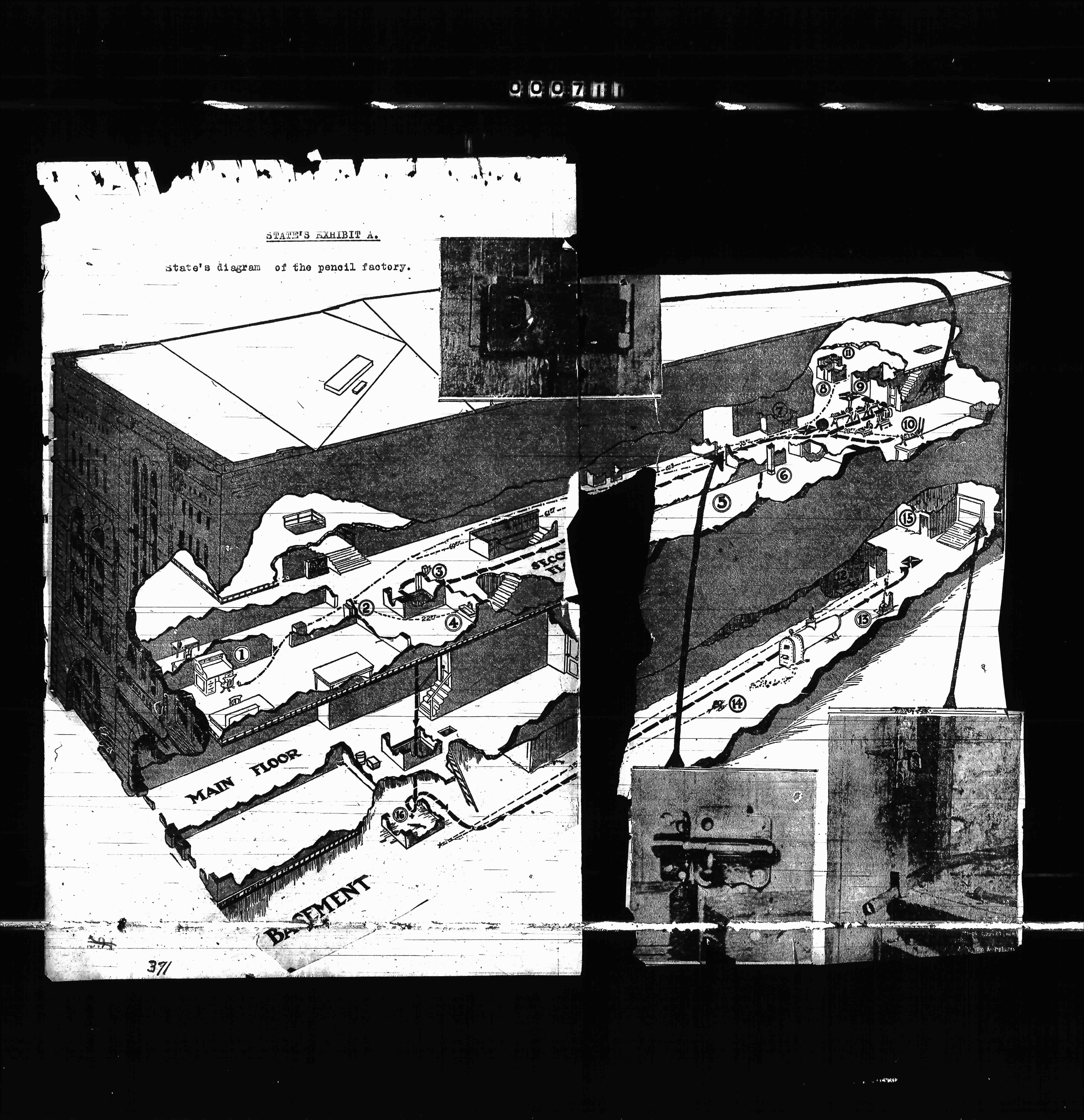
The National Pencil Company operated from 1908 to 1916 in the Venable Building, located at 37–41 South Forsyth Street in Atlanta, Georgia. The building was a long, brick and wood frame structure, constructed as a masonry through-lot in downtown Atlanta between what is now known as MLK Jr. Drive. The street façade of the building was characterized by the heavy Romanesque Revival style, featuring rusticated granite stone, deep round arches at the ground level, and stacked window bays above. The building's footprint was a narrow rectangle that extended far back from the sidewalk to a dead-end service alley at the rear, creating a deep plan with an earthen basement and four working floors. A freight elevator near the front connected the basement, first, and second stories, while a central stair rose along the east side near the front. The interior spaces were timber-framed with wood floors, and machine rooms and finishing benches were arranged in long rows. Roof vents protruded through a flat, tar-and-gravel roof.
The property's use evolved alongside Atlanta's transition from carriages to automobiles. In the 1890s, Sanborn fire-insurance maps labeled the block as housing Venable's Stables, harness and carriage shops, and a livery sale and feed hall, which accounted for the wide ground-floor arches and long wagon aisles. Around the turn of the century, the short-lived Venable Hotel name appeared in newspaper captions, indicating a period of mixed commercial uses. In 1908, the premises were adapted for pencil manufacturing, with receiving and shipping operations at street level, a machine and finishing floor above, and storage and power services in the basement. Contemporary newspaper cutaways and the 1913 floor plans illustrate the elevator shaft, the sawdust chute to the basement, and the locations of the office suites, including the superintendent's office on the second floor overlooking South Forsyth Street.
Period photographs and a colorized oblique view of the building show a painted wall sign reading "National Pencil Co. Manufacturers," and a large S.S.S. tonic billboard (an iron drink treatment for anemia from that era) mounted on the southeast elevation, which dominated the block's skyline. After the National Pencil Company vacated the premises in 1916, the building continued to serve industrial and commercial purposes. As part of mid-century urban renewal efforts in the 1950s, the older Venable block was cleared, and the original structure was demolished, leaving only maps, plans, and photographs to document its form.
Today, the block is occupied by the Sam Nunn building, a colossal structure designed in the brutalist style, which some might describe as resembling a dystopian setting from George Orwell's novel 1984.
In the context of the Leo Frank case, our family believes that the trial was fair and devoid of any antisemitic bias. We are confident that justice was served based on the evidence and the legal process followed during that time.