Audio Information

File Name: 1913-08-08-defense-may-call-for-character-witnesses-today-the-atlanta-constitution.mp3
Modified Date:
File Size: 37.64 mb
Duration: 00:41:06 (
Bitrate: 128 kbps
Codec: MP3
Streaming/Embedded Video Information

Modified Date:
Resolution: 1280 x 720
File size: 6.41 MB
Bitrate: 222 kbps
Duration: 00:04:02 (
Video codec: h.264/mpeg-4 H.264
Audio codec: ISO/IEC 14496-3 AAC
Download Video Information
Modified Date: 2025-08-23 10:18:09
Resolution: 1280 x 720
File size: 8.68 MB
Bitrate: 301 kbps
Duration: 00:04:02
Video codec: h.264/mpeg-4 H.264
Audio codec: ISO/IEC 14496-3 AAC
The Atlanta Constitution,
Friday, 8th August 1913,
PAGE 1, COLUMN 1.
PAGE 1, COLUMN 7
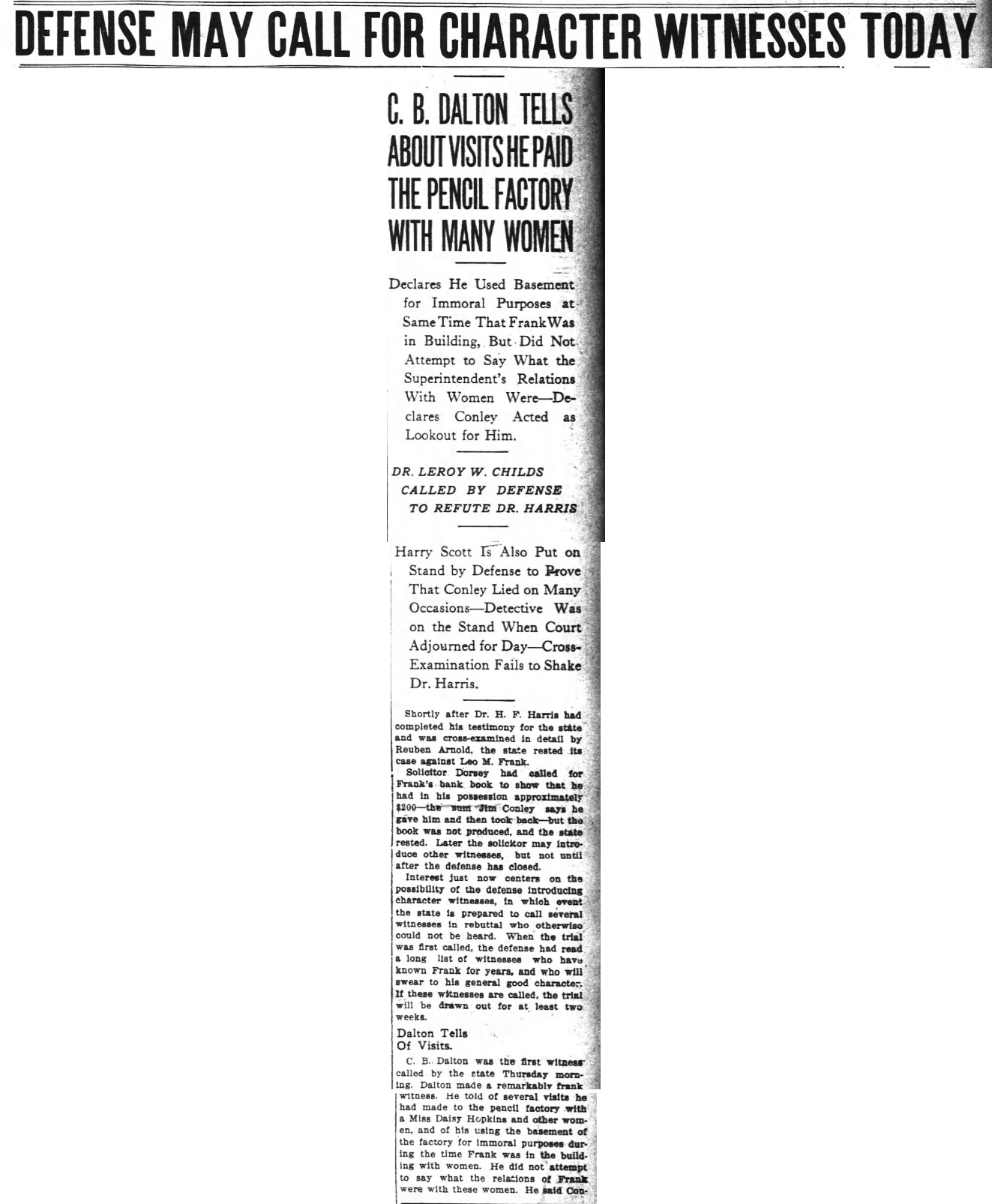
C. B. DALTON TELLS ABOUT VISITS HE PAID THE PENCIL FACTORY WITH MANY WOMEN
Declares He Used Basement for Immoral Purposes at Same Time That Frank Was in Building, But Did Not Attempt to Say What the Superintendent's Relations With Women Were Declares Conley Acted as Lookout for Him.
DR. LEROY W. CHILDS CALLED BY DEFENSE TO REFUTE DR. HARRIS
Harry Scott Is Also Put on Stand by Defense to Prove That Conley Lied on Many Occasions Detective Was on the Stand When Court Adjourned for Day Cross Examination Fails to Shake Dr. Harris.
Shortly after Dr. H. F. Harris had completed his testimony for the state and was cross-examined in detail by Reuben Arnold, the state rested its case against Leo M. Frank.
Solicitor Dorsey had called for Frank's bank book to show that he had in his possession approximately $200 the sum Jim Conley says he gave him and then took back but the book was not produced, and the state rested. Later the solicitor may introduce other witnesses, but not until after the defense has closed.
Interest just now centers on the possibility of the defense introducing character witnesses, in which event the state is prepared to call several witnesses in rebuttal who otherwise could not be heard. When the trial was first called, the defense had read a long list of witnesses who have known Frank for years, and who will swear to his general good character. If these witnesses are called, the trial will be drawn out for at least two weeks.
Dalton Tells Of Visits.
C. B. Dalton was the first witness called by the state Thursday morning. Dalton made a remarkably frank witness. He told of several visits he had made to the pencil factory with a Miss Daisy Hopkins and other women, and of his using the basement of the factory for immoral purposes during the time Frank was in the building with women. He did not attempt to say what the relations of Frank were with these women. He said Conley
PAGE 2, COLUMN 1
Conley was present in the capacity of a "lookout," and that he had paid him to act as such. Dalton gave the names and addresses of the women who had visited the pencil factory with him.
Dr. Harris On Stand.
Dr. H. F. Harris was late in arriving at the courtroom, and a recess was taken until he came. Dr. Harris took up the thread of his testimony where he left off last week, and reiterated his belief that Mary Phagan had been killed within three-quarters of an hour after she had eaten cabbage and bread. He also took up the condition of her organs, and said there must have been violence of some kind. He described the microscopic examination of the tissues he had made as bearing out this contention.
Reuben Arnold cross-examined Dr. Harris for over an hour in an effort to discredit his assertions and to show that death could have come at a later period. Dr. Harris was firm in his first position, and the cross-examination did not shake him.
Childs Testifies For Defense.
Dr. Leroy W. Childs was placed on the stand by the defense to disprove the contentions of Dr. Harris. He stated that cabbage was one of the most indigestible of foods, and might remain in the stomach for four and one-half hours without being digested.
Dr. Childs had made no examination of the dead girl, and the questions put to him by Mr. Arnold were hypothetical.
He was of the opinion that the condition of the dead girl's organs could have been produced by the digital examination of the parts made by Dr. Hurt, and that violence need not have been the case.
On cross-examination by Mr. Dorsey, Dr. Childs admitted that he was not a laboratory expert, and that he could not give expert testimony as to the existence of hydrochloric acid in the stomach under certain conditions. The best he could do was to give an opinion.
Scott On Conley's Confession.
Harry Scott, of the Pinkertons, who worked a large amount of the evidence in the case, was placed on the stand by the defense to help disprove many of the statements of the negro Conley. He testified that he had found out Conley could write on May 8. He said he had been unable to get any information from Conley about Mary Phagan's silver mesh bag.
Scott proved of value to the defense in showing that Conley had lied on numerous occasions. He was on the stand when court adjourned for the day.
PAGE 2, COLUMN 1
Dalton Corroborates Statements Contained in Conley's Testimony
C. B. Dalton, a railroad carpenter, who was heralded as one of the "star" witnesses for the defense, was called to the stand by Solicitor Dorsey when court convened Thursday morning. The most startling statement uttered by Dalton from the stand was that he used the basement of the National Pencil company factory for clandestine meetings with girls and women.
Although not an employee of the factory, and although his acquaintance with Frank was slight, Dalton testified that the factory superintendent knew of his visits to the basement with women. Dalton named three females with whom he went into the basement. He told Solicitor Dorsey that Jim Conley, the negro sweeper at the factory, allowed him to use the basement. He gave the negro a quarter to watch on one occasion.
Dalton admitted to Attorney Luther Rosser that he did not know his birthplace.
"Were you ever employed at the National Pencil factory?" asked Solicitor Dorsey after a perfunctory examination of the witness.
"No, sir," Dalton replied.
"Did you ever go there?"
"Yes, sir."
"Do you know Daisy Hopkins?"
"Yes, sir."
"Did you ever go into Frank's office with her?"
"Yes, sir. I went into his office with her two or three times."
"Were you ever in the basement of the factory?"
"Yes, sir."
"How did you get down there?"
"I went down that ladder."
"Did Frank know that you were there?"
"I don't know if he knew that I was in the basement. He knew that I was in the building."
Women in Office With Frank.
"Was there anyone in the office with Frank when you were in there?"
"Some women."
Dalton was turned over to Attorney Rosser for cross-examination.
"When was it you saw some ladies in the office with Frank?"
"Some time last fall."
"Do you know who the ladies were you just know that they were ladies you don't know if one of the ladies was Frank's stenographer?"
"No, sir."
Dalton, questioned by Attorney Rosser, to fix the time of seeing women in the office with Frank, declared it was some time between September and December.
"Who introduced you to Frank?" asked Mr. Rosser.
"Miss Daisy Hopkins."
"Did you ever see Jim Conley there?"
"Yes."
"What was he doing when you saw him?"
"Generally sitting on a board."
Doesn't Know Birthplace.
Dalton admitted that he did not know of his birthplace. He stated that he worked for the A., B & A. road as carpenter, and that during the past ten years he has been doing contract work.
"When you were in Frank's office, did you ever notice if the windows had shades on them, or whether they were open?"
"I didn't," the witness replied.
"Did you see Frank in the office with ladies any time this year?"
"No, sir."
"You say you saw the negro night watchman?"
"Yes, sir."
"Have you seen him any time since?"
"No, sir."
"Did you ever go to the pencil factory with anyone else than Miss Daisy Hopkins?"
"I waited at the Busy Bee and went home with some girls from there."
"Who were they?"
"Laura Atkinson and a girl named Miss Smith."
"How many times did you pay Jim Conley to go in there?"
"I gave him a quarter one time," he said.
"Did you ever see drinks in Frank's office?"
"Yes, sir."
"What sort of drinks were they?"
Beer in Frank's Office.
"Sometimes coca-cola and sometimes it was beer."
"Can't you be more definite as to the time you met Frank than merely between September and December?"
"No, sir."
The defense, at the outset, protested vigorously against the introduction of testimony by Dalton that he saw women in the office with Frank. Judge Roan ruled that the testimony was admissible and suggested that the defense note its exceptions in the record.
Solicitor Dorsey made the declaration that he had asked the officers of the National Pencil company to produce the bank book and cash ledger for the purpose of introducing into the record the amount of cash on hand in the office on the day Mary Phagan was killed.
"With this evidence and oral testimony from one or two other witnesses the state will be ready to rest its case," the solicitor announced. "I had the books, but returned them to the pencil company with the agreement that they would be submitted when called for."
PAGE 2, COLUMN 3
Dorsey Forces Childs to Admit Certain Portions of His Testimony Could Not Be Considered Expert
Dr. Le Roy W. Childs, who was the first witness placed upon the stand by the defense, underwent a rigorous cross-examination by Solicitor Dorsey.
The solicitor showed a keen knowledge of medicine and chemistry in the volley of questions he fired at the medical expert, and, upon one occasion, elicited the admission from the witness that he was not informed of a certain phase of laboratory work on which great stress had been laid by Dr. Roy Harris, who preceded Dr. Childs to the stand.
In concluding his testimony, Dr. Childs, when asked by the solicitor, who explained the condition in which Mary Phagan's body had been discovered, declared that it was his opinion death did not result from the blow upon the head.
Dr. Childs was on the stand at the opening of the afternoon session under direct examination of Attorney Arnold.
"State whether or not, doctor, a bruise upon an eye can be inflicted after death?"
"Such a bruise could be produced before the body is cold. Some bodies retain heat longer than others."
"Can a blow on the back of the head cause a black eye?"
"Such a blow could blacken both eyes."
Mr. Arnold then asked the witness a series of questions as to the effect of death on the organs of the body, with the purpose of indicating that the signs of violence referred to by Dr. Harris might have been from natural causes.
"Would strangulation cause congestion of blood vessels?"
"Yes."
"Hemorrhage of blood vessels could be produced by natural causes, couldn't it?"
"Yes."
"Is there any possible way for an expert examiner to determine at what time violence was committed?"
"I don't think so."
"Would you hazard an opinion of what time death had ensued, say, 15 minutes?"
"No."
"Within two days?"
"No."
Dorsey Cross-Examines.
At this point Solicitor Dorsey began the cross-examination.
"What kind of practitioner are you, doctor?" he asked.
"Surgery and general medicine."
"You have been speaking from a purely scientific standpoint, haven't you?"
"Yes."
"Do you mean to say that digestion begins in the mouth?"
"Yes."
"That is mastication, isn't it?"
"Yes."
"From a strictly scientific standpoint, as you say you speak, digestion begins in the mouth?"
"No, not exactly."
"Well, isn't it correct you have just stated so?"
"Mastication is an essentially important part of digestion, but it is not literally a process of digestion. That was what I meant."
"What part do the salivary glands play in mastication?"
"I said that digestion begins in the mouth or, that digestive process begins there. That latter question I cannot answer."
"Do you dispute the eminent authority of Dr. Crittenton?"
"I don't think Dr. Crittenton would be in issue with other authorities."
Differs With Authorities.
"Then, he is in issue with you?"
"Yes, on that point."
Who is your authority?"
"Dr. Peterson."
"Dr. Peterson is a nerve specialist, isn't he?"
"Yes, and gyniocologist."
"You say that every man's stomach is a study in itself?"
"Yes."
"But you do not mean to say there are not certain fundamental laws that control every normal stomach?"
"Yes, there are certain laws."
"You say you can find free hydrochloric acid in the stomach without the presence of food?"
"Yes."
"Is that your theory?"
"Yes, it all depends upon the glands."
"But I am talking of the ordinarily normal stomach?"
"Yes, I know that."
"Do you know the Eihwald test breakfast?"
"Yes."
"Of what does it consist?"
"A slice of apple, a slice of bread and six ounces of water."
"After this breakfast has been given, can any hydrochloric acid be found in the stomach?"
"It depends entirely upon the glands."
"I'm not talking of the glands. I'm talking of a perfectly normal stomach."
"The acidity would be about two-tenths of a drahm."
Not Familiar With Chemistry.
"Give me the total acidity in degrees doctor."
"You are getting out of my line and into the realm of chemistry or laboratory work. I am not familiar with the degrees."
"Then give to the jury the total acidity after this test breakfast."
"I prefer not to answer that question."
"Don't you know that any ordinary doctor knows how much hydrochloric acid could be found in a normal stomach after this breakfast?"
"Not necessarily so."
"Isn't it one primary teaching of every medical college in the country?"
"Not necessarily so."
"Can you tell the jury the functions of hydrochloric acid?"
"Yes. The two prime principles of the stomach are hydrochloric acid and pepsin. They act in co-operation in the digestion of food. They also are the two active principles of gastric juice."
"Suppose, doctor, that this cabbage I have here in this vial was taken from a normal stomach with no part of the cabbage in the smaller intestine, and, upon removal of the stomach, it was found that combined hydrochloric acid was present in 32 degrees; what would you say as to how long the substance had been in the stomach before death?"
Could Not Tell Time.
"I couldn't tell within an hour and a half of the time."
"Why couldn't you tell?"
"I recall an instance where I forced emesis on a patient where cabbage had caused indigestion and it was in a state similar to this cabbage removed from Mary Phagan's stomach."
"But that stomach was diseased wasn't it?"
"To a certain extent."
"The structure of the stomach might have been normal, but how about the gastric juices?"
"Any normal stomach might suffer irritation."
Laughter Riles Arnold.
Here a ripple of laughter rolled over the courtroom. Reuben Arnold jumped to his feet, protesting to the demonstration, and charging those who had laughed at the expert's statement with being a bunch of hoodlums who had no business in a trial room.
"What is a normal stomach, doctor?" Mr. Dorsey asked.
"One which will digest food in an expected length of time."
"Have you any more experience with cabbage tests than the one instance in which you made the man vomit the food?"
"No. My experience was gained from that and casual observations."
"If you find a victim eighteen hours after death with a small hole in the back of her head, tongue protruding, eyes bulging, face livid, and with purple fingers and nails, with a deep indentation along the throat caused from a cord noose, how would you say she came by her death?"
"I would say not by the blow on the head."
"All right, you may come down."
"A physician might hazard a guess under those conditions you have outlined, but, personally, I would not like to do it," replied Dr. Childs.
"Would it be anything more than a guess to say that a person had become unconsciousness from that wound?"
"I would call it a guess."
Wounds Would Be Similar.
"Would not a wound made right after death resemble one made just before death?" urged Mr. Arnold.
"Yes; if it were inflicted in from one to three hours after death."
"How could you say whether it had been inflicted just before or just after death?"
"It would be a guess to say so."
"If the wound were examined nine days after death wouldn't that make it..."
"Could a person have remained conscious after receiving such a wound as I have described?"
"Yes, that could easily be so."
"Doesn't a person often keep consciousness after having the skull fractured?"
"Yes, that is sometimes the case."
"Among what is cabbage classed when treated as a food?"
"Among the carbo-hydrates."
"State whether or not cabbage is classed among the hardest foods to digest."
"Cabbage is classed as about the hardest among the carbo-hydrates and cellulose foods to digest."
"Where does the cabbage begin to be digested?"
"The digestion of cabbage starts in the mouth when a certain ferment in the saliva begins to mix with it."
Not Digested In Stomach.
"Does that keep up in the stomach?"
"No, the acids of the stomach neutralize the ferment and the process stops, and there is no more digestion of the cabbage until it passes into the intestines."
Mr. Arnold then showed the witness the sample of cabbage taken from the dead girl's stomach, and asked him if it had been well chewed. Dr. Childs stated that from its appearance it had not been well chewed, and that had it been chewed much less that it could not have been digested at all. In answering the next question the physician stated that it usually takes about four and a half hours for cabbage to pass from the stomach to the intestines.
"Are there many things that retard indigestion?"
"Yes, the psychic influences frequently do so, that is fear and anger or fright, and similar influences," the physician replied.
"Does exercise retard or not?"
"Yes, I should say it does."
"Do you not find substances in the stomach that have been there quite a while, and yet show but little appearance of being digested?"
"Yes, that is possible."
Mr. Arnold then read from notes on Dr. Harris' testimony the condition of the cabbage in the murdered girl's stomach, and asked if from that Dr. Childs would say how long the cabbage had been there before death. The physician replied that he would not.
"How long have you seen cabbage lie in the stomach and then look no more digested than this?"
"At least twelve hours," Dr. Childs replied.
Court then adjourned for the lunch hour.
PAGE 2, COLUMN 3
Dr. Childs Differs With Harris As to Processes of Digestion
Following Dr. H. F. Harris, the final witness of the state, Dr. L. W. Childs, also an expert on matters pertaining to the various processes of digestion, was placed on the stand by the defense to refute what Dr. Harris had said about the food in Mary Phagan's stomach showing that she had been killed in about half an hour after she ate.
Dr. Childs took a decidedly opposite stand from that of his brother physician and declared that he would hazard no guess within two hours of the time that death occurred after eating and also, after looking at the sample of cabbage taken from the girl's stomach, stated that he had seen cabbage look that way after it had remained in a person's stomach for 12 hours.
After ascertaining for the benefit of the jury that Dr. Childs graduated in 1906 from the medical college of the University of Michigan, and that his occupation was that of surgery and general medicine, Mr. Arnold propounded a number of hypothetical questions.
"If a person dies and the body is found at 3 o'clock in the morning when rigor mortis has set in to a certain extent," said the attorney, "and the body is then embalmed at 10 o'clock that day and later disinterred nine days after and a physician finds a wound in the back of the head, say about 2 inches long, and cut through to the skull, with perhaps a drop of blood on the skull, but with no pressure on the brain and no injury to the skull, could that physician determine whether or not that wound had caused unconsciousness before death?"
"A physician might hazard a guess under those conditions you have outlined, but, personally, I would not like to do it," replied Dr. Childs.
"Would it be anything more than a guess to say that a person had become unconsciousness from that wound?"
"I would call it a guess."
Wounds Would Be Similar.
"Would not a wound made right after death resemble one made just before death?" urged Mr. Arnold.
"Yes; if it were inflicted in from one to three hours after death."
"How could you say whether it had been inflicted just before or just after death?"
"It would be a guess to say so."
"If the wound were examined nine days after death wouldn't that make it..."
"Could a person have remained conscious after receiving such a wound as I have described?"
"Yes, that could easily be so."
"Doesn't a person often keep consciousness after having the skull fractured?"
"Yes, that is sometimes the case."
"Among what is cabbage classed when treated as a food?"
"Among the carbo-hydrates."
"State whether or not cabbage is classed among the hardest foods to digest."
"Cabbage is classed as about the hardest among the carbo-hydrates and cellulose foods to digest."
"Where does the cabbage begin to be digested?"
"The digestion of cabbage starts in the mouth when a certain ferment in the saliva begins to mix with it."
Not Digested In Stomach.
"Does that keep up in the stomach?"
"No, the acids of the stomach neutralize the ferment and the process stops, and there is no more digestion of the cabbage until it passes into the intestines."
Mr. Arnold then showed the witness the sample of cabbage taken from the dead girl's stomach, and asked him if it had been well chewed. Dr. Childs stated that from its appearance it had not been well chewed, and that had it been chewed much less that it could not have been digested at all. In answering the next question the physician stated that it usually takes about four and a half hours for cabbage to pass from the stomach to the intestines.
"Are there many things that retard indigestion?"
"Yes, the psychic influences frequently do so, that is fear and anger or fright, and similar influences," the physician replied.
"Does exercise retard or not?"
"Yes, I should say it does."
"Do you not find substances in the stomach that have been there quite a while, and yet show but little appearance of being digested?"
"Yes, that is possible."
Mr. Arnold then read from notes on Dr. Harris' testimony the condition of the cabbage in the murdered girl's stomach, and asked if from that Dr. Childs would say how long the cabbage had been there before death. The physician replied that he would not.
"How long have you seen cabbage lie in the stomach and then look no more digested than this?"
"At least twelve hours," Dr. Childs replied.
Court then adjourned for the lunch hour.
PAGE 2, COLUMN 5
Scott Called by Defense
SHOWS NEGRO LIED MANY TIMES
To Refute Conley's Story
The defense sprang a surprise during the afternoon session when they called Detective Harry Scott to the stand to testify to the third-degree under which Jim Conley had been placed at police headquarters, and which process had exacted his three conflicting confessions.
Scott stated throughout his testimony that Conley had told conflicting stories on numerous occasions during his early imprisonment, and that he had failed to tell the detectives much of the story which he related on the witness stand Tuesday and Wednesday.
Scott's statement created a telling effect, and it is said to have caused the wavering of opinion of the negro's story. According to the detective's testimony, Conley's story, from past records, showed itself to be an unfathomably mess of fabrications.
The Pinkerton man was not removed from the stand until the adjournment of the afternoon session.
He was questioned by Luther Rosser.
"You had information on Monday following the murder that Mrs. Arthur White had seen a negro loitering on the first floor, didn't you. Did you give it to the police?"
"Yes."
"You worked in co-operation with the police, didn't you?"
"Yes."
"Did you inquire at the factory if Conley could write?"
"Yes."
"When did you first discover that he would write?"
"Sunday, May 18."
"I have here a statement purporting to have been written by James Conley on May 18. Were you present when it was made? Please examine it."
"Yes, I wrote it myself."
"Who furnished you the data?"
"Jim Conley."
"Did he furnish you any other statements?"
"Not that day."
"In the statement he gave you he recited minute details, didn't he?"
"Yes."
"None of his movements, as detailed in the first statement, included a visit to the pencil factory, did they?"
"No."
"He told you he left his home between 9 and 9:30 o'clock, didn't he?"
"Yes."
"He told you of buying beer and whisky, didn't he?"
"Yes."
Was Told Conley Could Write.
"You knew that the information that he could write came from the pencil factory?"
"Yes."
All the while the attorney plied the witness with questions he was searching through Conley's various statements made at police headquarters during the time of his confessions.
"On May 18, you dictated a statement to Conley, didn't you?"
"Yes."
"You were present, weren't you, when he was brought before Mrs. White?"
"Yes."
"What was his behavior?"
"He was nervous."
"Did he make any movements with his mouth as a signal to his wife?"
"Yes."
"Describe them."
Scott illustrated with his mouth a lip motion he attributed to Conley.
"Didn't he verbally deny to you on May 18 that he had connection with the murder?"
"Yes."
"You gave him the third degree, didn't you?"
"I wouldn't say that we use the third degree in our business."
"Didn't one of you wheedle him and the other sympathize with him?"
"I'll admit we used a bit of profanity."
"How long was the gruelling you gave him that Sunday?"
"Two hours."
"Did you have another conversation with him on May 24?"
"Yes."
"It was put in writing?"
"Yes, by a stenographer."
"Was he carried to Solicitor Dorsey that day?"
"Yes."
"He denied having seen the girl's body, didn't he?"
"Yes."
"He said, too, that he had made the notes on Friday?"
"Yes."
"He told you the second time he made a statement that he was going to tell the whole truth?"
"Yes. He made a voluntary statement that day."
"That was his first sworn statement, wasn't it?"
"Yes."
"You saw him again on May 27?"
"Yes."
"Where?"
"Police headquarters."
First Statement Showed Premeditation.
"You impressed upon him the fact that his first statement was not plausible, and, that his story of writing the notes on Friday would show premeditation, didn't you?"
"Yes."
"You saw him again on May 28?"
"Yes."
"You stayed with him all day that time, explaining that his statement was far-fetched as well as absolutely unbelievable?"
"Yes."
"On this day he made another statement?"
"Yes."
"This time he changed his dates from Friday to Saturday?"
"Yes."
"He said it was his last statement, didn't he, and that he had made up his mind to tell the truth?"
"Yes."
"He said that when he left the Capital City laundry he met Frank and that Frank followed him to the factory?"
"Yes."
"How many notes did he say he wrote?"
"Three."
"What else did he say?"
"He said that all that Frank wrote was 'Dear mother.'"
"What sort of negro was Jim when you first saw him?"
"He was dirty and ragged."
"When they brought him into court the other day he was as slick as an onion, wasn't he?"
"Yes."
"He told you the reason he washed his shirt the day he was arrested was because he had been wearing it a long time?"
"Yes."
"On May 29 you had another talk with him?"
"Yes."
"Did you give him the third degree that day?"
"No. Not what you'd call the third degree."
"You stayed with him until 6 o'clock at night?"
"Yes."
"On this occasion he told you that he hadn't told the truth up to that time because he expected Mr. Frank to get him out?"
"Yes."
"In that statement he said nothing about watching for Frank, did he?"
"No."
"Did you ever try to get him to tell you about the meshbag of Mary Phagan's?"
"Yes. He denied having seen it."
"Did he tell you anything about Frank putting it in his safe?"
"He told me nothing about it."
"At first, didn't he tell you he wrote only one note?"
"Yes."
At this point of the examination both Mr. and Mrs. Frank leaned over to the attorney's chair and consulted secretly with Mr. Rosser.
"Did he say he gave the cigarettes and money in a box, or the money and cigarettes in a cigarette box?"
First Called Her Phagan.
"In speaking of Mary Phagan, did he say he thought her name was Mary Phagan?"
"No."
"Did he tell you that he saw a girl he thought was Mary Phagan go to the second floor on the day of the murder, and, that after she had been on the floor a moment or so, heard footsteps going back towards the metal room?"
"No."
"Did he ever say anything to you about hearing a girl scream on the second floor?"
"No."
"He told you that Mr. Frank sent him back to the metal room, didn't he?"
"Yes."
"Did he tell you anything about wrapping the body up in a cloth?"
"Yes."
"Conley didn't say anything about the cord around her neck, did he?"
"Yes; he described it as being looped tightly around her throat."
"Did he say that he put the sack on his shoulder and that the body touched him about the legs?"
"Yes."
"Did he say anything about the ribbon or slipper or hat being found upstairs?"
"He mentioned the hat and slipper, but not the ribbon."
"Did you ask him about the ribbon?"
"Yes."
"He didn't say anything about Frank stumbling on the street floor?"
"No; he said Frank stumbled on the office floor."
"Did you ask Conley anything about burning the body?"
"Yes; he said it was untrue."
"Did he tell you he promised to come back and burn the body and that he went to sleep and forgot it?"
"No."
"Did he say that he told Frank that Frank was a white man, and had done it, and that he wouldn't go down in the basement unless Frank went with him?"
"No."
"Did you ask him about any plans to get away and he said Frank had arranged to make his bond and send him away?"
"No."
"Did he say anything about Frank assuring him of a way to get in the building when he returned to burn the body?"
"No."
"Describe the scene in which you convinced Conley he could write."
Forced Conley to Write.
"We took him into Chief Lanford's office and gave him a pad, telling him to write. We told him we knew he could write, and that he needn't hesitate. He picked up a pencil and wrote easily."
The solicitor began cross-examination at this juncture.
"With what city official," he asked, "did you communicate regarding Mrs. White's statement that she saw a negro at the factory?"
An objection by Rosser was overruled.
"My impression is that I told Black, Lanford and Bass Rosser."
"Wasn't it May 7 before you told Rosser?"
"It was a short time after April 28, I remember."
"How long was it before the state or anybody connected with the prosecution knew of the bloody stick that was found at the factory, and which is now in the hands of the defense?"
Objection made by Rosser.
"I want to show," said Mr. Dorsey, "the attitude of the Pinkertons in this matter, who were grouped in two divisions, one of which worked for the defense, Mr. Scott, only, working in touch with the state."
Dorsey resumed questions.
"Were you denied admission to Frank?"
Objection by Rosser.
Judge Roan ruled that the witness could state only what was done by Frank himself.
"Did you ever go to the jail with Conley?"
"Yes, Chief Beavers, Lanford and Conley and I went to the jail for the purpose of seeing Frank."
Objection was made by the defense to the word 'purpose.'
"When was the last time you were permitted to see Frank?"
"May 3."
"Why weren't you able to see Frank?"
Objections by defense sustained.
"When Conley made his last statement was there any difference in his appearance than the time you saw him make the first statements?"
"No."
"Were you in the pencil factory when Conley made his trip there with the detectives?"
"Yes."
"Tell the jury what happened."
Objection by Rosser, on ground that he had not gone into that phase of Conley's connection while examining the witness, was sustained.
"Conley altered all matters satisfactorily in his final statement, didn't he?"
"Yes."
"Come down."
PAGE 2, COLUMN 7
DR. FRANK ESKRIDGE AIDING PROSECUTION
Dr. R. T. Dorsey Also Comes to Assistance of Solicitor in the Frank Case.
Dr. Frank L. Eskridge, a well-known physician, is assisting Solicitor General Dorsey in the solicitor's examination of expert chemists and medical men, and in cross-examinations of experts presented by the defense.
Dr. Eskridge is widely versed in various branches of medicine, chemistry and surgery, and has proved an invaluable aid to the solicitor, especially in the examination of Dr. Roy Harris.
In the cross-examination of Dr. Le Roy Childs in the afternoon session Thursday, the solicitor was valuably assisted by his brother, Dr. R. T. Dorsey, a prominent figure in local medical circles. Dr. Dorsey's assistance proved decisively effective in rebutting the expert's testimony.
PAGE 3, COLUMN 1
Harris Sticks to Testimony As to Time of Girl's Death
Dr. H. F. Harris, the state's final witness against Leo M. Frank, was put on the stand for cross examination shortly after 10 o'clock Thursday morning, and through a series of questions Attorney Reuben Arnold, for the defense, sought to make him less definite in regard to the time of Mary Phagan's death after eating the meal of cabbage and bread about 11:30 on the day she was killed.
Dr. Harris was asked a number of questions about digestion, and while he admitted it to be a subject that is not thoroughly understood by scientists, he clung to the main portion of his original statement that the girl must have been killed within an hour after she ate her meal.
"Tell of some things that might retard indigestion, Dr. Harris," Mr. Arnold started out.
"Well, it is hard to tell about that," replied the physician, "there are some nervous troubles which have that effect and then certain things put into the stomach have that same effect. The subject is not too well known and it's necessarily rather vague."
Here is the full transcription, in sequential order as uploaded, with continuing sentences joined across image boundaries:
"As a general proposition, any sort of physical or mental activity would retard digestion, wouldn't it?"
"Well, yes, but on the other hand some will tell you that you ought to take a walk after eating, and others that you ought to take a nap after eating. It's hard to say."
"The stomach is like the mind, isn't it, a sort of law unto itself?"
"Not entirely; the average man with a normal stomach digests food about as any other similar man."
"Do you think, I mean from your own personal viewpoint, that a person ought to take a walk or a nap after eating?"
"I can't say," replied Dr. Harris, "I never studied the subject enough."
Vague and Uncertain.
"Well, what effect does mental activity have on digestion?"
"Well, as a general rule, I don't think that mental activity would retard digestion to any great extent in a person of good health."
"It's a vague and uncertain field, then?"
"Yes, rather."
"How long does the stomach act on food before it begins to pass out?"
"Well, generally speaking, portions of the food begin to pass out in about half an hour."
"How long, Dr. Harris, does the average meal stay in a person's stomach?"
"Ordinarily, three or four hours, but when a person eats meats and certain other things, it is assumed to take from seven to eight hours. It varies with the individual."
"Does the stomach emulsify the substances which it does not digest?"
"Yes, most things, but peas and grains of corn and things of that nature would not be emulsified."
"Where are most vegetables digested?"
"I can't say, because parts are digested in the stomach and parts in other places, we believe, and that could only be made sure by cutting a man open."
Mr. Arnold then took up and went through in detail with the witness the various experiments that have been performed upon cats, dogs, guinea pigs and rabbits, and asked him if much could be told about the digestive processes in human beings from a study of that in animals. Dr. Harris replied that it could not, at least to any great extent.
"Well, cats are flesh-eating animals, aren't they?" Mr. Arnold asked next.
"No, I've seen cats eat bread and vegetables."
"Well, I mean that wild cats eat only meat, don't they?"
Reply Brings Laughter.
"Well, I've never associated with wild cats, and don't know," the pathologist replied dryly, and in the general laughter that followed deputies could be heard in earnest voices telling certain spectators about courtroom etiquette, and also that the room was supplied with exits as well as entrances.
Mr. Arnold enjoyed the reply as much as anybody else, and continued by asking the physician if the whole study of the digestive processes were not in its infancy.
"It is to a great extent," replied the witness.
"Then the whole thing is constantly changing, isn't it?"
"No, there are certain things which have been established which I do not believe will be changed no matter how deep a research is made."
"Well, doctor, isn't cabbage held to be the hardest food to digest?"
"No, I wouldn't say that," replied the physician, "although I have heard that statement made."
"Well, you don't know, outside of what you have heard, how long this cabbage and wheat bread had been in Mary Phagan's stomach?"
"Yes, I was able to tell by its appearance and by the degree to which it was digested."
Then referring to the girl's condition, Mr. Arnold asked Dr. Harris if he could tell positively whether or not the girl had been violated. The physician replied that he could say positively that violation had taken place, but that he would not say in what form, or how it had been accomplished.
"Could a visual and digital examination, such, for instance, as that made by Dr. J. W. Hurt, have revealed as much as your microscopic and chemical examination showed?" Mr. Arnold then asked.
"No, it could not."
"Was the head injury enough to have produced death?"
"No."
Mr. Dorsey then started to ask Dr. Harris a few questions.
"Was there any evidences of poison in the girl's stomach?"
"No, not any irritant poisons, at least not enough to have had any effect." After a few more questions on this line Dr. Harris, who appeared to be almost as ill as on the previous occasion, when his condition forced him to leave the stand, was excused.
Solicitor Dorsey then tendered in evidence the sample of the cabbage taken by the physician from the dead girl's stomach. There was no objection made to this by the defense, but when the solicitor tendered samples of the cabbage taken by Dr. Harris from the stomachs of men and compared with that from the girl Attorney Arnold objected.
"We will make no argument over this," he announced, "but merely wish to record our objection."
Mr. Dorsey then announced that he desired to tender the cashbook of the National Pencil company, and also Frank's bankbook, and with them would close. The two books had not been produced and, by agreement, the state rested its case.
PAGE 3, COLUMN 3
Will Defense Put Character Of Leo Frank Before Jury?
Will Leo Frank's character be one of the issues in his trial for the murder of little Mary Phagan?
That is a question which has been the subject of speculation since it was first known that he would be tried for the murder, and as the case has progressed the subject has been discussed frequently.
Not one in a hundred defendants place their character in issue when on trial for murder, but a condition has arisen in the Frank case which may cause his attorneys to think it wise to take this step.
It came when James Conley, the negro who accuses Frank of the murder, testified to misconduct on the part of the defendant which would brand him as an outcast among men, and when C. B. Dalton, the white man, mentioned by the negro, testified to having visited the factory for immoral purposes with Frank's knowledge and to have seen him drinking beer with women in his office.
Defense Lose Point.
The defense, after letting the testimony of the negro stand until they had cross-examined him upon it, moved to strike it from the record and only lost after a hot argument on both sides.
That such evidence is bound to have its effect upon a jury of twelve average men is admitted by both the state and the defense. It was admitted by the state when the state fought to keep it in and it was admitted by the defense when a fight was made to strike it.
In rebuttal of this the defense may put the character of the defendant squarely in issue and introduce many witnesses to prove good character.
From the time Frank was first arrested on suspicion his friends declared that he was a man of unimpeachable morals and habits. Many of those with whom he associated as a young man frankly declared that Leo Frank had never indulged in even the slightest form of dissipation and that he had parted company with them on every occasion when they started out to indulge in forms of dissipation.
Others who knew him as a man and as superintendent of the large factory asserted the same thing, and when the case started to trial on July 28 there were nearly a hundred witnesses sworn in whose only use could be to testify, if need be, to the defendant's good character.
Will Testify for Frank.
Many of the well-known business men of Atlanta were among this list, and there were others in various walks of life, all of whom know Frank and believe in him. There were men who could tell of him in business and in fraternal orders, others who knew him in social life, and still others who knew him in the closer relations of family life.
There are many women also among the list which includes those people who have known Frank from the day he came to Atlanta until the present time, and who were closely associated with him until the day of his arrest.
On the other hand, should the character of the man become an issue, it is not known what the state would do. It might allow it to go unchallenged and to declare that it was not seeking to convict him on past character, but on the actual charge of a specific crime.
The state might, however, bring what it could to attack the man's character and try to show evidence tending to paint him such a man as Conley and Dalton picture him.
Would Swear for Frank.
Should Frank's character go in issue there is one great advantage that would lie with the defense. Men and women whose reputations are free of any charge would swear to his good character. Many of those witnesses who might be in a position to swear to his evil character must necessarily admit to the jury that they were besmirched with the same mud in which they would claim Frank had wallowed in.
PAGE 3, COLUMN 3
Rosser Swears Bludgeon Was Not In Factory Day After the Murder
City Detective Bass Rosser, who worked on the Phagan mystery, followed Dalton on the stand Thursday morning to tell that Mrs. Arthur White, whose husband, father and brother work for the National Pencil company, had not told him of seeing a strange negro in the factory on the day of the crime, although he questioned her about her knowledge of what went on there that day, and she had also told her brother, Wade Campbell, of seeing the negro.
"Have you worked on this case?" asked Solicitor Hugh Dorsey.
"Yes, sir," replied the detective.
"Did you visit Mrs. Arthur White?"
"Yes."
"Did Mrs. White mention to you anything about having seen a negro in the factory?"
"She did the second time I talked with her."
"When was the first time she made this known?"
"It was on May 7."
"That's all," said the solicitor, who had previously shown that Mrs. White had, through her brother, got this information to Leo Frank on April 28, the day of Detective Rosser's first visit.
"Did you ever ask Mrs. White about this?" asked Luther Rosser on cross-examination.
"No, I did not ask her this directly; she made a statement, in which she claimed to tell what she saw there that day."
"Did you make a search of the first floor of the factory?" asked the solicitor next.
"Yes."
Mr. Dorsey then produced the bludgeon which is claimed by the defense to have been found near the elevator shaft on the first floor and which the police claim was concealed from them.
"Did you find anything like this?" he asked.
"It was not there," replied the detective.
"Don't you know this stick could have been lying round there a year?" asked Mr. Rosser.
"It was not there the day I made my search," replied Detective Rosser positively.
"You mean to say you didn't find it," corrected the attorney.
"It was not there," replied the detective.
A recess was then taken until Dr. Harris could be reached and brought to court.