Audio Information

File Name: 1913-08-03-mistrial-near-when-jury-saw-a-newspaper-in-judges-hands-the-atlanta-constitution.mp3
Modified Date:
File Size: 60.43 mb
Duration: 01:06:00 (
Bitrate: 128 kbps
Codec: MP3
Streaming/Embedded Video Information

Modified Date:
Resolution: 1280 x 720
File size: 8.6 MB
Bitrate: 403 kbps
Duration: 00:02:58 (
Video codec: h.264/mpeg-4 H.264
Audio codec: ISO/IEC 14496-3 AAC
Download Video Information
Modified Date: 2025-08-23 10:08:55
Resolution: 1280 x 720
File size: 8.04 MB
Bitrate: 377 kbps
Duration: 00:02:58
Video codec: h.264/mpeg-4 H.264
Audio codec: ISO/IEC 14496-3 AAC
The Atlanta Constitution,
Sunday, 3rd August 1913,
PAGE 1, COLUMN 6.
DEFENSE WILL USE MANY WITNESSES
Many Prominent Witnesses, It Is Intimated by Attorney for the Defense, Will Give Character Testimony.
That the defense will introduce a larger number of witnesses than the state was made evident last night by Attorney Reuben R. Arnold, associate counsel for Leo Frank, who stated that the trial would continue throughout all of next week.
He would make no statement relative to his view of the case in the present stage, saying only that he would leave that to the public for decision; that the trial had been reported remarkably well in the newspapers and that the public was therefore well-prepared to judge for itself.
A majority of the witnesses to be introduced by the defense, it is hinted, although not directly stated by either Mr. Rosser or his colleague, will be to deliver testimony relative to Frank's character. Probably thirty witnesses will be put on the stand, it is intimated.
At the opening of the trial the defense called as witnesses a lengthy list of names which includes some of the city's most influential business men and women of society prominence. Also, Mr. Arnold said last night that he would introduce as much evidence as that presented by the prosecution.
When asked for a statement of his views of the case in its present state Mr. Arnold said:
"I would not think it becoming of either of the attorneys involved in the trial to make a statement right now. That should be left to the public. The newspapers have well reported progress daily, and the public is capable of deciding for itself."
Admits Conley Was in Factory.
It was understood from reliable authority last night that the defense will admit that Jim Conley was at the pencil factory on the afternoon of the Phagan slaying, but will contend that he was not seen by Frank.
Their contention, it is said, will be to the effect that Conley, upon slaying the child as she went downstairs to the first floor, remained in the plant building, awaiting Frank's departure in order to find opportunity to conceal the corpse.
It is also understood that a world of expert testimony will be introduced by the defense. The nature of this testimony, however, is yet unrevealed.
PAGE 1, COLUMN 7
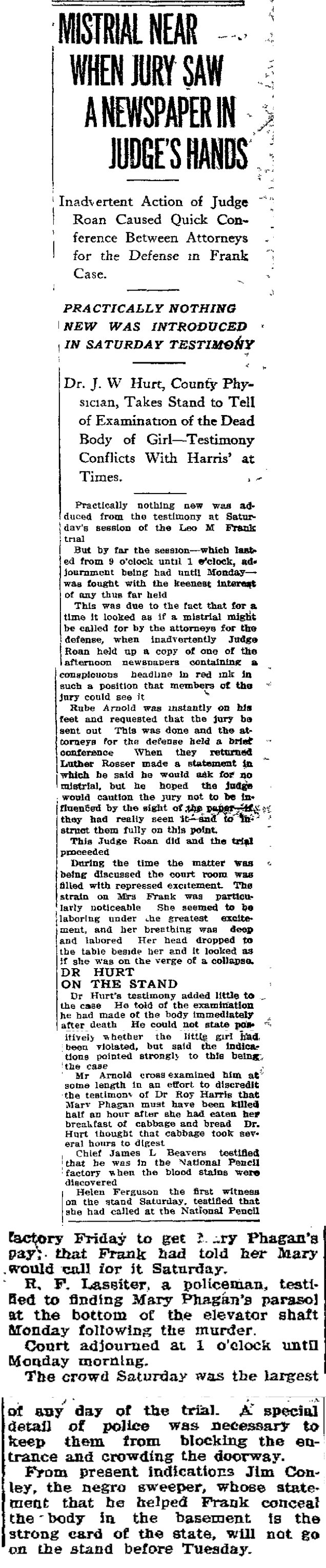
MISTRIAL NEAR WHEN JURY SAW A NEWSPAPER IN JUDGE'S HANDS
Inadvertent Action of Judge Roan Caused Quick Conference Between Attorneys for the Defense in Frank Case.
PRACTICALLY NOTHING NEW WAS INTRODUCED IN SATURDAY TESTIMONY
Dr. J. W. Hurt, County Physician, Takes Stand to Tell of Examination of the Dead Body of Girl Testimony Conflicts With Harris' at Times.
Practically nothing new was adduced from the testimony at Saturday's session of the Leo M. Frank trial.
But by far the session which lasted from 9 o'clock until 1 o'clock, adjournment being had until Monday was fought with the keenest interest of any thus far held.
This was due to the fact that for a time it looked as if a mistrial might be called for by the attorneys for the defense, when inadvertently Judge Roan held up a copy of one of the afternoon newspapers containing a conspicuous headline in red ink in such a position that members of the jury could see it.
Rube Arnold was instantly on his feet and requested that the jury be sent out. This was done and the attorneys for the defense held a brief conference. When they returned Luther Rosser made a statement in which he said he would ask for no mistrial, but he hoped the judge would caution the jury not to be influenced by the sight of the paper if they had really seen it and to instruct them fully on this point. This Judge Roan did and the trial proceeded.
During the time the matter was being discussed the court room was filled with repressed excitement. The strain on Mrs. Frank was particularly noticeable. She seemed to be laboring under the greatest excitement, and her breathing was deep and labored. Her head dropped to the table beside her and it looked as if she was on the verge of a collapse.
DR. HURT ON THE STAND.
Dr. Hurt's testimony added little to the case. He told of the examination he had made of the body immediately after death. He could not state positively whether the little girl had been violated, but said the indications pointed strongly to this being the case. Mr. Arnold cross-examined him at some length in an effort to discredit the testimony of Dr. Roy Harris that Mary Phagan must have been killed half an hour after she had eaten her breakfast of cabbage and bread. Dr. Hurt thought that cabbage took several hours to digest.
Chief James L. Beavers testified that he was in the National Pencil factory when the blood stains were discovered.
Helen Ferguson, the first witness on the stand Saturday, testified that she had called at the National Pencil factory Friday to get Mary Phagan's pay; that Frank had told her Mary would call for it Saturday.
R. F. Lassiter, a policeman, testified to finding Mary Phagan's parasol at the bottom of the elevator shaft Monday following the murder.
Court adjourned at 1 o'clock until Monday morning.
The crowd Saturday was the largest of any day of the trial. A special detail of police was necessary to keep them from blocking the entrance and crowding the doorway.
From present indications Jim Conley, the negro sweeper, whose statement that he helped Frank conceal the body in the basement is the strong card of the state, will not go on the stand before Tuesday.
PAGE 7, COLUMN 1
Resume of Week's Evidence Shows Little Progress Made
Place and Time of the Murder Only Big Facts Brought Out in the Mass of Evidence.
One week of the battle of Leo M. Frank, accused of the murder of Mary Phagan in the factory of the National Pencil company, for his life has elapsed, and his fate is yet a question for future developments to decide.
The first week of the trial has been markedly free from sensations.
The two big facts that the week's evidence would seem to show are that Mary Phagan was murdered in the second floor of the pencil factory, and that she was murdered within one hour after she ate her breakfast at home shortly after 11 o'clock.
The principal features of the week's evidence are as follows:
Mary's Mother Testifies.
The examination of witnesses began with the most pathetic scene in the whole week, when Mrs. J. W. Coleman, mother of the murdered girl, took the stand.
With appealing simplicity the mother told of how her little daughter had arisen on the fatal Saturday morning about 11 o'clock bright and joyous in her childish excitement over going to see the Memorial day parade; of the frugal breakfast of bread and cabbage she had eaten, and of how the little girl had happily busied herself helping her mother by doing this or the other small turn in the housework. At about 12 o'clock little Mary had finished with her chores, and dressed in a light summer frock, as fresh and sweet as a wild rose, sallied forth to meet her fate.
The mother wept gently as she was compelled to recall her little girl's fourteenth birthday, which would have been June 1, and to which she and Mary had looked forward to celebrating with so much pleasure, and as Mrs. Coleman told of the child's beauty, she dwelt tenderly on each feature as if her very heart were breaking once more to caress them.
Identifies Daughter's Dress.
Bearing up wonderfully under the ordeal of beholding once more the frock which she had helped little Mary to adjust before she left home for the last time, Mrs. Coleman identified the dress and the hat with the pale blue ribbon and the tiny bunch of flowers.
Mrs. Coleman was followed on the stand by George Epps, a little "newsy" and a companion of Mary, who had been with her on the street car as she came into the city, and had talked with her about the fun they would have that afternoon when they had promised each other to watch the big parade together.
With his head shaven as smooth and slick as a billiard-ball, George mounted the stand and told his story, boy-wise, in minute detail even to the point of explaining how he could squint one eye at the sun and tell the time of day.
Were Going to Parade.
He testified that Mary Phagan got on the English avenue incoming trolley car with him about 10 minutes before 12 o'clock and that they had ridden together to Forsyth and Marietta streets, when Mary had left him to go to the pencil factory to get her wages and that they had agreed to meet again at 2 o'clock at Elkin's drug store to see the parade. George said that he waited until 4 o'clock that afternoon to meet Mary, and when she did not meet him as she had promised, he had grown tired of waiting and went to the ball game.
George Epps left the stand and Newt Lee, the nightwatchman at the National Pencil company's factory, who discovered the body of Mary Phagan in the basement and reported his grewsome find to the police, followed him. Stolid and stubborn, all negro, and without any refined sensibilities to be hurt, Newt Lee stood the punishment of Attorney Rosser's gruelling cross-examination without a shadow of a qualm, never once departing in any particular from the story he has repeated innumerable times since that gray Sunday dawn when he found the body.
Sent Away From Factory.
Lee testified that, in view of the fact that Saturday, April 26, was a holiday, he had been ordered to report for duty at the pencil factory at 4 o'clock, instead of 5 o'clock which was the time when he was accustomed to report on Saturdays, and accordingly had arrived at the factory a few minutes before 4 o'clock. He found the front door unlocked as usual, but found the door on the stairway leading to the second floor locked.
Lee testified that when he arrived at Mr. Frank's office, Frank met him at the door rubbing his hands saying that he was sorry that he (Lee) had come so early. Frank insisted that Lee go up town and "have a good time," and Lee says that he told Frank that he needed sleep. Frank, according to Lee, continued to insist that he leave the factory, and said that Lee needed a good time. Lee said he could have slept in the packing room of the factory.
When Frank insisted, however, Lee says he left the factory and did not return until 5 o'clock, at which time he found the doors just as he had left them.
Gantt Scared Frank.
Lee said that Frank told him then not to punch the clock as there were some workmen in the building. Immediately afterwards Frank put a punch slip in the clock.
Lee was questioned about the relations between Frank and Gantt on that afternoon, and said that he saw Gantt downstairs about 6 o'clock, when he claimed to be looking for a pair of shoes he had left there when discharged from the factory. About that time Frank came downstairs unexpectedly and when he saw Gantt jumped back a little frightened. Gantt explained to Frank that he came for his shoes. Frank intimated that the shoes had been swept out, but at length allowed Gantt to enter the factory with Lee, at which time Gantt got two pairs of shoes and left. By this time Frank had also left.
About 7 o'clock, Lee said, Frank telephoned to him to know if "everything was all right," which action on the part of Frank had not been done before during Lee's service.
Lee then explained how he had gone to the basement to the toilet about 3 o'clock, and while there saw an unusual object lying on the ground, which he investigated with a smoky lantern and found to be the dead body, which was later identified as that of Mary Phagan. Lee says he then notified the police and tried to notify Frank.
Frank Dropped His Head.
When the police arrived Lee was taken to police headquarters and did not see Frank until he was carried back to the factory about 7 or 8 o'clock.
Lee said when he saw Frank then it was in the factory office and that Frank looked at him and then at the door and dropped his head without saying anything. He testified that N. V. Darley, an official at the factory, examined the time clock and stated that it was correctly punched.
Lee and Frank were then carried to the police station and Lee said that he did not see Frank any more until a night soon after then, when Lee was handcuffed to a chair in a room at the police station and Frank was shut in the room alone with him.
On this occasion, said Lee, Frank looked at him and dropped his head. Lee testified that he (Lee) said:
"Mr. Frank, it's mighty hard for me to be handcuffed to this chair for something I didn't do."
To this Lee said Frank replied:
"We'll Both Go to Hell."
"What's the difference, they've got a man guarding me." Frank then told Lee that he didn't believe that Lee killed the girl, but knew something about it. Lee told Frank that he only discovered the body, whereupon Frank, according to Lee, replied:
"Yes, and if you keep that up, we'll both go to hell." The detectives came in at that time.
Upon cross-examination by the defense, Lee testified that if he had inspected the basement of the building with the regularity required by his instructions, he would have found the body earlier.
Thus, without sensation or the disclosure of a single fact that had not been public property for many weeks, ended the first day of the most famous murder trial in the history of Atlanta.
At the opening of Tuesday's session Newt Lee was again placed on the stand and Attorney Rosser continued his cross-questioning without bringing out further material facts from the watchman.
Girl's Body Found.
Sergeant L. S. Dobbs, the officer who headed the squad which responded to Newt Lee's alarm, went on the stand and stated that when he arrived at the factory Lee was apparently not laboring under excitement, but that he took him in charge and had him direct the officers to the body in the basement. He stated that he found the girl's body lying there face down with blood on the back of her head and with a cord tied so tightly around her neck that it cut into the flesh. There was also, he stated, a piece of underclothing tied loosely around the neck.
The finding of the murder notes was next related as well as of the discovery of the missing shoe and hat and traces of where a body had apparently been dragged along the ground in the basement from the elevator shaft to where the body was lying.
Tuesday afternoon Detective J. N. Starnes was placed upon the stand and testified corroboratory to Sergeant Dobbs' story of finding the body.
Says Frank Was Nervous.
Detective Starnes brought upon his head the gruelling fire of the defense when he stated in regard to telephoning Frank that the superintendent was nervous. A sharp tilt between Solicitor Dorsey and Attorney Rosser ensued, in which the former accused the defense of trying to impeach the testimony of the witness.
This closed Tuesday's hearing of the trial with no material advantage one way or the other since the beginning of the trial.
Affairs took a turn on Wednesday morning, however, which aroused great hopes of acquittal among the friends of the defense when the memory of Detective John Black, who was the first witness of the morning, proved treacherous and his testimony did not pan out as the state had evidently expected.
Mary's Chum Goes on Stand
Photo by Francis E. Price. Staff Photographer.
HELEN FERGUSON.
Who testified that she tried to get Mary Phagan's money for her on Friday, and was told by Frank that girl would come for it the next day.
Black Gets "Mixed Up."
Black admitted that he was "mixed up" and could not recall to mind what he had testified a few moments before. He failed particularly in recalling dates and details in regard to the finding of the bloody shirt at Newt Lee's house.
The solicitor had hoped to prove by Black that he went to Lee's home and found the shirt after Frank had informed him that there were irregular punches on the slip in the time clock, showing that Newt Lee would have had time to go home; that after Frank's house had been searched for incriminating evidence at the suggestion of Herbert Haas, that Frank sought to have Lee's house also searched and that the bloody shirt was a "plant."
Black's answers, however, failed to bear these points out.
Black also failed in recalling the exact time within a few hours when he and Detective Haslett took Frank to the police station on Monday morning following the discovery of the murder.
"Frank Didn't See Body."
W. W. (Boots) Rogers, who went with the officers to the factory at the time the body was discovered and who was subsequently active in the investigation of the case, testified that to the best of his knowledge Frank did not look at the body of Mary Phagan when he was taken to the undertaking establishment where the body was lying, and that he could not, therefore, have known who the dead girl was. Frank had previously testified at the coroner's inquest that he saw the body.
Attorney Rosser resorted to the grilling tactics which had played havoc with the faculties of Detective Black, but was unable to confuse Rogers.
Grace Hicks Identifies Body.
Grace Hicks, who worked at the pencil factory, testified that she had identified the body as that of Mary Phagan on the morning of its discovery. She stated that during the five years she had been employed at the pencil factory she had spoken to Leo Frank but three times. She did not know whether Frank was personally acquainted with Mary Phagan or not.
J. M. Gantt, a former employee at the factory, stated that he had known Mary Phagan for years, his and her family having been neighbors in Cobb county. He recalled that Frank had once asked him:
"You know Mary pretty well, don't you?"
Gantt said that Frank appeared nervous when he went to the factory on Memorial day to get his shoes which he had left there when discharged for alleged shortage in the pay roll.
The feature of Thursday's proceedings was the failure of other witnesses to testify as the prosecution had expected, and introduction of the first new testimony since the trial began.
Mary's Pay Envelope Found.
R. B. Barrett, a machinist at the pencil factory, disclosed the fact that he had found the supposed pay envelope of Mary Phagan near her machine on the second floor. Until Barrett's testimony the question of the pay envelope had been a mystery. Barrett also stated that he had discovered blood stains on the floor near the girl's machine and had found strands of hair on the machine. The blood stains, he said, had been smeared over with some sort of a white preparation. Barrett's testimony, as did the testimony of other witnesses, seemed to bear out the contention of the solicitor that the murder was committed on the second floor.
A surprise was in store for the prosecution when Harry Scott, a Pinkerton detective who had been employed by the defense, was placed upon the stand. Solicitor Dorsey sought to prove by Scott that Frank was nervous the first time he saw him, but contrary to the solicitor's expectations Scott testified that such was not the case. Solicitor Dorsey became somewhat excited at this turn in the detective's testimony and intimated that he had been "trapped." Scott did, however, testify that Frank was nervous at police station. He also stated that either Frank or Darley had told him that Gantt had been very familiar with Mary Phagan.
Defense Wanted Evidence First.
Scott declared that Herbert Haas, one of Frank's attorneys, had suggested to him that the Pinkertons turn over to him all evidence found before turning it over to the police department. Scott said he declined to do this, declaring that he would give up the case first.
Monteen Stover, a former employee at the pencil factory, declared that she was in Frank's office on the Saturday of the murder from 12:05 until 12:10, but that she did not see Frank. Frank has claimed that he was in his office at that time.
Dr. Claude Smith testified that he had examined the bloodstains of the shirt found at Newt Lee's home and the blood found on the pencil factory floor, but was unable to decide whether or not it was human blood.
Elevator Power Box Unlocked.
When E. L. Holloway, an employee of the pencil factory, and the last witness of the day, was placed upon the stand, his testimony also turned out to be not all that was expected of him.
Holloway had previously made an affidavit to the effect that the power box to the elevator at the factory was locked on the day of the murder. But when he testified on the stand he stated that he was mistaken, and that, after all, the power box was not locked at all, but was unlocked.
With the attorneys for both sides greatly ruffled on account of the failure of witnesses to testify as they had been led to believe they would, Thursday's hearing closed. If there was an advantage either way in the day's testimony it was not so favorable to the defense.
The most startling fact brought out on Friday, and probably the most startling fact in the whole testimony given in the trial so far, was that within three-quarters of an hour after Mary Phagan had eaten her frugal breakfast of bread and cabbage she was dead, as shown by the testimony of Dr. Roy Harris, secretary of the state board of health, who made an examination of the dead girl's stomach.
Murdered Hour After Breakfast.
The evidence throws considerable light on the much mooted question of the exact time of the murder.
Dr. Harris exhibited on the stand a small bottle in which were particles of undigested cabbage, which he declared he had removed from the girl's stomach. He declared that the cabbage could not have remained in that state of preservation longer than one hour at the outside while the girl was alive.
Dr. Harris stated that the nature of the wound on the back of Mary Phagan's head seemed to indicate that she had been struck an upward blow. The blow on the eye, he said, looked as if it had been inflicted by a person's fist.
Dr. Harris was unable to testify positively as to whether Mary Phagan had been outraged or not, although he said there were indications that such was the case.
Dr. Harris' testimony had to be discontinued within a few minutes after he took the stand, when he was attacked by a fainting spell as the result of recent illness. His testimony will be resumed as soon as his physical condition will permit.
Says Frank Didn't Eat.
The testimony of N. V. Darley, assistant superintendent of the pencil factory, who followed on the stand, was to the effect that Frank was very nervous on the morning following the murder, but on cross-examination Darley also testified that he had on two other occasions seen Frank equally as nervous.
Albert Mc Knight, husband of Frank's cook, stated that he had seen Frank in the dining room of his home when he came home for lunch on the day of the murder, but that he did not see him eat anything.
There were several other witnesses who testified to minor details.
PAGE 7, COLUMN 3
Condition of Girl's Body Described by Dr. J. W. Hurt
Dr. J. W. Hurt, county physician, who examined the body of Mary Phagan, took the stand following Detective Waggoner. Dr. Hurt not only made an examination on the Sunday morning that the body was found, but he was present several days later when the girl's body was disinterred at Marietta by Dr. Roy Harris.
"How long have you been a physician?" asked Solicitor Dorsey after he had put the formal questions to establish the physician's connection with the case.
"Since 1884."
"What are your duties as county physician?"
"To attend all inquests and examine the bodies of the dead."
"Did you see Mary Phagan's body?"
"Yes."
"Where did you first see it?"
"At P. J. Bloomfield's undertaking establishment on the Sunday morning that the body was found."
"Describe its condition."
"I was called to the undertaking establishment about 9 o'clock and saw the body then. There was a scalp wound on the left side of the head about two and a half inches long and about four inches from the left ear.
"The wound went through and touched the skull and there was a small part of the skull exposed. The right eye was black and contused. There were minor scratches on the cheek and a slight contusion on the forehead, but the skin was not broken there. The tongue protruded about two inches from the mouth.
"There was also a wound on the left leg about two inches below the knee," he continued, "and this wound was 3x1 inches in size. There were also superficial scratches on the left elbow."
Death From Strangulation.
"There was a cord around the neck that left its impression on the skin and my belief is that the girl died from strangulation. I saw another bruise on her right leg also."
"Look at this cord and tell if this looks like the one to which you refer," said the solicitor, extending the cord that was taken from the girl's neck.
"This looks like the cord that was around her neck."
"In your opinion what kind of instrument was it that caused this strangulation?"
"The cord around the neck, sir. There was another piece of cloth that was lying loose from her chest and around the hair. This cord was next to the skin under the hair and it had indented itself in the skin it was so tight around the neck."
"How deep was the indentation around the neck?"
"Well, sir, it was very marked, nearly burying the cord."
"Do you see that knot there in the cord?"
"Yes, sir."
"Was there, or not, any impression there indicating that that had been indented?"
"There was, sir."
"Where was that?" asked Mr. Dorsey.
"It was on the inside of the neck."
"Was there, or not, any swelling in the neck?"
"There was."
"What did that indicate, doctor?"
"It indicated that there was quite a good deal of contusion there, or swelling over the parts, from the strangulation," the witness replied.
"I will ask you as to whether or not that was done before or after death?"
"What, the cord?" Dr. Hurt asked.
"Yes."
"It was done before death, sir."
"In reference to this 2 1-2-inch wound, was there anything to indicate it was done before or after death?"
Blunt Instrument Used.
"Well, this wound, if you will allow me to describe it a little more minutely, seems to have been made by a blunt-edged instrument of some sort, and the blow was from down, upward. The scalp in the upper part of the wound was loose from the skull, which shows that the lick was coming this way and it seems to have been made with a blunt-edged instrument of some sort."
"Well, now, is it your opinion that that was made before or after death?"
"Now," interrupted Mr. Rosser.
"This scalp wound?" the solicitor continued.
"Yes."
"Before death, sir."
"What effect would you say that wound had on the girl?"
"I would say it was calculated to produce unconsciousness."
"Was there or not much blood?"
"I did not see very much blood, sir."
"Doctor, describe anything you found around the eye area."
"The right eye was black and blue, contused, skin not broken."
"What would that indicate to your mind. That it was done before or after death?"
"Before death, sir."
"What character, or what kind of instrument? Could you tell what kind of instrument that was probably made with?"
"I would say it was made by some soft instrument, although the skin was not broken it was contused."
"Could or not the fist have produced that kind of contusion?"
"Could have, sir."
Face Scratched After Death.
"What about any bruises or scratches on the face?"
"There were a good many bruises or scratches on the face, sir; around the cheek, above the cheek and forehead."
"Give an opinion as to whether these scratches were made before or after death."
"I would suggest, sir, they were made after death."
"Why do you say that, doctor?"
"I did not see any blood, sir, that went through the dermis."
Here the solicitor entered into a detailed description of the girl's condition through the testimony of the witness, who after stating what he had found by an examination that morning, declared that he was not in a position to say whether or not the girl had been violated. His testimony was to the effect that she had, but to this he added the statement that as far as his examination had carried him, he would not state positively either way. Certain facts that he stated seemed to bear out the testimony of Dr. Roy Harris in this respect.
Arnold Cross-Examines.
After this Attorney Arnold took up the cross-examination. He dwelt on the same subject for quite a while, and succeeded in making Dr. Hurt state that he was even less positive as to certain evidences of violation than had been brought out in his direct statement.
The attorney then took up the question of the girl's death.
"What part of the anatomy would show the results of strangulation?" he asked.
"The lungs and windpipe, sir."
Dr. Hurt, with the air typical to what the New Yorkers call the "Professional Southerner," nearly always prefixed or added the "sir" to his remarks, and gave it the soft slur of the south.
"Would the lungs show congestion in case of strangulation?"
"Yes."
"Are the lungs the only sure test?"
"No, sir, I wouldn't say that they are."
"This witness has shown," objected Mr. Arnold, "that the process of digestion depends entirely on mastication. This cabbage may have been in the stomach in the same shape in which it was chewed. The question is not borne out by the evidence. The girl may not have chewed the cabbage and the question is unjust and unfair."
"Had rigor-mortis set in?"
"Yes, sir."
There was then a number of questions and answers in regard to rigor-mortis and the varying time with which it may set in on different subjects and under different conditions.
"Can you account for the blood on the undergarments by the presence of any superficial wounds?"
"There were no superficial wounds."
"Was there any mutilation of the body, except what you have described?"
"There was not, sir," replied the physician, setting at rest the various rumors in regard to mutilation of the child's body.
"Would you say that the girl had been violated?"
"I would not say yes or no."
Dr. Hurt then went into detail on this subject and stated certain indications which might show that she had been so treated, while at the same time, he indicated that these facts did not necessarily show that it had occurred.
Saw Harris Make Post-Mortem.
"Were you present when Dr. Harris made his post-mortem examination?"
"I was."
"Did he examine the lungs?"
"Yes."
"Tell us all of the body that was taken away."
"I took away none myself; but Dr. Harris removed certain parts."
The witness then told that Dr. Harris had removed portions of the stomach and intestines and other organs for his examination.
"Was the body swollen at that time?"
"Slightly so, I think. It was in about the same condition as when I first saw it at the undertaker's."
"Had decomposition set in?"
"I don't think it had."
Time Needed for Digestion.
"Cabbage is one of the hardest things to digest, isn't it?" added Mr. Arnold, referring to the contents of the girl's stomach.
"Yes," answered the physician.
"It takes some people longer to digest it than others?"
"Yes."
"Don't you know that completely masticated cabbage takes from three to four hours to digest?"
"Yes, I think so."
"Badly chewed food, of any kind, takes longer to digest, doesn't it?" asked Mr. Arnold.
"Certainly, sir."
"Suppose, then," said the lawyer, "that a child eating a meal hurriedly in order to catch a car and go uptown had taken into her stomach a piece of cabbage not chewed, as children frequently do, wouldn't it take longer for her to digest that than the three or four hours usually taken to digest well-chewed cabbage, and don't you think it a very wild guess for a physician to undertake to tell by the contents of the stomach exactly how long it was between the time of eating the food and the time that death occurred?"
Mr. Dorsey promptly objected to Dr. Hurt giving any opinion as to what his opinion might be of Dr. Harris' deductions and Judge Roan held that he could not be allowed to give it.
After some parley Mr. Arnold then asked: "When a person becomes unconscious does the digestive process keep up?"
"I don't think so."
"If a person ate something and then went to sleep the digestion would go on, wouldn't it?"
"Well, why wouldn't it go on if a person became unconscious? Unconsciousness and sleep are similar in their relation to the nerves, aren't they?"
"Well, the effect that renders a person unconscious has the effect of paralyzing the digestive or gastric juices," Dr. Hurt replied.
Dorsey Again Objects.
Mr. Arnold again entered into a series of questions to have Dr. Hurt say what was his opinion of the Harris testimony and Mr. Dorsey continued his objections, declaring that it was illegal for one physician to be put up to discuss the deductions of another.
Judge Roan ruled out all actual criticism of another witness, but declared that Dr. Hurt might answer hypothetical questions in this matter and thus give his own opinions of the possibility of drawing the deductions.
Mr. Dorsey then placed in evidence the two bottles, one containing particles of the cabbage taken from Mary Phagan's stomach and the other containing parts of cabbage taken from the stomach of a man one hour after his eating it.
"If this cabbage had been in the stomach one hour," said Mr. Dorsey, holding up that taken from a man's stomach, "how long do you think this other had been in?"
"What is the question?" asked the judge.
"Mr. Dorsey says," replied Mr. Arnold rather sarcastically, "that if this mixture was of cabbage and bread, how long would it have been in the stomach after having been pumped out?"
Mistrial Is Threatened.
The jury was then given a few minutes intermission and both judge and jury left the court room. After the jury returned Judge Roan came in with a newspaper in his hand.
"Mr. Arnold says," stated Mr. Dorsey, all the facts are not embodied in the hypothetical question, but I say that Dr. Hurt is an expert and should know if he has enough facts given him upon which to make a deduction and state his opinion. If there are not enough facts and yet Dr. Hurt goes on and gives an opinion the defense can bring that out, as they certainly will try to do, and the jury can decide on it."
At this juncture Attorneys Rosser and Arnold went up to the judge and spoke to him in a low tone. Then they went out together, shortly followed by Attorneys Herbert Haas and Stiles Hopkins. An air of mystery invaded the courtroom. The attorneys for the defense would say nothing to the newspaper men and Dorsey and Hooper declared that they wished the newspaper men would find out for them what it was about.
"We are going to make a statement to the judge," Mr. Rosser finally declared, and then he and Mr. Dorsey both talked to Judge Roan so quietly that their voices could not be heard.
By this time spectators who had craned and stretched their necks off during parts of the testimony, exerted themselves still further.
The jury was then sent out at the request of both sides and Attorney Rosser addressed the judge.
"Your honor," he said, "a moment ago when you came into the courtroom you carried in your hand a newspaper which you had probably been reading and in coming in you held it so that the jury could see it. In box-car letters of red ink it bore across the top words to this effect, 'State adds links to case.'"
Mrs. Frank Breaks Down.
At this moment Mrs. Frank, who had hitherto held up during the trial and who during the day had renewed her previous habit of glaring at Solicitor Dorsey while he was speaking, broke down and began to sob. Her bosom heaved and she finally threw herself slightly forward and gave way to her tears.
"I know that your honor would not jeopardize this case for anything," added Mr. Arnold. "We all know you and your reputation far too well to think that, but the jury had an opportunity to see that head line and, as we all know headlines do not always tell the facts clearly. For instance, in this case the head line states that the state has added new links and while the offense may claim them to be strong ones, we deny it and claim that the reading of the body of the story will show that, for the newspaper men here have certainly acted fairly in the matter of handling this case. Now the jury will have no opportunity to read the body of the article and we think something should be told them to keep them from being influenced by what they saw.
"We are not going to ask a mistrial, but we want something said to them."
"I want your honor to put in writing so there can be no mistake about it, that the jury is to put no faith in a headline," said Mr. Rosser.
"We deny that the jury saw this headline," stated Mr. Dorsey, "but we
Continued on Page Three.
PAGE 13, COLUMN 1
CONDITION OF GIRL'S BODY DESCRIBED
Continued From Page One.
also want to go into other features of the newspapers. In going to and fro from their headquarters in the Kimball house the jurymen frequently have papers thrust before their eyes by newsboys, and they also see them in the hands of people on the street, and for several days the newspaper accounts of this trial have put the state's case as decidedly light and faulty.
Dorsey Criticises Newspapers.
"In fact, your honor, I think that the papers have been so prejudiced in the matter that they have committed contempt of court. We want you to take up the entire situation in regard to the jury having seen newspapers."
"I will state to the jury," answered Judge Roan, "that they are not to pay any attention to what they may have seen in the papers, or, in fact, to anything that they have seen or heard in any way but in sworn evidence."
The jury was then called back, and Judge Roan explained the situation to them.
"Gentlemen," he began, "you know that in the case that you are trying that we must all be extremely careful to decide it only on evidence regularly and legally admitted before the court, and on nothing else. It has been suggested that you may have seen some writing in the papers which might influence you in your decision, and now I desire to remind you that nothing you may see in the papers about this can be allowed to influence you in any way. You are to try this case on sworn evidence only."
Examination Again Taken Up.
Mr. Dorsey then took up again the examination of Dr. Hurt.
"Have there, or not, been cases of blows on people's skulls where death did not ensue?" he asked.
"Yes," replied the witness.
"What process of the body is delayed by unconsciousness?" asked Mr. Arnold, who took up the cross-examination again.
"Is the nervous system delayed and what else?" he continued.
"The nerves of sensation and emotion are delayed," replied the witness.
"Isn't it the same as in sleep?"
"Yes, to a certain extent."
After discussing still further the effect of unconsciousness and of sleep upon the nerves, Mr. Arnold entered upon detailed questioning in regard to Mary Phagan's condition upon the day that she was murdered.
"You saw a discoloration on the right eye?" he then asked.
"Yes."
"Well, don't the nerves cross from the right side of the front of the head to the left side of the back?"
"Yes."
"Doesn't a blow on the back and to one side of the head sometimes cause the eye on the other side to become blackened?"
"Yes."
Mr. Arnold then took up in detail again the girl's physical condition on the day. At 12:10 Dr. Hurt was excused.
PAGE 13, COLUMN 1
"Break" in the Frank Trial May Come With the Hearing Of Jim Conley's Testimony
By Britt Craig.
Jim Conley isn't a cornfield negro he's more of the present-day type of city darkey and that's the only difference between him and Newt Lee. Outside of that there is but little variance.
However, Jim's ancestors hoed cotton and plowed bottom lands long before Jim had any idea of existing. He's got the good, old country strain in him and he's as black as tar.
Some folks say he'll make a witness as good as Newt, and others say he won't. That all remains to be seen. One thing is sure! There'll be plenty of pyrotechnics when he begins to show whatever kind of witness he is.
Jim is the hinge of the Frank case. His testimony is expected to swing it one way or the other. If his story sticks and he is as firm as he has been thus far, things will look quite melancholy for the white man. If he falls down, as the defense expects, then Lord help his neck.
It's a question of Jim Conley or Leo Frank with Jim Conley's testimony as the scales.
As has been said, Jim's complexion is not unlike the ace of spades and his features are coarse. He is as full of native dialect as Newt Lee, and those who heard Newt will agree that that is a whole lot.
Particular About Details.
He talks slowly and deliberately with a kind of African drawl and some of his vocabulary is so peculiarly "niggerish" that it is hard to distinguish, at times, what he means. He isn't bashful, by any means, and has Newt Lee's aptitude for unconsciously running over the other fellow's rights when contradicted.
He'll squabble over a "junebug" and "lightningbug" illustration just as quickly as Newt contradicted Attorney Rosser when that lawyer called his pet light out of its name.
Friday afternoon kind-hearted police authorities took Jim from his cell and gave him a bath. They took him into the back yard where nobody could see, it is said, and turned a liberal hose on him.
They scoured and scraped and scoured and scraped and had him as shiny as the brass trimmings on a 1914 model auto. Then they took him back into the prison and sicced a negro barber on him. The barber shaved his head and his face until it was as slick as an egg.
Jim has an eye for immaculateness. It was his desire to look "p'sentubble" that caused his arrest when he washed out his faded blue shirt in the pencil factory in preparation to attend the coroner's inquest that afternoon.
Watchman Holloway, who had an eager eye out for clues and anything else that might throw light on the murder that had been committed the preceding Saturday, saw Jim performing his meager washing. Maybe Jim's shirt was bloody and that was why he was washing it! Maybe there was something else that! Maybe there was anything! Maybe Jim knew something of the murder!
He called the police, and Jim, shirt and all, were taken to headquarters! From that time until the last Friday afternoon, he has remained in prison shaveless, haircutless, but quite content with the buffetings of Fate.
Has Dropped His Swagger.
Jim was born in the country and raised in the city. Although there is still within him the vein of bucolic manners and ignorance, he has contracted quite a bit of city airs and city ways that are to his detriment.
One of these is a swagger which he used to assume, but, very likely, has dropped completely during the past few months. Another is a rising admiration of himself and a feeling of superiority that is as common to the city-bred negro as his love for ham. Recent reports, however, say that Jim has lost these weaknesses and has satisfactorily reverted to type.
Then, too, Jim, like most city-bred negroes, is a bit vain. He doesn't hate himself, by any means. He considered himself "some bear" with the women folks, and it was with the probable expectation that he might meet some of his 'ladies of color' at the inquest that he washed the shirt that caused his arrest.
Police officials and Jim's attorney say that they have been unable to budge him in his story, and that he sticks to it as firmly as a leech. They hopefully expect him to hold up on the stand. They say that it isn't the rough, battering kind of tactics that elicits information from him, but kindness and gentleness.
During the rigorous third-degree under which he was put at police headquarters for a solid week, the detectives hammered and hammered on him in vain. They could easily tell that he had a secret, was withholding something and was doing a good job on the withholding, but as long as they blazed upon him with police fury, he was as adamant as a new tile sidewalk.
When He Told His Story.
When somebody suggested gentle tactics and scientific procedure upon the negro, and forthwith inaugurated these methods, Jim's story began coming, bit by bit, and eventually spilled out as though the bottom had dropped. He "kicked in" with the whole business.
It is either a question of pride or vanity or sulkiness with Jim. If you pounce upon him and try to shake it out of him, like shaking a fox terrier loose from a bone, he'll talk just about as freely as he'd submit to an unnecessary pulling of a back tooth.
But, if Jim is approached gently and scientifically, he'll rattle away like a 1907 Gazump pulling Hunter street on low gear. The prospects are that he is going to be a witness as interesting as Newt Lee. Not that he already is. In fact, more interest centers on him than on any other of the case, purely because of the importance of his testimony. But, from a standpoint of character, fortitude and deliverance, speculation is wide and varied.
It all remains to be seen.
Jim Conley never was so important before.
The odds are he wishes he never had been.
PAGE 13, COLUMN 4
Guardian of Order at Trial
Photo by Francis E. Price, Staff Photographer.
OFFICER "BILL" PAYNE.
PAGE 13, COLUMN 4
Detective Waggoner Describes Extreme Nervousness of Frank
City Detective D. L. Waggoner was called to the stand following Miss Ferguson. Attorney Rosser immediately raised the objection that he had been in the court room and the solicitor declared that he did not know whether or not the detective had. Waggoner stated that he was present for about 20 minutes Wednesday.
"He was not sworn and put under the rule," explained Solicitor Dorsey, "because I did not know that I would need him."
The defense made no further objection and the examination began.
"How long have you been on the force, Mr. Waggoner?" the solicitor asked.
"About four years, in all."
"Where were you on Tuesday, April 29?"
"From 10:30 to a little after 11 that morning I was in front of the National Pencil factory."
"Did you see Frank?"
"Yes."
"What did he do?"
"I was standing on the sidewalk across the street and saw him repeatedly come to the window and go back. He would look down and repeatedly twist his hands. He walked to the window and back in his office out of my sight about twelve times in the half an hour I stayed there."
"Was Frank nervous when you were with him?"
"Yes, on the way to the station house I rode in the auto with him and Black and Starnes and all the way down there his legs were trembling just like that."
The witness held up both hands and made them quiver and shake.
Mr. Rosser then began the cross-examination.
"Frank sat between you and Black, didn't he?"
"No, not between us; I was next to him, though."
"Did you see any other people in the office when you were looking at Frank from the street below?"
"Yes."
"Who were they?"
"I don't know who they were."
"Did you go there to arrest Frank?"
"No, I was sent there to watch the factory and keep a general lookout."
"Did you know he would be arrested?"
"No, I didn't know it, but I thought he might be."
Waggoner was excused from the stand after this.
PAGE 13, COLUMN 4
Fixing Hour of Girl's Death Through Aid of Modern Science
The Prosecution's Greatest Aid
By Britt Craig.
When Mrs. J. W. Coleman, mother of Mary Phagan, related a simple story on the witness stand the first day of the Frank trial of the slain child's frugal meal of cabbage and biscuit which she ate upon leaving home that fateful day, she paved the way for the most thrilling development thus far in the entire case.
Her story was as devoid of thrills as any yet told. It was an ordinary recitation of a common meal and told in the mother's plain, simple manner. Had she not broken into tears her connection could have been completely devoid of interest, except for the fact that she was Mary Phagan's mother.
But her statement of the meal the murdered child had eaten, prepared an opening for the startling testimony of Dr. Roy F. Harris, the state chemist, who testified that the cabbage found in the stomach, and which Mrs. Coleman stated the child had eaten at the noon meal, indicated that she had met her death within 45 minutes after eating.
And another extraordinary incident for which the trial has been peculiarly noted: The biggest thrill of the case was created by two ordinary vials that looked as though they had once contained substance no more interesting than household vaseline, which were produced by Dr. Harris the vials containing the 160 cubic centimeters of cabbage removed from the girl's body.
Morbid Curiosity of Audience.
There was a straining of necks. Many arose from their seats. Women and girls looked on eagerly, expectantly, intent upon missing none of the details. A silence prevailed that could almost be felt and only the buzzing of the fans and ozonators could be heard.
Dr. Harris' testimony was grewsome harrowingly so. An air of tragedy pervaded the room as he spoke in the terse, crisp words of the medical expert. As he spoke of exhuming the body at dawn in the little Marietta grave yard and of cutting into the child's skull to examine the brain, there were visible shudders throughout the crowded room. Many women left their seats, walking hurriedly to the exit, hiding their features with newspapers.
When Mrs. Coleman told of Mary's last meal many wondered why the solicitor introduced such apparently trivial evidence. It irritated them to listen to such unimportant statements while there were more thrilling ones to follow. Inwardly they, no doubt, rebuked the prosecutor for dallying with such a story.
But a lasting lesson was learned upon the introduction of Dr. Harris a lesson of how big sometimes are the infinitesimally small and seemingly inconsequential things of life and mystery.
The trend of modern science is graphically shown in this particular phase of the Frank trial. It forces one to believe that, sooner or later, the secret will be learned from the Sphinx, and the world will know the moon's inhabitants. Dr. Harris' testimony indicates that Mary Phagan's last meal her cabbage and biscuits will reveal almost the exact minute of her end.
When the Dead Do Tell Tales.
This is, undoubtedly, the most effective adaptation of science to any trial in the history of Georgia. Chemistry has played important roles in modern trials, and so has medicine, but not once in the records of Georgia justice has it been employed in an effort to prove the exact time of murder.
They say the dead tell no tales. That was said a long time ago, some early philosopher, probably, who lived in a period when science was in swaddling clothes. It is true enough, but should be changed. Dead men speak no tales, would be better, for it is about to be proved that the corpse of Mary Phagan is disclosing the hour of her death.
Probably the discovery of Dr. Harris' was a result of infinite thought and patience. Probably it was an accident. Anyway, he exhumed the body of the murdered child, examined her stomach and found the undigested cabbage. His medical knowledge told him of the length the digestive organs require to act upon this certain vegetable, and this same knowledge told him of how long it had been within the stomach before death.
He informed the solicitor and the solicitor learned from Mrs. Coleman the exact hour at which Mary ate dinner. From this summing up of conditions and circumstances and science, Dr. Harris gathered that the girl had been slain not more than forty-five minutes after she had quit the meal.
It is very simple, but a product of science. Mrs. Coleman's simple tale of Mary's dinner of cabbage and biscuit was the genesis of the most scientific move made in a courtroom in Georgia's history. It was the first link, and without it, the other links could not have been attached to the chain.
But, as is characteristic of the typical courtroom audience, it fretted at such obviously unnecessary testimony relating to what a child ate for dinner.
PAGE 13, COLUMN 6
Finding of Dead Girl's Parasol Is Told by Policeman Lasseter
Following Chief Beavers the name of Detective Bass Rosser was then called, but he was not present and Policeman R. F. Lasseter was put on the stand.
"Did you go to the National Pencil factory on Sunday morning, April 27?"
"Yes."
"Did you ever see this parasol before?" asked the solicitor, holding up the parasol which was found in the elevator shaft and identified as Mary Phagan's.
"Yes, I found it that morning at the bottom of the shaft."
"What else did you find? Any other wearing apparel?"
"No."
"Well, did you find anything else?"
"Yes, some twine."
"You saw evidence of something having been dragged near there, didn't you?"
"Yes."
"Traced it back to the foot of the ladder?"
"Yes."
"Didn't you tell the coroner that you traced it nearly to the foot of the ladder?"
"No, I don't think so."
"Didn't you pass by that back door on the alley about 1 o'clock that Sunday morning?"
"Yes, but I didn't shake the door."
"How did you get down into the basement when you first went there that Sunday morning?" asked Mr. Dorsey when Mr. Rosser stopped.
"Went down the ladder."
"Did you see the elevator run before you found the parasol?"
"No."
Lasseter was then excused and Sergeant L. S. Dobbs, who had previously been used by the state, was called upon. He did not respond and court was adjourned until 9 o'clock Monday morning.
PAGE 13, COLUMN 6
LOTS OF EASIER WAYS TO EARN
Frank Jury Under Lock and Key Today
$2 A DAY THAN BEING A JUROR
This business of being a juror in an important trial isn't what it's cracked up to be not by any means.
Having to submit to enforced, though temporary, confinement, to restriction on all sides, to a deputy sheriff censoring your mail, your literature, your notes and to walking side-by-side in a kind of convict-like line on constitutional meanderings isn't worth any $2 a day, after all.
This Sunday will be a day of rest for them, all right, but that's the trouble too much rest. All that this dozen good men and true will be allowed to do this glorious Sabbath will be to lounge around the room in which they are confined, to read censored literature, censored mail, to play censored games and to take a censored stroll.
Deputy Sheriff Plennie Miner is in charge of them. Not a note gets by Plennie without his eagle eye sees whether or not it pertaineth to the Frank case. Not a letter, not a magazine, not a thing.
Even the shells of the jurors' hard-boiled eggs in the morning are inspected for possible script that might relate to something or other, it ought not.
The harem of Kalem al Sheik whoever he chanced to be was not guarded more zealously than the jury in the Frank case.
But that's something he asked not to be published. You who read it, for Plennie's sake, don't tell Mrs. Miner.
The newspapers asked Plennie what he would do when it came to censoring that portion of the jurymen's mail that bore a pinkish complexion and exuded a subtle aroma of perfume that men don't put in business correspondence. He was non-committal, saying only that: "He didn't reckon they'd get any of that kind."
The Frank jury can do nothing today, but read and talk to one another, play an occasional card game if it's sufficiently censored and take a carefully-guarded stroll along the boule They are incarcerated you might call it incarceration, for that's what it is equivalent to in two wide adjoining rooms in the Kimball house. The connecting doors are swung open, and it is converted into practically a single apartment. Here they sleep, eat, read and do all other censored things under the censorship of Deputy Plennie.
Some time this afternoon the jury will take a walk. It will be a short one and a guarded one. They will stroll through the uptown district and not outside of police protection. Alongside of them will walk grim-visaged deputies with determination on their faces, pistols in their pockets and a gnawing appetite for any outsider who wants to start something.
They can't read newspapers the jurors can't. They can't read anything that relateth to the trial in which they are serving. Judge Roan read the riot act on that sort of stuff Saturday morning when he unwittingly came near getting the state and defense into a battle royal by handling a newspaper on the bench.
There are a lot of easier ways of earning $2 a day than being on a jury.
Who said anything about manicuring cobblestones on a sun-broiled highway?
PAGE 19, COLUMN 1
Girl Asked for Mary Phagan's Pay But Was Refused by Frank
Miss Helen Ferguson, formerly employed at the National Pencil factory, but now working for Marcus Loeb and company, was the first state witness put on the stand Saturday morning.
She proved to be a little girl in short dresses with her hair hanging in two braids down her back. Her age she gave as sixteen. On the stand she was rather timid and answered questions in an almost inaudible voice, but replied positively to each one. She was only kept on the stand about fifteen minutes.
For two years previous to the murder she declared that she had been working for the National Pencil factory.
"Did you see Frank on April 25, the Friday before the murder?" the solicitor asked after the usual introductory questions of her age and identity.
"Yes," she replied.
"At what time?"
"At about 7 o'clock in the evening."
"What was said?"
"I asked Mr. Frank for Mary Phagan's money."
"Well, what did he say?"
"He told me that I couldn't get it; that Mary would be there Saturday and she could get it, then alright."
"Had you ever got Mary Phagan's money for her before that?"
"Yes, on two occasions."
"From Frank?"
"No, from other people there."
Mr. Rosser here took up the cross-examination.
"When you got the money before, you got it from the man paying off, didn't you?"
"Yes sir."
"Didn't you ask for it by number?"
"Yes."
"Did you on that occasion?"
"No sir; I had forgot Mary's number."
"What time did you say it was?"
"About 7 o'clock."
"Was anybody else in the office?"
"Yes, two men, but I don't know their names."
"Wasn't one of them Mr. Schiff?"
"I don't know."
"You work in the same department with Mary Phagan?"
"Yes."
"How old are you?"
"I'm sixteen, or I was sixteen last February."
"What office was Frank in when you went to see him?"
"In his office."
"There are two offices there; I mean which one was he in?"
"Oh, he was in the inner office."
"Some gentlemen with him; talking to him?"
"Yes."
"How often had you been there before?"
"Two times," the little girl replied.
"Ever see Mary Phagan there?"
"No, sir."
"Did Frank know your name?"
"I don't think he did."
Mr. Dorsey, on his opponent's conclusion, again took the witness.
"Who paid you off that Friday?" he asked.
"I don't know, sir."
"What did Frank say when you asked for Mary's money?"
"He said she'd be there Saturday and could get it then."
"That'll do" said the solicitor and the witness was excused.
PAGE 19, COLUMN 1
Good Order Kept in Court By Vigilance of Deputies
Despite the throng that has gathered each day around the courthouse where a man is on trial for his life, and despite the number of people who have crowded in to fill every seat, there has been on the whole good order in the courtroom, due to the vigilance of the deputies in charge.
Photo by Francis E. Price, Staff Photographer.
PLENNIE MINER.
Sheriff C. W. Mangum sits daily in the room and with him are practically every deputy and bailiff that the courtrooms afford. To handle the large crowd and to take care of the entrance all of them are needed. In charge of the men is a deputy who has figured in practically every sensational trial in Atlanta for a number of years and whose knife with which he raps for order and tiny rose which he wears on his lapel are known to every court attendant in Atlanta. He is Plennie Miner, deputy sheriff in charge of the criminal division of the Fulton superior court and a master-craftsman in handling crowds, enforcing order and yet doing it in such a way as to avoid giving offense.
Liddell Second in Charge.
Drew Liddell, another one of the sheriff's deputies, is second in charge, and there are in addition a number of city and county policemen who keep the crowds on the outside from clustering around the doorway.
The task that the deputies have is a big one each hour on account of the interest in the case and the length to which some of the spectators will go to obtain a choice seat. Should one of the lawyers or others directly interested in the trial leave his seat inside the railing for a moment some one is sure to watch for the deputy nearby to turn his back and then make a sudden dive for that seat. When one of the newspaper men goes to the telephone the same thing nearly always happens, and to prevent disorder and keep things moving the deputies have to keep constantly on the alert.
That it is only a certain element that will do this, of course, makes it easier for the men upon whom devolves the duty of keeping order, for if every one were like the husky that climbed through the window the other day, the task would indeed be hard.
Deputy Miner's Statement.
That the deputies appreciate the efforts of a great number of the spectators to keep order and desire to ask that others do the same is shown by the statement which Deputy Miner gave out Saturday:
"As the first week of the Frank trial is nearing an end, I desire to express the gratefulness I feel to the public for its kind consideration of the conditions and circumstances which have crowded the place daily.
"Only 250 persons can be seated in the improvised courtroom, and the public, realizing this fact, has refrained from attempting to attend the sessions. Of course, the place has been filled each day, but not to overflowing.
"Sheriff Mangum has been in constant attendance, with all the deputies of his staff. Attached to this force has been a sufficient number of officers from other sources. The county police also have been an invaluable aid to handling the crowds. I wish to extend thanks to the city police, without whom we would probably have suffered.
"But, above all, the public, realizing the situation, has acted in such a considerate manner that I wish to give my sincerest thanks to every one who, for a single instance, contributed one iota toward our assistance.
"Gratefully,
(Signed.) PLENNIE MINER."
PAGE 19, COLUMN 1
Chief Beavers Tells of Seeing Blood Spots on Factory Floor
Police Chief James L. Beavers followed Dr. Hurt upon the witness stand. Mr. Rosser immediately asked him if he had been in the courtroom, as he had not been named by the state when other witnesses were named, sworn and put under the rule. He replied that he had for a short time and Mr. Dorsey explained that in the beginning of the case he had no intention of using him.
"Were you present at the National Pencil factory on the Monday following the finding of the dead girl?" asked Mr. Dorsey.
"I was there not on Monday, I believe, I think it was on Tuesday," he replied.
"Did you see the area of the floor around the girls' dressing room?"
Mr. Rosser then arose and declared that he did not think that the court should allow Mr. Dorsey to get Chief Beavers in as a witness merely on his statement that at the time the other witnesses were sworn and put under the rule that he did not know he would need him.
After some further parley Judge Roan allowed him to go on testifying.
"Well, did you examine the area of which I asked?"
"Yes."
"What did you see?"
"I saw spots of blood."
"What size?"
"There was a spot about the size of a quarter and there were other and smaller spots leading towards the door."
"Describe the blood."
"Well, it was just ordinary blood."
Mr. Arnold then took up the cross-examination.
"Hadn't the spots been chipped up early Monday?"
"Well, I think that they had, but I know that I was there when they were chipped up."
"You must have been there and seen them on Monday then, rather than on Tuesday."
"Maybe so, I may be mistaken about the exact day."
"Who else was present?"
"Starnes and Campbell and another man who chipped the blood spots up."
"Do you know Mr. Barrett?"
"Well, yes, in fact, I believe he is the man who chipped up the spots but I never saw him before that day."
The witness was then excused.
PAGE 19, COLUMN 3
DORSEY PLEASED WITH PROGRESS
Solicitor Will Put Dr. Roy Harris on the Stand Again on Next Tuesday Afternoon.
While Solicitor General Hugh M. Dorsey declined to make an expression of what he believed would be the outcome of the case against Leo M. Frank, which he has been prosecuting all the week, he expressed himself yesterday afternoon as thoroughly satisfied with the present progress.
The solicitor held an extended conference immediately after court adjourned with his assistant, E. A. Stephens, and with Attorney Frank A. Hooper, who is aiding him, and together with the lawyers went over what had been done and mapped out their program for the coming week.
With the attorneys were detectives J. N. Starnes and Pat Campbell and others who have assisted in getting up the evidence and working the preparation of the case.
Dorsey Well Pleased.
The solicitor asked for his opinion of the outcome, based on the evidence he had already placed before the jury and on what he expects to use before he closes his side. He declined to say what he thought about the outcome, but stated that so far he was well pleased and satisfied with what had been done.
"Will you put Jim Conley on the stand this week?" he was then asked.
"Well, I'm not in a position to say right now whether I will or not," he replied.
It is the general belief, however, that the solicitor intends to use Conley during the early part of the week, should nothing unforeseen prevent it, and also that the importance which is attached to Conley's testimony or failure to testify is sufficient to prevent the solicitor from being in position to make a definite statement one way or the other.
During the afternoon Mr. Dorsey called Dr. Roy Harris over the telephone and made arrangements for him to continue his testimony at 2 o'clock Monday afternoon. Dr. Harris was on the stand Friday and during his testimony, which is considered exceedingly strong for the state, was compelled to leave on account of his illness.
Dr. Harris on Monday.
He stated Saturday that he would very probably be ready to appear Monday and complete his statement.
The state has yet several witnesses whom it intends to put up and among them will probably be Detective Bass Rosser, who was not present when called Saturday. Police Sergeant L. S. Dobbs was also called for Saturday, but he was not present. He has been on the stand already for the state and it is not known what is expected to come of his second appearance.
The state has other witnesses, it is said, whose identity is yet a secret, but who will be called upon during the early part of this week. That the state has also some new evidence which they expect to place before the jury is also known.
Just what will be the action of the defense during the present week is kept a careful secret. It has frequently been said during the week that they would place no evidence before the court and would introduce no witnesses. This has been done in some of the most talked of trials in the country and some Atlanta attorneys regard it as very probable that such will be the procedure in the Frank trial.
Character Witnesses Ready.
That scores of Frank's closest friends and associates in business and social life have been formally summoned shows that they are ready, if they think it necessary, to make his personal character an issue.
There may have been a desire to prepare for this and again it may have simply been done to keep the state from knowing what would be done in that matter.
It is exceedingly rare that a man ever consents to make his character an issue when involved in a criminal trial, but with the number of men and women subpoenaed for this purpose should the defense decide upon this move, there is no doubt but what a strong character will be made for him.
That the state's attorneys rather fear that the defense will take advantage of this feature and will do the unusual thing in placing the defendant's character in issue is apparent from various remarks dropped by the attorneys in discussing the case.
PAGE 25, COLUMN 2
:: Eager, Impatient Crowd Waiting for Doors to Open for Frank Trial ::
Photo by Francis E. Price, Staff Photographer.
The seating capacity of the courtroom at the corner of Hunter and Pryor streets is limited to 250, so it's a case of "first come, first served," and all the others are barred out. Consequently many interested in Frank's trial are willing to wait a long time in order to get in.
PAGE 31, COLUMN 2
"Covering" Frank Trial for Atlanta Newspapers
Photo by Francis E. Price, Staff Photographer.
Left to right, first row: Archie Lee and W. W. Flyth, Jr., of The Georgian; Harllee Branch, of The Journal; Britt Craig and Sidney Ormond, of The Constitution, and James Keeling, of The Georgian. Back row, left to right: John P. Minar, of The Georgian; Maxwell Swain, of The Star; H. W. Ross and Charles Phillips, Jr., of The Journal, and Vernon Stiles, of The Constitution.
PAGE 31, COLUMN 2
"I'm a Reporter" Now the Universal Cry
With the Morbidly Curious at Frank Trial
Being a newspaper reporter is the most popular pastime there is in the city of Atlanta just now.
If you don't believe this just stroll down to the courthouse any hour of the day during the Frank trial and see the different varieties of self-made newspaper men who apply for admission to the court room on the plea that they are reporters. You will find men whose wealth ranks well up into six figures pleading with the doorkeeper that he is doing a grave injustice to the press by refusing them admission, and that he will suffer dire consequences if he does not immediately open the doors to them. On the other hand, you will see individuals who can neither read nor write talking knowingly of their bosses, Dick Gray, Clark Howell or Willie Hearst, and pointing out just what they wrote in the paper the day before.
The worst of it all is that some of these imposters actually "get by" with this class of rough stuff and succeed in gaining choice seats. Occasionally one of them has the nerve to stroll over to the press table, where the real reporters are grinding away as mechanically as a grist mill. His stay is short. There is a sort of free masonry between members of the newspaper profession and an imposter finds it impossible to make good with his bluff. It makes no difference if the man is a millionaire. He looks the same as any other brand of imposter to conscientious newspaper men.
The press table has been about the busiest place in all the court room during the Frank trial. Twelve men are seated at a table so small that there is scarcely room to move about comfortably. They have their coats off a special concession on the part of the judge, which has been greatly appreciated. No, gentle reader, there are no note books. There is but one reporter in Atlanta who uses a note book, and she is working in the society department. Great masses of "copy" paper litter the desk. The men on each paper take it turn about in writing what is known as the running story that is, the actual happenings of the day. On the afternoon papers the time is very limited and more men are required.
While one man is writing, another is telephoning his "stuff" to the office, where a man with a head-piece on puts it on the typewriter.
The lead or the general summing up of the story is written by a man who has digested the day's proceedings, but who has taken down little of the running story.
There are a number of special feature writers in the court room. They are there for the impressions, not the facts. They form a sort of aristocracy of their own and do not sit at the press table.
The distinguishing thing about the special feature writer's stuff is the fact that the personal pronoun "I" occurs ten times where "he" meaning Frank is seen.
The accompanying picture is of the men actually on the job for the four Atlanta papers. They have worked from Bangor, Maine, to San Francisco, and from New Orleans to Chicago. The list of names of the papers they have worked for would fill a column, and have written "stuff" about most of the sensational happenings of the past ten years or more. Their birth places range from Gainesville, Ga., to Ypsilanti, Mich. Their histories prove interesting, but don't worry they'll never be written!