Audio Information

File Name: 1913-08-04-rossers-grilling-of-negro-leads-to-hot-clashes-by-lawyers-the-atlanta-georgian.mp3
Modified Date:
File Size: 103.65 mb
Duration: 01:53:12 (
Bitrate: 128 kbps
Codec: MP3
Streaming/Embedded Video Information

Modified Date:
Resolution: 1280 x 720
File size: 21.02 MB
Bitrate: 364 kbps
Duration: 00:08:04 (
Video codec: h.264/mpeg-4 H.264
Audio codec: ISO/IEC 14496-3 AAC
Download Video Information
Modified Date: 2025-08-15 18:00:59
Resolution: 1280 x 720
File size: 24.42 MB
Bitrate: 423 kbps
Duration: 00:08:04
Video codec: h.264/mpeg-4 H.264
Audio codec: ISO/IEC 14496-3 AAC
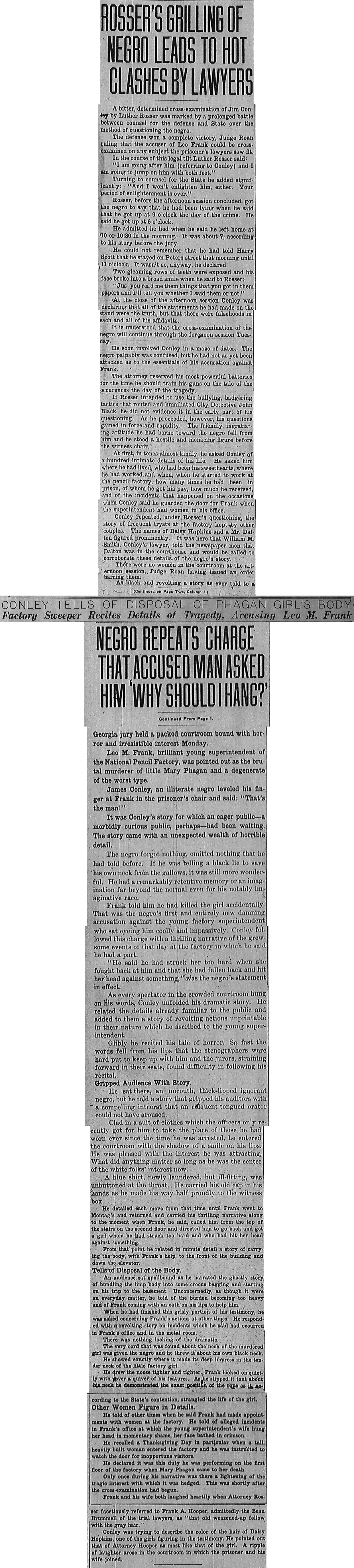
The Atlanta Georgian,
Monday, 4th August 1913,
PAGE 1, COLUMN 1.
A bitter, determined cross-examination of Jim Conley by Luther Rosser was marked by a prolonged battle between counsel for the defense and State over the method of questioning the negro.
The defense won a complete victory, Judge Roan ruling that the accuser of Leo Frank could be cross-examined on any subject the prisoner's lawyers saw fit.
In the course of this legal tilt Luther Rosser said:
"I am going after him (referring to Conley) and I am going to jump on him with both feet."
Turning to counsel for the State he added significantly: "And I won't enlighten him, either. Your period of enlightenment is over."
Rosser, before the afternoon session concluded, got the negro to say that he had been lying when he said that he got up at 9 o'clock the day of the crime. He said he got up at 6 o'clock.
He admitted he lied when he said he left home at 10 or 10:30 in the morning. It was about 7, according to his story before the jury.
He could not remember that he had told Harry Scott that he stayed on Peters street that morning until 11 o'clock. It wasn't so, anyway, he declared.
Two gleaming rows of teeth were exposed and his face broke into a broad smile when he said to Rosser:
"Jus' you read me them things that you got in them papers and I'll tell you whether I said them or not."
At the close of the afternoon session Conley was declaring that all of the statements he had made on the stand were the truth, but that there were falsehoods in each and all of his affidavits.
It is understood that the cross-examination of the negro will continue through the forenoon session Tuesday.
He soon involved Conley in a maze of dates. The negro palpably was confused, but he had not as yet been attacked as to the essentials of his accusation against Frank.
The attorney reserved his most powerful batteries for the time he should train his guns on the tale of the occurences of the day of the tragedy.
If Rosser intended to use the bullying, badgering tactics that routed and humiliated City Detective John Black, he did not evidence it in the early part of his questioning. As he proceeded, however, his questions gained in force and rapidity. The friendly, ingratiating attitude he had borne toward the negro fell from him and he stood a hostile and menacing figure before the witness chair.
At first, in tones almost kindly, he asked Conley of a hundred intimate details of his life. He asked him where he had lived, who had been his sweethearts, where he had worked and when, when he started to work at the pencil factory, how many times he had been in prison, of whom he got his pay, how much he received, and of the incidents that happened on the occasions when Conley said he guarded the door for Frank when the superintendent had women in his office.
Conley repeated, under Rosser's questioning, the story of frequent trysts at the factory kept by other couples. The names of Daisy Hopkins and a Mr. Dalton figured prominently. It was here that William M. Smith, Conley's lawyer, told the newspaper men that Dalton was in the courthouse and would be called to corroborate these details of the negro's story.
There were no women in the courtroom at the afternoon session, Judge Roan having issued an order barring them.
As black and revolting a story as ever told to a
(Continued on Page Two, Column 1.)
PAGE 2, COLUMN 1
CONLEY TELLS OF DISPOSAL OF PHAGAN GIRL'S BODY
Factory Sweeper Recites Details of Tragedy, Accusing Leo M. Frank
NEGRO REPEATS CHARGE THAT ACCUSED MAN ASKED HIM 'WHY SHOULD I HANG?'
Continued From Page 1.
Georgia jury held a packed courtroom bound with horror and irresistible interest Monday.
Leo M. Frank, brilliant young superintendent of the National Pencil Factory, was pointed out as the brutal murderer of little Mary Phagan and a degenerate of the worst type.
James Conley, an illiterate negro leveled his finger at Frank in the prisoner's chair and said: "That's the man!"
It was Conley's story for which an eager public a morbidly curious public, perhaps had been waiting. The story came with an unexpected wealth of horrible detail.
The negro forgot nothing, omitted nothing that he had told before. If he was telling a black lie to save his own neck from the gallows, it was still more wonderful. He had a remarkably retentive memory or an imagination far beyond the normal even for his notably imaginative race.
Frank told him he had killed the girl accidentally. That was the negro's first and entirely new damning accusation against the young factory superintendent who sat eyeing him coolly and impassively. Conley followed this charge with a thrilling narrative of the gruesome events of that day at the factory in which he said he had a part.
"He said he had struck her too hard when she fought back at him and that she had fallen back and hit her head against something," was the negro's statement in effect.
As every spectator in the crowded courtroom hung on his words, Conley unfolded his dramatic story. He related the details already familiar to the public and added to them a story of revolting actions unprintable in their nature which he ascribed to the young superintendent.
Glibly he recited his tale of horror. So fast the words fell from his lips that the stenographers were hard put to keep up with him and the jurors, straining forward in their seats, found difficulty in following his recital.
Gripped Audience With Story.
He sat there, an uncouth, thick-lipped ignorant negro, but he told a story that gripped his auditors with a compelling interest that an eloquent-tongued orator could not have aroused.
Clad in a suit of clothes which the officers only recently got for him to take the place of those he had worn ever since the time he was arrested, he entered the courtroom with the shadow of a smile on his lips. He was pleased with the interest he was attracting. What did anything matter so long as he was the center of the white folks' interest now.
A blue shirt, newly laundered, but ill-fitting, was unbuttoned at the throat. He carried his old cap in his hands as he made his way half proudly to the witness box.
He detailed each move from that time until Frank went to Montag's and returned and carried his thrilling narrative along to the moment when Frank, he said, called him from the top of the stairs on the second floor and directed him to go back and get a girl whom he had struck too hard and who had hit her head against something.
From that point he related in minute detail a story of carrying the body, with Frank's help, to the front of the building and down the elevator.
Tells of Disposal of the Body.
An audience sat spellbound as he narrated the ghastly story of bundling the limp body into some crocus bagging and starting on his trip to the basement. Unconcernedly, as though it were an everyday matter, he told of the burden becoming too heavy and of Frank coming with an oath on his lips to help him.
When he had finished this grisly portion of his testimony, he was asked concerning Frank's actions at other times. He responded with a revolting story on incidents which he said had occurred in Frank's office and in the metal room.
There was nothing lacking of the dramatic.
The very cord that was found about the neck of the murdered girl was given the negro and he threw it about his own black neck.
He showed exactly where it made its deep impress in the tender neck of the little factory girl.
He drew the noose tighter and tighter. Frank looked on quietly with never a quiver of his features. As he slipped it taut about his neck he demonstrated the exact position of the rope as it according to the State's contention, strangled the life of the girl.
Other Women Figure in Details.
He told of other times when he said Frank had made appointments with women at the factory. He told of alleged incidents in Frank's office at which the young superintendent's wife hung her head in momentary shame, her face bathed in crimson.
He recalled a Thanksgiving Day in particular when a tall, heavily built woman entered the factory and he was instructed to watch the door for inopportune visitors.
He declared it was this duty he was performing on the first floor of the factory when Mary Phagan came to her death.
Only once during his narrative was there a lightening of the tragic interest with which it was hedged. This was shortly after the cross-examination had begun.
Frank and his wife both laughed heartily when Attorney Rosser facetiously referred to Frank A. Hooper, admittedly the Beau Brummell of the trial lawyers, as "that old weazened-up fellow with the gray hair."
TRIAL JUDGE L. S. ROAN
Conley was trying to describe the color of the hair of Daisy Hopkins, one of the girls figuring in the testimony. He pointed out that of Attorney Hooper as most like that of the girl. A ripple of laughter arose in the courtroom in which the prisoner and his wife joined.
PAGE 2, COLUMN 2
Conley's Story In Detail; Women Barred By Judge
There was a murmur of excitement following the calling of Jim Conley; there was a wait of several minutes, officers having just left the police station with the negro a minute or two before he was called.
Judge Roan impatiently ordered the Sheriff to bring in the witness. A number of spectators who were crowded up too close to the jury box were moved back by the court deputies.
"The Sheriff hasn't got Jim Conley," said Attorney Rosser, after a statement from Deputy Sheriff Plennie Miner.
"Mr. Starnes will bring him in," returned Solicitor Dorsey.
"See if Mrs. White has arrived," then requested Dorsey. "She has a very young baby, and when I had her subpoenaed this morning she said that she would have to send to the factory and get her husband before she could come."
Courtroom Quiet as Conley Enters.
"You may call her later," said Mr. Rosser, "there won't be any objection."
Jim Conley was brought into the courtroom just at this time. He took the witness chair and was sworn in while in the chair. Solicitor Dorsey examined him and everyone leaned forward, while extreme quiet prevailed.
Q. What is your name? A. James Conley.
Q. Do you know Leo M. Frank? A. Yes.
Q. Point him out. (Conley did so.)
Q. Did you have any conversation with him on Friday afternoon before the murder of Mary Phagan? (Conley's answer was indistinct.)
Q. How long had you been working at the pencil factory? A. About two years.
"Frank Told Me to Come Back."
Q. What did he say to you on Friday? A. He said for me to come back at
8:30 o'clock Saturday morning.
Q. Did you go? A. Yes, about 8:30 o'clock.
Q. Who got there first, you or Mr. Frank? A. We met at the front door.
Q. What did he say? A. He said I was too early for what he wanted me to
do. I told him I thought he wanted me to do what I had been doing on every Saturday.
Q. What had you been doing on other Saturdays?
"I object," said Rosser. "This witness should not be led."
Q. What did you do this Saturday? A. I watched the door while Mr. Frank said he was going upstairs for a little chat.
Q. Was anybody else with him?
"I must object again," interrupted Rosser.
Q. Who was there? A. Well, girls would come up. One time another man and another girl come up.
Q. What sort of looking woman was she? A. She was a heavy woman.
Q. What time was this? A. Thanksgiving day, 1912.
Watched at Door.
Q. What did you do? A. I stayed down at the door and watched.
Q. Now state all that Mr. Frank said to you that morning. A. He said I was a little early; that he wanted me to do what I had done on other Saturdays.
Q. What was that? A. To watch while he went up and had a little chat.
Q. What did Mr. Frank do then? A. He went over to Mr. Montag's.
Q. That is the corner of Nelson and Forsyth streets, isn't it? (Dorsey showed a rough sketch to the witness.) A. Yes.
Q. What time did you get to Nelson and Forsyth streets? A. Somewhere between 10 and 10:30.
Q. Did you see Mr. Frank? A. Yes, he passed me going toward Montag's.
Q. What did he say? A. "Ha, ha, you are here, are you?"
Q. Did you see him later? A. Yes, when he came back.
Q. Did he say anything? A. No, except to come over.
Followed Him to Factory.
Q. Did you go, and what way? A. He passed Alverson's grocery store and bumped against a man.
Q. What else? A. He stopped at Curtis' drug store and drank something.
Q. Did you follow him? A. Yes.
Q. When you got to the factory, what happened? A. He opened the door and showed me how to lock the door. He said that he was going to have a young lady up there and he wanted me to lock the door. He said that he would stamp his foot and that would be a signal for me to come up.
Q. What else? A. He knocked me in the chest kind of playful-like and said: "Don't let Darley see you."
Q. What did he do then? A. He went up to his office.
Q. Who else did you see? A. I saw Darley come in and come down.
Q. Who was with him? A. Miss Mattie Smith.
Q. What was she doing? A. She had a handkerchief as if she was crying.
Q. What, if anything, did Miss Mattie Smith have in her hand? A. She had a pocketbook, a handkerchief and an umbrella.
Q. Was she in a good humor or a bad humor? A. She looked like she was crying.
Q. How long did Miss Smith stay in the factory? A. Just a short time.
"You promised me you wouldn't lead this witness," interrupted Mr. Rosser.
"I promised you I would do the best I could," replied Dorsey.
Q. Was this before or after you went to Nelson street? A. It was after.
Conley then told of seeing a number of employees come in.
Q. Who else did you see? A. Miss Mary Perkins.
Q. Who? A. Miss Mary Perkins, I called her, the girl who is dead.
Q. What else did you hear? A. I heard footsteps going back towards the metal room, and in a little bit I heard a scream.
Q. What happened next? A. Miss Monteen Stover came in. In a little bit she went out.
Q. What did you hear then? A. Heard footsteps like somebody running on tip toe from Mr. Frank's office towards the metal room. In a minute I heard the steps running back to the metal room.
Q. What happened after that? A. I sat down on a box and went to sleep.
Q. What was the next thing you heard? A. Mr. Frank stamping on the floor three times. Then he called me.
Q. What did he say? A. He asked me if I noticed a little girl go out. I told him I saw one, but didn't see the other.
Q. How long was it before you heard the whistle? A. Not long.
Q. What did you do? A. I unlocked the door and went upstairs. Mr. Frank was standing at the head of the stairs shivering and shaking.
Q. Did he have anything in his hand? A. A cord.
Q. What did he say? He asked me if I noticed a little girl come in. I told him I saw two.
Q. Did you ever see any girls in Frank's office alone with him? A. One day I saw him down on his knees in front of a girl in his office and she was stroking his hair.
Says Frank Said He Hit Girl.
Q. When Frank called you upstairs that Saturday afternoon, what did he say? A. He said he had struck a little girl with his fist and she had fallen against something and hurt herself.
Q. What else? A. He told me he wanted me to help him carry her down stairs. He said there was money in it for me.
Q. What else did you do? A. I went back to the dressing room where he told me she was and found a girl lying flat of her back with a cord around her neck
Dorsey here interrupted the witness.
Q. About where did you find this girl when you went back there? Conley took a parasol and pointed out where he had found the girl, using the diagram to show it). A. It was right in front of the ladies' washroom.
Q. What did Mr. Frank do? A. He said "sh-h, sh-h, sh-h." I told him she was dead. He told me to get a piece of cloth out of a box back there and wrap up her head.
Solicitor Dorsey had to admonish Conley not to talk so fast.
A large piece of cotton bale wrapping was exhibited.
Q. What is that, Jim? A. That is a piece of cloth like I got out of the box and rolled the girl's body into.
Q. Why did you do it? A. Because Mr. Frank told me to.
Q. How did she look? A. She had her hands stretched out
PAGE 4, COLUMN 1
"I WRAPPED HER BODY UP LIKE DIRTY CLOTHES," SAYS CONLEY
Whole Court Audience Keyed to Catch Every Word of the Witness
SWEEPER FIRST ADMITS HE SAW GIRL VICTIM AT PLANT
(Continued from Page Two.)
and cords around her neck.
Q. How did you put her in the cloth? A. I wrapped her up like you would dirty clothes, tying the cloth in a knot.
Q. What did you do with her then? A. I tried to pick her up. She was so heavy I dropped her. I was nervous and scary and called Mr. Frank. He came and took her by the feet. When we started off he dropped her feet. I was backing back and Mr. Frank was carrying her feet. He let her feet drop when we were toting her. When we got to the elevator he tried it and found it was locked. He went into the office and got a key, came back and unlocked it, and when it started he said "Come on and get on here." When we got to the basement, he told me to take her on back. I said, "Where must I put her?" He said, "Back there by the sawdust pile." I hollered to him when I got back there and asked him if that was the place. He said "Leave her there." When we got up to the second floor he jumped off before we got even with the floor and fell. He jumped up and went to wash his hands. When he came back he went to the office and said, "Come in, damn it." I went in and in a few minutes he said, "Somebody is coming." He was trembling and shaking all over, and his eyes were dancing like diamonds. He says, "Here, jump in here," and he opened the wardrobe door. I got in, and after a long time he came and let me out. I said, "You kept me in here a mighty long time."
Says He Was Asked to Write Notes.
Q. Did you hear anything while you were in the wardrobe? A. Yes, I heard someone come in and say "Good morning, Mr. Frank." "Good morning," he said. "You are all alone," said the other voice. That's all I heard, but the footsteps going out. He came back and let me out of the wardrobe. "You kept me in here a mighty long time," I said. "Yes," he said, "you are sweating." We went into his office and he reached over and gave me a box of cigarettes. He offered me one. They don't allow cigarette smoking around the factory. He said there was some money in the box and I could keep it. Then he asked me to write some notes for his mother. I don't know what it was I wrote, but the first one did not suit him. I wrote another on some green looking paper. I was glad to do anything for Mr. Frank. He was the superintendent and all that. He slapped me on the back at that and said "Good boy." He had promised me some money and I asked him about that. He pulled out of his pocket a large roll of greenbacks. I took them. I told him I was scared. He said something about getting me out of town. Then he asked me for the money back. I thought he was just going to count it, but he put it in his pocket. "Is that the way you are going to treat me, Mr. Frank?" I asked. "You keep your mouth shut," he said. He
held his hands together, and looking up toward the ceiling said: "Why should I hang; I have wealthy people in Brooklyn." I looked up toward the ceiling, but didn't see nothing. I looked and said: "Is that all you want?" and he said "Yes." I sat in a chair and saw him start to write a note. The first letter was "W." He turned and saw me. He jumped up and grabbed me by the shoulder, turned me and put me to the head of the stair and told me to go. He said: "Don't you say anything now, and I will make it all right." I went down and went out to a saloon on Peters street; I took a double-header and looked at the clock. It was twenty minutes to 2. I asked a boy to have one with me, then I went home.
Frank came to him Tuesday, he says.
Q. Did you see Frank any more? A. Between 10 o'clock and 11 o'clock Tuesday morning. He came to me while I was sweeping on the fourth floor and said: "Be a good boy," and I said: "Yes, I will be a good boy."
Q. Did you see him Monday? A. No.
Q. Why? A. Because it was a holiday and I didn't go to work until Tuesday. After Mr. Frank spoke to me, somebody told me they were going to arrest Mr. Frank.
Dorsey interrupted: "Never mind that, what somebody told you."
Q. When were you arrested? A. On the first of May.
Q. Do you remember the day of the week? A. Thursday.
Q. Look at these notes (handing the negro the two murder notes found in the basement beside Mary Phagan's body). A. Yes, these are the notes fixed up in Mr. Frank's office. That man right there (pointing to the defendant) took them off his desk and had me write them.
Doesn't Know Mrs. White.
Q. Did you notice the time that morning? A. Yes, at Broad and Mitchell street it was 9 minutes past 10.
Q. Who left the factory first? A. Frank.
Q. Do you know the name of the man or woman up there with Frank Thanksgiving Day? A. I don't know the woman, but the man's name was Dalton.
Q. What did Frank have on that Saturday morning? A. A raincoat.
Q. Where were you sitting? A. Right here (indicating a spot in the first floor of the factory near the trapdoor that leads to the basement).
Q. Where did you work all of the time? A. Up until Christmas I worked on the elevator. After Christmas they took me off of the elevator and put me to cleaning up on the fourth floor.
Q. Do you know Mrs. Arthur White? A. No.
At this point Solicitor Dorsey spoke to one of the deputies and said: "If Mrs. White has come, show her in."
Q. When you found the body, how did you know she was dead? A. She was lying flat of her back with her arms outstretched and she wasn't breathing.
At this juncture Mrs. White entered the courtroom.
Q. Did you see this woman (Dorsey pointed to Mrs. White). A. No, sir.
"Your honor," said Dorsey, "I will put this witness on the stand for a moment."
"We object," said Rosser. "I told you privately we wouldn't consent."
"I thought you said Dr. Harris," returned Dorsey.
"Nobody," said Rosser.
Dorsey continued to question the negro.
Q. What kind of a lady was it you saw in Frank's office Thanksgiving day? A. She was a tallish, pretty lady, with a polka-dot dress and a kind of grayish skirt, white shoes and white stockings.
Q. Did Frank say anything then? A. He kept saying: "That's all right; that's all right."
Q. Did you ever watch for Frank before, and if so, when? A. I don't know exactly, but I watched down there once or twice.
Q. Did Frank know you could at first.
LEO FRANK AND FIVE LINKS IN CHAIN STATE HAS WOVEN FOR HIM MONTEEN STOVER SAYS FRANK WAS NOT IN OFFICE BETWEEN 12:05 AND 12:10
Vital points in evidence against Frank illustrated by artist
P. A. Carter.
FRANK TELLS CORONER'S JURY MARY ARRIVED BETWEEN 12.05 AND 12.10
DR. HARRIS TESTIFIES UNDIGESTED CABBAGE SHOWS MARY DIED ONE HALF HOUR AFTER SHE ATE OR ABOUT 12.10
MOTHER SAYS MARY LEFT AT 11.45 AFTER EATING
MRS. WHITE TESTIFIES SHE SAW NEGRO, PRESUMABLY CONLEY, AT 1 O'CLOCK ON FIRST FLOOR OR ONE-HALF HOUR AFTER GIRL DIED
Q. Did Frank know you could write? A. Yes, sir. I signed a paper for a bailiff before him.
Rosser objected, but was overruled.
Puts Rope Around Neck.
Probably the most dramatic moment in the direct examination came when Solicitor Dorsey handed to the negro the underskirt ruffle which had been taken from the dead girl's neck, and the negro identified it as the cloth to which he had referred.
The solicitor then handed to him a piece of cord and directed him to illustrate to the jury just how it was tied about the girl's neck.
Conley put one end through the loop at the other end. Then he placed the bight around his own neck and drew it tight with the slip knot on the right side of his neck. Picking up the underskirt ruffle, he said that this was tied around the girl's neck.
"Did you notice the clock while you
were up there?" asked the solicitor. A. I didn't see any clock in the metal room, but after I saw the girl was dead and went back up to the front I noticed the clock.
Q. What time was it? A. Four minutes to 1.
Q. You say the girl was dead when you saw her? A. Yes, sir.
Q. What did you do when you found the girl was dead? A. I come back and told Mr. Frank, "She's dead." Mr. Frank told me to get a piece of cloth out of the cotton box and put it around her up here. I heard a noise up toward the third floor about that time. Both Mr. Frank and me looked up there. It was then that I looked at the clock and saw it was four minutes to 1.
Q. Well, what did you do then? A. I went and got the cloth like Mr. Frank told me to do.
Solicitor Dorsey handed to the witness Mary Phagan's parasol and asked him to point out on the big diagram hanging before the jury the place where he found the girl's body. The negro indicated an areaway leading off at the left of the metal room, saying that the areaway led to the ladies' toilet.
Q. Jim, where is the metal kept? A. It's kept back there in a room near the ladies' toilet.
Rosser Starts Cross-Examination.
The witness was then turned over to the defense and Rosser and Arnold retired for a conference. Mr. Dorsey asked another question.
Q. How long did you work for the National Pencil Company? A. Two years.
Q. Where did you work before that? A. For Dr. Palmer.
Q. Why did you quit? A. Well, he got an automobile. He didn't know how to run it and I didn't, so he had to get another man.
Q. How old are you? A. 27. Conley then rapidly reviewed where he had worked for a number of years, giving himself a good record.
Rosser and Arnold returned to the courtroom here and Rosser took the witness on cross-examination.
Q. How old are you, Jim? A. 27.
Q. Where were you born? A. Right here in Atlanta.
Q. When did you get your first job? A. About eleven years ago.
Q. When you were about 16 years old? A. No, I was about eleven years old.
Q. What year was that? A. About 1901, I won't be sure.
Q. Can you read newspapers? A. Not much, I read them some.
Q. Do you read them often? A. I pick them up now and then.
Q. What do you read? A. Little words like "this" and "that."
Q. They are pretty common words in the newspapers, aren't they? A.
Yes.
Tries Conley on Spelling.
Q. Can you spell "school?" A. Yes.
Q. Color? A. No.
Q. Shirt? A. Yes.
Q. Cat? A. Yes.
Q. Do you spell it with a "k" or with a "c?" A. With a "k."
Q. Can you spell "mother?" A. No.
Q. Can you spell "papa?" A. Yes.
Q. How? A. P-a-p-a.
Q. Can you spell "day?" A. Yes.
Q. "Daylight?" A. Yes.
Q. Can you spell "beer?" A. Yes.
Q. Can you spell "whisky?" A. No.
Q. Look at this picture and tell me if you can read any of these words? A. No.
Q. Do you know your figures? A. Yes.
Q. You know a good deal more about figures than you do about spelling, don't you? A. Yes. I can count better than I can spell.
Q. Then you are better at figuring than you are at writing? A. Yes; I am better at counting.
Q. Well, isn't figuring counting? A. I don't know.
Q. You don't know you are 27 years old, do you, Jim? A. Yes, sir, that's what my mother said.
Q. When did you go to school? A. Before I went to work.
Q. You don't know where it was? A. Yes, it was at the Mitchell street school.
Q. Who was your teacher? A. Miss Aaron Cook.
Q. Who was the principal? A. Miss Corey.
Q. What year was it? A. I don't know.
Q. What did you do for Dr. Palmer? A. I drove for him.
Quizzed About Former Employment.
Q. How long did you work for Mr. Coates? A. About five years.
Q. He ran a pressing club? A. No, sir, he ran a woodyard.
Q. Do you remember any of the names of the white men who worked there? A. Yes, Mr. Babe, I think.
Q. He wasn't 'Baby', was he? A. No, sir.
Q. Jim, when you went to the National Pencil Factory, who employed you? A. Mr. Herbert Schiff.
Q. Who paid off? A. Mr. Schiff and sometimes Mr. Frank.
Q. Give me the dates Mr. Frank paid off A. I hardly ever drew my money. I had somebody draw mine, usually.
Q. Why did you do that? A. Well, I owed money, and I wanted to get it and get away without them getting it all.
Q. Did you not owe the boys more than you wanted to pay them? A. No, sir, I just owed 10 or 15 men.
Q. What were you drawing? A. $6.05.
Q. Who else worked there? A. Joe Bryce.
Q. What did he draw? A. He said $6.48.
Q. What made him tell you that? A. We were arguing down in the basement.
Q. Did you tell him what you drew? A. No.
Q. Why didn't you tell him? A. I didn't think it was any of his business.
Q. You didn't want him to know? A. No, sir.
Q. All you had to do was to put your envelope in your pocket and he couldn't see it, or tell what was in it? A. Yes.
Settled His Bills by Buying Beer.
Q. Then if you owed this fellow Bryce money, you were afraid to get it while he was there? A. No.
Q. Why didn't you settle with them? A. I usually settled with them at the beer saloon by buying twice as much beer.
Q. Didn't you say a while ago that you owed Joe Bryce some money? A. No, I said Walter.
Q. Then the reason you didn't draw your money was that you wanted to get it and get away without paying money? A. Sometimes.
Q. What time did the night watchman come? A. I don't know. I never saw him come to work.
Q. You never saw the watchman there? A. I saw the white watchman get his money there.
Q. At what time did he come? A. About 2 o'clock.
Q. Did you see old man Newt Lee there? A. No, I heard he was.
Q. Who was there before Newt? A. Old man Kendrick.
Q. Who was there before that? A. His son, I think.
Q. What time did they pay off on Saturdays? Was it 12 o'clock? A. Sometimes 12, sometimes a quarter to 12 and sometimes at 11:30.
Q. Now you said you watched for Mr. Frank, didn't you? A. Yes.
Q. When was the first time you ever watched for Mr. Frank? A. Sometime last summer.
Frank Called Him Into Office.
Q. What did Mr. Frank say to you? A. He came out and called me into his office.
Q. What did he say? A. Well, he sometimes talked to me about the work.
Q. When did he first call you in and talk to you about the work? Didn't he call you in during the week, sometimes? A. No, sir. He called me into the office to talk about the work one Saturday night after I went there.
Q. Did you punch the clock? A. Sometimes I did and sometimes I didn't.
Q. Didn't they pay you by the clock? A. No, they didn't pay me that way.
Q. Didn't they pay everybody by the clock? A. They paid me $1.10 a day.
Q. Don't you work by the hour? A. Yes, sir.
Q. How much? A. Eleven cents an hour.
Q. Did you miss any time? A. Sometimes.
Q. Wouldn't they dock you when you were not punched right on the clock? A. Sometimes Mr. Frank would come out and say he didn't dock me for the time I missed.
Q. Why did he tell you that? A. I don't know, sir. He just come out said he hadn't docked me.
Q. They didn't ask you how long you had been there? A. No, they just asked me if I was there.
Q. You say the first time you watched was back there in July? You don't know the name of the man? A. Yes, the man was Dalton.
Q. You don't know the name of the woman, do you? A. No, but she lives on West Hunter street.
Tell Name of Woman.
Q. Do you know the name of the woman who was with Frank? A. Yes, her name was Daisy Hopkins. She worked on the fourth floor.
Q. He asked you to watch? A. Yes.
Q. What time was it? A. 3 or 3:20.
Q. What did Frank say to you? A. He called me to his office and said: "You see that young lady going out?" I said: "Yes, sir." He said: "Watch the door, and don't let anybody but them in."
Q. Was the woman, Daisy Hopkins, at the office then? A. Yes.
Q. What did the other woman do? A. She went out and came back later with a man that was Dalton.
Q. What did they do? A. They went into Mr. Frank's office.
Q. How long did they stay? A. About 10 or 15 minutes.
Q. Did they come out? A. Yes, after a while. The man and the woman came out. Mr. Frank said: "All right, Jim."
Q. Then the man's name was James Dalton? A. No, he was talking to me.
Q. What did they do? A. They came down and went towards the basement.
Q. What did you do? A. I went back and opened the trap door for them.
Q. How long did they stay down there? A. I don't know.
Q. Frank stayed in his office? A. Yes.
Q. What time did he leave? A. About 4:30.
Q. What time did the people downstairs go? A. I don't know exactly, but they came up and went to Mr. Frank's office.
Q. Was the front door locked? A. No, sir, I was standing there watching it.
Q. Was that the first time this happened? A. Yes.
Q. When did it happen again? A. About the last part of July, or the first part of August.
Q. When did Mr. Frank tell you about it? A. That same Saturday morning.
Q. What did he say? A. He said, "Well, you know what you did for me last Saturday?" I said: "Yes, sir." He said: "I want to put you wise to this Saturday."
Q. What happened after this? A. After Mr. Holloway left, Miss Daisy Hopkins came in.
Q. Did she see you? A. Yes, sir.
Q. Did anybody else come that day? A. No, sir.
Q. How long did she stay up there? A. About half an hour.
Q. Did he give you any money? A. Yes, sir; he gave me half a dollar.
Q. When was the next time? A. I don't hardly remember; it was near wintertime.
Q. About what time? A. About the middle of August.
Q. I thought you said it was near winter? A. Well, that's near winter.
Q. Middle of August near winter! It's mighty hot then. A. Yes, sir; it's pretty near winter.
Q. What did Frank say? A. He said: "I'm going to put you wise."
Q. That's what he said every time, was it "I'm going to put you wise?" A. Yes, sir; something like that. But he said what he did in a funny way.
She Had Red Hair.
Q. Who was the woman? A. I don't know who she was.
Q. How did she look? A. She had hair like Mr. Hooper.
Q. How do you know Mr. Hooper so well? He has questioned you a lot, hasn't he? A. No, sir; I never saw him but once before.
Q. She was gray-haired, then, was she? You see Mr. Hooper is gray-haired, old and broken with a somewhat weasly appearance. A. I don't know whether he is gray or not. Her hair was like his.
Q. What color was her dress? A. It was green.
Q. What kind of clothes did she have on the first time? A. A white waist and black skirt.
Q. When did you see her last? A. The morning I was arrested.
Q. What did she have on then? A. A black skirt with paint spots on it.
Q. You swept the fourth floor? A. Yes.
Q. Saw that little girl on the fourth floor every day, didn't you? A. Not all the time, but often.
Q. That first time he told you not to tell Darley, didn't he? A. Yes.
Q. What time was it, Thanksgiving Day? A. I don't recall.
Q. Who came down first? A. Mr. Frank.
Q. What did he do? A. He went to the front door and opened it and looked out.
Q. What did he do then? A. He went to the stairway door and let the woman out and walked to the front door with her. As she passed me the lady said, "Is that the negro?" and he said, "Yes, that's him. He is the best negro in the State."
Frank Walked to Door With Her.
Q. Did he walk out? A. No, he just walked to the door with her and came back.
Q. How was she dressed? A. A blue dotted dress and a gray coat that looked like it was tailored, white shoes and white stockings.
Q. What kind of a hat? A. A big black hat with big feathers.
Q. Did you see that woman in the office before? A. I thought I saw her in his office sometime before Thanksgiving.
Q. What did she have on? A. I don't know.
Q. What kind of a looking girl was she? A. A tall, heavy set girl.
Q. Who else was there in the office? A. Friends of Mr. Frank.
Q. What time was it? A. About 8 o'clock.
Q. What were you doing there at that time? A. Stacking some boxes.
Q. Any jewelry? A. I didn't notice any.
Q. What was the next time after Thanksgiving? A. Along after Christmas.
Q. What time? A. I don't know exactly.
Q. What is your best guess? A. It was some time about the first of January.
Q. When did Mr. Frank speak to you about it the first time? A. I don't remember.
Q. You don't remember anything about it except that you watched? A. Yes, sir; I do remember one thing.
Q. I thought you said you didn't remember anything? A. Yes, sir; Mr. Frank told me a man with two women would be there and I might make a piece of change off of the man.
Q. When was this? A. About 7:30.
Q. I thought you said you didn't remember? Why didn't you tell that
Continued on Page 8, Column 1.
PAGE 8, COLUMN 1
Dalton To Corroborate Conley's Story On Stand
Continued from Page 4.
then? A. You cut me off so sharp I didn't have a chance.
Q. What time did they come? A. Some time about 2:30 or 3 o'clock.
Q. What did he say? A. He asked me if Mr. Frank had put me wise.
Q. He and Frank used the same expression? A. Yes, sir.
Q. How were the women dressed? A. I don't remember.
Court was then adjourned until 2 o'clock.
Jim Conley was brought to the courtroom at five minutes to 2 o'clock. He was accompanied by W. M. Smith, his lawyer, and Chief of Police James L. Beavers. He spent the noon recess at the police station. The negro went straight to the stand and waited for court to open. Frank, who was in the room, sat with his back turned to the witness stand and talked to his wife.
Conley showed no signs of nervousness, and for the greater part of the five minutes he kept his hands locked in his lap and gazed calmly at the curious faces turned his way.
Just as Judge Roan walked to the stand, Deputy Sheriff Plennie Minor announced all women would be excluded from the room for the remainder of the hearing. Reluctantly they vacated the seats they had secured and held during the noon recess.
Fully 150 women were barred by the ruling. Rosser resumed his cross-examination at five minutes after 2 o'clock.
Q. Who saw you at the police station? A. Chief Beavers.
Q. Anybody else? A. My lawyer, William Smith.
Q. What did they say? A. Well, my lawyer
I object," said Attorney Hooper. "You can't bring out what took place "
between him and his lawyer."
Didn't Remember About Time.
Q. Well, Jim, what did you do on the Saturday before you watched for Mr. Frank the first time? A. I don't know.
Q. What did you do the Saturday after that? A. I don't know, sir, I disremember.
Q. What about the Saturday after that? A. Well, long about August 1 I watched again.
Q. Let me see if I get that right one Saturday you didn't watch and the next Saturday you did. The next Saturday you didn't watch, and the next Saturday you did, and then you didn't watch any more until Thanksgiving? A. I don't know exactly, I can't count it like you.
Q. Well, I got it like you said, didn't I, Jim? A. The last time I watched was about the last of September.
Q. Jim, what time was it you watched the second Saturday? A. I don't remember, sir.
Q. You don't know what time you left for home? A. No, sir.
Q. Jim, we don't want any controversy between us, but tell all about these times you watched. A. I done told you like I remember them.
Doesn't Remember Pay.
Q. When did you draw your pay, before or after Thanksgiving day? A. I can't remember.
Q. The day after Thanksgiving day what did you do? A. I came back to work.
Q. Who did you see? A. Mr. Frank.
Q. Who else? A. I can't recall.
Q. Did you see Mr. Darley? A. I don't remember.
Q. That first time you watched, how many hours did you work and what did you get? A. $1.25.
Q. I mean what did you get for your services? A. I don't remember.
Q. Where were you living in July, 1912? A. 37-B Vine street.
Q. How long did you live there?
A. I don't know. Part of that time I was in prison.
Q. What time did you go to prison? A. I can't remember.
Q. What length of time were you there? A. Two or three days.
Q. You can't remember what time you got there and got out? A. No.
Q. When you got out, your woman had moved? A. Yes.
Q. Where to? A. 122 Rhodes street.
Q. Who were you living with? A. Lorena.
Can't Remember Prison Terms.
Q. The same one you were living with when you were arrested? A. Yes.
Q. When were you in prison again? A. I can't remember.
Q. Before or after Christmas? A. I can't recall.
Q. Was it cold or hot? A. I can't recall.
Q. How long were you there? A. About twenty days.
Q. Were you in prison before that first time you told me of? A. Right after I went to the pencil company.
Q. How long were you there? A. About 30 days.
Q. How many times were you in prison since you went to the pencil factory? A. Three times.
Q. How many times altogether? A. Four or five times.
Q. You can't recall the number of times? A. No.
Q. Was it six A. Yes, five or six.
Q. Can you remember the first? A. No.
Q. You can't remember the first time you were in prison? A. No.
Q. You can't remember any time at all? A. No.
Q. You can't tell how long you were in at all? A. No.
Q. First time? A. No.
Q. Second time? A. No.
Q. Third time? A. No.
Thinks It Was Seven Times.
Q. Fourth? A. No.
Q. Fifth? A. 1911.
Q. What month? A. I don't remember.
Q. Sixth time? A. It was after that.
Q. Seventh time? A. After that.
Q. You can't tell what time? A. No.
Q. What about the eighth time? A. I didn't say I had been arrested eight times. You said that.
Q. But you don't know whether you have been arrested seven or eight times? A. I think it was seven.
Q. You have been arrested three times while you have been working at the pencil factory, haven't you? A. Yes.
Q. Let's go back a little the day you found this child was April 26? You knew the factory was not going to run that day? A. Yes.
Q. You saw the placards telling that it would be a holiday? A. Yes.
Q. Did you read them? A. Mr. Campbell read them to me. So did Snowball.
Drank Beer in Factory.
Q. What was on the placards? A. I don't know. He read something about the factory would be closed down on April 26.
Q. You and Snowball were good friends? A. Yes.
Q. Did you drink beer together? A. Yes.
Q. Did you ever get drunk in the factory? A. No.
Q. Did you drink beer there? A. Yes.
Q. How much would you drink each day? A. A dime's worth each day.
Q. Where would you drink it? A. In the basement.
Q. Did you see Snowball Thanksgiving? A. No, but I saw him the day before or after.
Q. How long did Snowball work there? A. I don't know.
Q. Was he an educated negro? A. I don't know.
Q. He could read, couldn't he? A. Yes, he used to pick up funny papers and read them to me. He did this once.
Q. That time when you watched him in January, was Snowball there?
Six Negroes Worked In Plant.
Q. Couldn't you see him? A. Snowball was in the back. There was a partition between him and Mr. Frank.
Q. Well, Mr. Frank wouldn't have come if he had heard, would he? A. No, sir, I don't guess he would.
Q. You worked all the time for two years? A. Yes, except a few times when I was in jail.
Q. Who worked in your place when you were in jail? A. I don't know.
Q. You have no recollection about it? A. No, sir.
Q. Besides yourself and Snowball, how many other negroes worked there? A. I don't know, sir.
Q. Ever count them up?
Conley counted on his fingers and then announced six.
Q. Six with you and Snowball? A. Yes.
Q. You all did just plain labor, you and Snowball and the fireman? You didn't run any machines? A. Yes, sir, except the fireman.
Q. When was the first time Mr. Frank spoke to you? A. I don't know.
Q. You were there three or four months before he even spoke to you? A. No, sir. He had not spoke to me about anything but business for some time.
Q. When was the first time he spoke to you about anything but business? A. Do you mean about these private things?
Q. Yes, wasn't that first Saturday the first time he ever spoke to you about anything but business. A. Yes, sir, except laughing and joking.
Q. When did he ever joke with you and what did he say? A. I don't know,
sir, just when.
Q. Who heard him say anything? Tell me one thing he ever said joking to you?
Recalls One "Little Joke."
"Your honor," said Attorney Hooper, "I object to the manner of questioning. He doesn't give the witness time to answer. I don't think he intends to be unfair, but the witness just doesn't have time to answer."
"If that is the case, it is wrong," said Judge Roan.
"You ought to know," returned Rosser. "You have heard all the questions."
"Don't ask the questions too fast," returned the judge, and the case proceeded.
Q. When did he jolly with you the last time? A. I can't recall.
Q. Give one little joke you ever heard him crack? A. I can't.
Q. Give just one? A. One day he hollered down the elevator and said, "If you don't hurry up with that elevator I will start a graveyard down in the basement."
Q. What else? A. Well, he would pinch me.
Q. Did Mr. Holloway or Mr. Darley see that? Mr. Holloway did.
Q. Do you remember what time you went to the factory to work? A. About two years ago.
Q. Do you remember the year? A. I think it was 1910.
Q. How do you know? A. I heard Mr. Schiff say.
Q. How many girls were there? A. Emma Clark, Miss Hill, Rebecca Carson I can't recall how many.
Carried Note for Girl.
Q. What girls were on the fourth floor in 1912? A. Miss Daisy Hopkins was there.
Q. Was she there in 1913? A. No, sir.
Q. Do you know where she lived? A. No.
Q. How did she look? A. She is low, chunky and pretty.
Q. Was she dark or fair? A. She was fair.
Q. What kind of ears did she have? A. Like folks' ears.
Q. You didn't expect them to be like a rabbit, did you? A. No.
Q. How did you know she was there in June? A. She gave me a note for Mr. Schiff.
Q. How do you know that was in June? A. It had that on the note.
Q. Did you read it? A. No.
Q. Then how did you know? A. He said something about June and laughed.
Q. That is all you know about it? A. Yes.
Q. You never saw her before that time when she gave you the note? A. No.
Q. How did you fix the time when she left? A. Mr. Dalton told me it was about Christmas.
Frank Appears Weary.
Frank appeared very weary during the questioning of Conley. He alternated his intent gaze from Mr. Rosser to the negro witness. His eyelids twitched nervously at intervals. Every now and then he would take a deep breath.
Mrs. Frank, his wife, sat with her left arm around his shoulder. His mother sat close on his left with her eyes closed most of the time. Still she appeared to be listening.
Mr. Rosser kept his seat while cross-questioning the witness. After almost two hours of grilling he still had not reached the story of the crime. He seemed to be waging a blind fight to entangle the negro.
One listening to the constant rapid questioning felt that surely sooner or later the brain of the negro would falter, but Conley kept responding readily, unfalteringly, about every other question with "I don't know."
Rosser resumed the questioning about Dalton.
Describes Dalton.
Q. Where did you see him? A. He was coming out of the basement.
Q. What color was his hair? A. Black. He weighed about 135; height about like that (the witness indicated Mr. Arnold).
Q. How old was he? A. About 35.
Q. Where did he live? A. I don't know.
Q. How many times did you see him? A. Several times.
Q. How many times A. Only several times.
Q. When did you see him the first time? A. He was coming out of the basement that first time.
Q. When else? A. That time Daisy Hopkins brought him there.
Q. When else? A. About Christmas.
Q. Did you see him Christmas? A. Not on Christmas Day.
Q. When did you see him? A. Along in January.
Q. When was the last time you saw him? A. About six months ago.
Q. Where was he? A. The detectives brought him down to the police station and asked me if I knew him.
Q. How was he dressed the first time you saw him? A. I don't know.
Q. You don't know what color his suit was? A. No, sir.
Q. How did he look? A. He looked like a man who had just finished work and had dressed and come up town.
Worked in Holloway's Place.
Q. That first Saturday you watched was Mr. Darley or Mr. Holloway there? A. Yes, sir, but they left early.
Q. Now, the next time you watched? A. Mr. Holloway was sick.
Q. Who worked in his place? A. I did.
Q. How do you know he was sick? A. They told me he was sick.
Q. Well the next time, was Mr. Holloway sick? That was Thanksgiving, wasn't it? A. No, sir, it was before Thanksgiving.
Q. What time was it? A. Last of August.
Q. Was Mr. Holloway sick then? A. No, sir.
Q. Was he at the factory that Satur
A. Yes, sir he left about 2 o'clock.
Q. Now, the next time was after Thanksgiving? A. It was in September.
Q. I thought you said it was after Thanksgiving? A. September is after Thanksgiving.
Q. September is after Thanksgiving? A. Yes, sir, September is after Thanksgiving.
Shifts Calendar Again.
Q. In September after Thanksgiving was Mr. Darley and Mr. Schiff there? A. Yes, I saw them, but not in September, because that is before Thanksgiving.
Q. Don't lots of people work there every Saturday? A. Yes.
Q. Was anybody working there the time you watched? A. I don't remember.
Q. Didn't Mr. Schiff work there Thanksgiving? A. I don't remember. I know he wasn't in there when Mr. Frank told me he wanted me to work.
Q. Do the metal room doors lock? A. I don't know.
Q. You know the factory pretty well, don't you? A. Some parts of it.
Q. Did you ever sweep the metal room? A. No, I never swept anything except the fourth floor.
Q. There is a dark room on the left in the back of the metal room, isn't there? A. Yes.
Q. Did you ever see anybody go there? A. Once in a while.
Q. Do you know where the plating room is? A. I don't know anything about that department.
Q. Do you know where Mr. Quinn's office is? A. Yes.
Visited Long, Dark Room.
Q. But you have never been there? A. No, I have never been in Mr. Quinn's office.
Q. You don't know much about the left part of the building by Mr. Quinn's office? A. No, sir.
Q. Were you ever back where the ladies' toilets were? A. I put disinfectants back there.
Q. You said a while ago that you had never been back there? A. Not since I have been working on the fourth floor. I just sprinkled the floor with disinfectant.
Q. Have you ever been in Mr. Quinn's office? A. No, but I have been up to it.
Q. You have never been back there by that long dark room on the left hand side? A. Yes.
Q. You just told me you never had. A. No sir, you misunderstood me.
Q. What were you doing down there where they washed lead? A. I went there to wash overalls for Mr. Becker and Mr. Fritz.
Q. Are they there now. A. I don't know.
Q. Outside of the lead room, the ladies' toilet and Mr. Quinn's office, have you ever been there? A. Yes, I went in that long, dark room.
Frank Sent Him There.
Q. Why didn't you tell me that before? A. You didn't give me time.
Q. When were you back there last? A. To get a piece of cloth for Mr. Frank.
Q. How many other times did you go back there? A. I don't recall.
Q. What were you doing there? A. Mr. Frank sent me there to move some boxes the rats were eating.
Q. Who else ever sent you back there? A. Mr. Schiff.
Conley here called for a glass of water and Mr. Rosser said "We will rest a little while."
Q. How big a room is Mr. Frank's office? A. I don't know, sir.
Q. It has got two desks in it, hasn't it? A. Yes, sir.
Q. Who uses the other desk? A. Mr. Herbert Schiff.
Q. When was Mr. Schiff on his vacation, according to your recollection? A. About Christmas.
Q. You don't know whether he was traveling for the pencil factory, or was on his vacation, do you? A. I don't know, sir, he was away.
Q. How big is the outside office? A. I don't know, sir.
Q. What is in it? A. A safe and a desk.
Q. You don't know whether the door of that safe when open covered the door to the inside office, do you? A. No, sir, I don't.
Q. Can you see Mr. Frank's inside office from the top of the steps? A. Yes, sir.
Q. Can you sit in Mr. Frank's office and see anyone pass up the steps? A. Yes, sir.
Q. You don't mean a man can sit in Mr. Frank's office and see a person come up on the second floor, do you? A. No, sir, I was talking about the steps from the second to the third floor.
Shows Where They Talked.
Q. When a person gets down to the clock he can see them? A. Yes.
Q. Who saw Mr. Frank talk to you that day on the fourth floor? A. I don't know.
Q. Who was near you? A. Miss Willis.
Q. Did she see you? A. I don't know.
Q. Show on this diagram where you were standing when Mr. Frank was talking to you. A. I was standing here (indicating a spot near the aisle). Miss Willis was here near this petition.
Q. Could she see you? A. I don't know.
Q. You know whether she saw you or not, don't you A. No.
Q. What did Mr. Frank say? A. He asked me what I was going to do the next day. I told him nothing much and he said he wanted me to do a little work on the third floor.
Q. What time did he tell you to come? A. About 8:30.
Q. What else did you do? A. I went on sweeping and left at 5:30.
Didn't Draw Pay.
Q. Did you punch as you went out? A. Yes, I think so. I stopped there and talked to Mr. Holloway about the clock being wrong.
Q. Don't you remember whether you rang out or not? A. No sir, I don't remember.
Q. Why didn't you stop and get your pay? A. I knew I wasn't going to get but $2.75 and that watchman would get me, so I told Snowball to get it for me.
Q. Where did he give it to you? A. At a shoe shining parlor near there.
Q. How much did you get? A. $3.75.
Q. I thought you said you were only going to get $2.75? A. That's all, but Mr. Frank forgot to take out $1, and that made $2.75.
Q. Did Mr. Frank make up the payroll that week? A. I don't know, but he always took out the money that way.
Q. How do you know that? A. I don't know, but that is what I have always understood.
Q. How much did you drink Friday? A. I didn't drink nothing.
Q. How many beers did you drink? A. I disremember.
Q. Do you know Mr. Harry Scott? A. Yes, sir.
Q. You told Mr. Scott you got down about 9 o'clock that morning? A. Yes, sir.
Q. That wasn't so? A. No, sir, that wasn't so.
Q. You also told him you had a little before 9 o'clock. A. Yes, sir.
"It Wasn't All False."
Q. What time did you have breakfast? A. About 7 or 7:30 o'clock.
Q. You told Mr. Scott that you left Peters street about 11 o'clock? A. I disremember.
Q. Didn't you swear you were there till 11 o'clock? A. If it's there I swore to it, I guess.
Q. You bought a pint of whisky on Peters street, didn't you? A. No, sir, a half pint.
Q. Nearly everything you swore to down there was false? A. No, sir, it wasn't all false.
Q. You made statements there and swore to three affidavits and they were all false, weren't they? A. No, sir, there was some truth in all of them.
Q. What was true? A. If you will read them to me I'll tell you what was true and what was false.
At this point the spectators broke into a laugh, and while Deputy Plennie Minor rapped for order Jim Conley smiled broadly, showing all his teeth.
Mr. Hooper interrupted.
"Your honor, I am surprised that my friend should pursue such a line of questioning, knowing that it is illegal."
"I didn't think you have the cheek to make the objection," said Mr. Rosser.
"He is trying to bring out part of these affidavits without bringing out the whole," said Mr. Hooper. "As the negro suggests, let them bring out the whole document. They asked for them and we furnished them."
Conley Unusual Witness.
"I know," cried Rube Arnold, "that this witness who has been drilled and coached and finally canned is quite familiar with those printed comments. Our friends would like to have us read them to him. But we are not going to do it. What we are trying to show is what he said to parties admitting that it led up to the making of the affidavit. This is an unusual witness and we think we are entitled to get at him in a way a little out of the ordinary."
Mr. Hooper replied:
"Because Mr. Arnold gets up here and shouts 'canned' does not change the law. We demand these proceedings be legal. He can't bring out parts of these affidavits without bringing out the whole.
Mr. Dorsey then had a word.
"I object to the language of Mr. Arnold," he said. "He charges the 'canning' of this witness' testimony without proof. That statement is prejudiced and should be stricken."
"My friend Dorsey has made one of the usual smiling objections," said Mr. Arnold.
"Well, I am going to present an argument whenever I want to. Whenever he objects I intend to make comment."
Continues Examination.
Judge Roan interrupted:
"What is the question asked the witness?"
"I'll ask it," said Mr. Rosser.
He changed the form of his question and proceeded without interruption.
Q. You were undertaking to tell me your conversation with Scott and Black on May 18. A. I don't remember what day it was.
Q. How long did they talk to you? A. I don't remember. I sent for Mr. Black to come down to my cell.
Q. That wasn't that day? A. I don't recall.
Q. The first time you made any statements about your movements, Scott and Black were together? A. Yes.
Q. Was that the time you sent for Black. A. I think so.
Q. Will you swear that the time you made this statement about your movement was on that Saturday you sent for Black? A. No, I won't swear it, but I think so.
Bought Some Whiskey.
Q. How long did they talk to you before you gave them the statement? A. I don't know.
Q. Didn't they have to work on you a long time before you made any statement? A. Yes.
Q. Didn't they have to force from you the fact that you could write that time you made the affidavit? A. No, I wrote in the chief's office Sunday before that.
Q. Didn't you tell the detectives you bought a pint of whiskey? A. No, only half pint.
Q. What did you pay for that? A. Forty-five cents.
Q. How did you remember that? A. It was what I always paid for it.
Q. Didn't you tell the detectives
Mr. Hooper jumped to his feet with an objection.
"The State has no objection to all this evidence going before the jury, but we do insist that it be done in the prescribed legal way. This is intended for nothing but impeachment, and the code says the witness has the right to be confronted with a written statement. Let me ask my friend Rosser what document he is reading from."
Rosser replied hotly:
"I do not intend to tell you or the witness either."
Judge Roan said: "I think you gentlemen can cross-question the witness on any subject."
Rosser replied: "I am going after him and I am going to jump on him with both feet."
Then, turning to Mr. Hooper, continued: "And I won't enlighten him any, either. Your period of enlightenment is over."
Rosser then turned to the witness:
Q. Did you tell Mr. Scott that you went to a saloon on Peters street just after 11 o'clock and got some whisky? A. I didn't tell him at 11 o'clock; I told him I went to get a drink.
Q. You didn't say after 11 o'clock? A. No.
Q. When you were talking to Scott and Black, didn't you tell the truth? A. I told him some things and held some things back.
Q. Didn't you tell him lies? A. No. I didn't answer some of the questions and they kept on writing.
Q. When they asked you if you were telling the truth you didn't answer? A. No, sir; I hung my head and they kept on writing.
Q. You told them you went into three saloons, didn't you, and got some whiskey? A. No sir, I said I got whiskey at one saloon. It was Mr. Early's saloon.
Says He Played Dice.
Q. Didn't you tell them that you got whiskey in the Butt saloon? A. No sir, I didn't say nothing about buying any whiskey there. I told them about going into this saloon and winning 90 cents playing dice, and then buying some beer.
Q. Didn't you tell them that first time about buying some wine? A. No sir, I will explain that.
Q. You needn't tell us that. Didn't you say you went home from Peters street? A. No sir, I didn't say that exactly.
Q. Didn't you tell them that you went between 3:30 and 4 o'clock and bought beer? A. I didn't go between 3:30 and 4. If I told them that, it wasn't so.
Q. Did you send a little girl out for something after you got home? A. Yes, I sent her out for a pound of sausage.
Q. That was after 3 o'clock? A. It was after I bought the beer and had come back.
Q. Was that after 3 o'clock? A. If they have that on that paper I must have said it, but I don't remember now.
Q. You don't remember telling them that? A. No, sir.
Q. What did you tell them about the money you had? A. I don't remember what I told them.
Q. Why can't you remember that? A. I just haven't got it in my mind.
Q. In your first statement you denied going to the factory at all? A. Yes.
Admits He Told Lie.
Q. You say now that it was an untruth? A. Yes.
Q. Did you hang your head when you told them that? A. Yes.
Q. Why do you hang your head? Just to let the man who you were talking with know you were telling a lie? A. Yes.
Q. Which one of the detectives told you to look him in the face? A. Nobody told me to.
Q. How do you do when you are telling an untruth? A. I don't know exactly. Sometimes when I am holding back things I look down and play with my hands.
Q. How did the detectives treat you when they were talking with you? One would cuss you and the other one would tell you you were a good negro? A. No sir, they have never cussed me.
Q. Didn't they accuse you of things? A. No sir, only they said they wanted me to tell the truth. They just kept telling me that.
Says He Didn't Curse Him.
Q. Didn't Black say you were a good negro, and Scott curse you out and say you were a rascal? A. No, sir. They sat there and talked murder sometimes, and then they would whisper to each other.
Q. You don't mean you sat up and spieled away for three or four hours at a time? A. No, sir.
Q. Well, what did they do to you? They were just trying to get me to tell all of the truth at one time.
Q. Didn't they put another negro in the same cell with you and try to get you to tell everything? A. They put another negro in my cell for a day and a night.
Q. You told him the detectives were mad with you, didn't you? A. No, sir. They sat there and talked murder sometimes, and then they would whisper to each other.
Q. You don't mean you sat up and spieled away for three or four hours at a time? A. No, sir.
Q. Well, what did they do to you? They were just trying to get me to tell all of the truth at one time.
Q. Didn't they put another negro in the same cell with you and try to get you to tell everything? A. They put another negro in my cell for a day and a night.
Q. You told him the detectives were mad with you, didn't you? A. No, sir.
Q. What did you say to him? A. I didn't discuss the case with him. He was crying all the time.
Q. Now this second statement you made. You sent for Black and told him you wanted to tell the truth, didn't you? A. No, sir; I will explain.
Allowed to Explain.
Q. I don't want you to explain; answer my question.
"He has a right to explain," said Dorsey.
"He can," said Judge Roan.
A. I said sitting down there feeling bad because I couldn't get out.
"He has no right to go into that," said Rosser.
The negro turned to the jury and began a round about explanation.
"Here," said Judge Roan, "answer the question."
A. I told Mr. Black I wanted to tell him a part of the truth.
Q. You told Black you didn't intend to tell all of the truth? A. Yes, sir, them very words.
Q. Let's see, what you did tell him. (Rosser referred to his notes.)
"I Got a Poor Memory."
"You have got it?" asked Dorsey.
"Yes, and we will show it," replied Rosser.
"Do it, and don't talk about it," returned Dorsey.
"I don't blame you for snickering," said Rosser. "The man who got all this stuff ought to snicker, too."
Q. Didn't you tell the detective you couldn't write? A. I told him I could write a little.
Q. What else did you tell him? A. I disremember.
Q. Is that the little truth you were going to tell them? A. I told them some more, but I disremember.
Q. What is the matter with your memory, Jim? A. I got a poor memory.
Q. You can remember a few things, but you can't remember most things? A. Some things I can remember and some I can't.
Q. You know what you wrote for the detectives? A. Yes sir.
Q. I thought you said this morning you didn't remember? A. You reading that thing there just reminded me.
Q. What was it? A. That long tall black negro did it by hisself.
Q. What did you write on the other note? A. Yes sir, that's what I wrote.
Q. And you said this morning you didn't remember A. Yes sir, I didn't remember.
Dorsey Objects Again.
Q. And now you say you do? A. Yes sir, I remember just what wrote for the detectives.
Q. Did you tell Black in that second statement that you carried the body downstairs? A. I don't think so.
Q. Don't you know that you told Black you carried that body downstairs? A. Yes sir, I remember telling him that.
Q. Don't you know you did? A. No sir I don't know it, but I think I remember it.
"Your honor," interrupted Dorsey, "doesn't the court know what is going on before it? Here is Mr. Rosser reading the exact text of these affidavits. I want to ask the witness a question to show these statements were written."
"I object," said Rosser.
"The defense served us with a deces tecum to have these affidavits in court," continued Dorsey. "It is illegal for them to impeach this witness by extracts from these affidavits without introducing the whole affidavits."
"This witness has sworn," replied Judge Roan, "that he can't write. I ruled that they can ask him any questions about what he said, so long as the affidavits are not introduced as affidavits."
"Let me cite you an authority," said Dorsey.
The Solicitor started to read, but Judge Roan looked away. Solicitor Dorsey slammed the book closed and sat down.
"That is right," said Rosser, rising to resume his questioning.
"The judge is making the rulings, and not you," said Hooper.
"I thank you," said Rosser, "you are a smart man."
Still He "Don't Remember."
Rosser then put the question again.
Q. In that affidavit when you sent for Black you gave Frank clean away, did you? A. Well, I don't know about that. I disremember.
Q. Well, don't you know that you didn't say a word about that little girl at that time? A. I thought I did.
Q. You think you told it at that time? A. Yes, I don't know exactly about that.
Q. Now, are you sure about that? I want you to tell me whether you are telling the truth about that now or not. Just make your sign for telling the truth, Jim, so I will know you are telling it. Now, didn't you tell at that time that you were going to tell the truth about all things? About going to the basement and all of that? A. I don't remember.
Q. Now, Jim, where is your memory? A. In my head, I suppose.
Q. Well, then, what were you going to tell them? A. I was going to hold the best back.
Q. Oh, yes, you were not going to tell everything? A. Yes, sir.
At this point the jury was sent from the room and Mr. Arnold made a motion that the negro Conley be turned over to the sheriff and kept from everyone. The prosecution agreed.
"We want to stress the fact that no one be allowed to see him," said Dorsey.
"You have had him all the time," said Rosser, "but we agree."
Conley's Attorney Speaks.
William M. Smith, attorney for the negro, then made a statement to the court:
"This negro is going through a severe ordeal," Smith said.
"We object to that," said Arnold. "This man has no connection with this case."
"This man is my client, and I just want to say that he should have a little extra than the prison fare to revive him. Don't the Sheriff allow Frank better than the regular prison fare?"
"Send it down and he will get it," interrupted Rosser.
"All right," replied Smith, "I will send it down. I also think he should have a special guard at the jail."
Dorsey and Hooper both smiled.
Court then adjourned until 9 o'clock Tuesday morning.
PAGE 2, COLUMN 7
JIM CONLEY'S STORY AS MATTER OF FACT AS IF IT WERE OF HIS DAY'S WORK
By O. B. KEELER.
Jim Conley, hewer of wood and drawer of water.
On the witness stand at the Frank trial this morning, Jim unfolded a tale whose lightest word you know the rest. It was a story that flexed attention to the breaking point; a story that whitened knuckles and pressed finger nails into palms; a story that absorbed the usual courtroom stir and rustle, and froze the hearers into lines upon lines of straining faces.
And Jim Conley told that story as he might have told the story of a day's work at well-digging, or driving a dray, or sweeping up the second floor at the National Pencil Factory.
Jim was matter-of-fact.
A Story in Monosyllables.
And the farther boundary of the hideous slips very near as you listen to a matter-of-fact narrative, in words of one syllable, such as that Jim Conley told this morning.
A hewer of wood and Jim Conley own neck, to show how he said he had found it about the neck of Mary Phagan. A drawer of water and Jim Conley's work-worn hands were quick to twist and turn the burlap, wrapping and lifting and bearing an imaginary horrid burden.
True or false, Jim Conley told his tale as a part of the day's work.
He spoke rapidly; very rapidly. His vocabulary was small, and he seemed to know all the words well. Mr. Dorsey asked him few questions, once the real business was reached. The defense opposed fewer objections.
It was with Jim Conley.
His Face Never Changes.
Not a line of his face changed. His broad, low forehead was unwrinkled. He was prompt to eke out his meager descriptive powers with gestures.
"Mr. Frank, he set in his chair, and he twis' about, this way and that; he twis' like he was too far to the front, or too far to the back, or the chair was too big, or too little. And then he do his hands this way (clasping them), and he look up at the ceiling, and he say: 'Why should I hang? I got rich people in Brooklyn.'"
"And what did Jim do then?"
"Me? I look up at the ceiling, too. But I ain't see nothing."
And again, after the fearful visit to the basement:
"Mr. Frank, he stumble like that when he get out of the elevator, and he wipe his face and he say, 'Gee, that was an awful hard job.' And I say, 'Pshaw, Mr. Frank, your job wasn't nothin' like what mine was.'"
"And what time was it?"
"I look up at the clock and the clock say 'fo minutes of 2.'"
Story Unfolds Like a Film.
True or false, Jim Conley's story unrolled itself with all the speed and certainty of a picture film. He did not hesitate once. His narrative was packed with detail. But there was no emotion in the telling.
"Yes, sir I didn't want to go back there with them notes because I was scared," Jim said readily. But he might have been talking of not wanting to go down in a well on a "job of work," because the rope didn't look good.
And about this grim task of wrapping the dead girl in burlap, "like you do up the wash in a sheet on a Monday morning" and the struggling journey to the basement and the scrawled notes, and all the rest why did Jim Conley do it?
"Mr. Frank, he tell me to do it."
True or false, there spoke the crude training of the centuries, the enduring command laid from near the beginning on the hewers of wood and drawers of water on the servants of the world.
PAGE 3, COLUMN 1
BOILED CABBAGE BRINGS HYPOTHETICAL QUESTION STAGE IN FRANK'S TRIAL
By JAMES B. NEVIN.
When a prospective juryman is on his voir dire in a given criminal case, he is asked if his mind is perfectly impartial between the State and the accused.
If he answers yes, he is competent to try the case, so far as that is concerned. If he answers no, he is rejected.
How many people in Atlanta and Georgia, having heard part of the testimony in the Frank case, still feel themselves to be perfectly impartial between the State and the accused?
How many people, having heard part of the evidence, still have refrained from expressing an opinion as to the guilt or innocence of Frank?
Not many, I take it and yet, that jury is supposed to be perfectly poised and as yet impartial between the State and the accused, notwithstanding the State's evidence thus far delivered, and the presumption of innocence legally established in behalf of the defendant.
I venture the opinion that nothing developing in the Frank trial last week so profoundly weighed upon the minds of the people over Sunday as the question of the digestibility of boiled cabbage nice, greasy, palatable, if often shunned, boiled cabbage!
It is rather curious that of all the mass of matter brought out last week this point should have furnished the greatest amount of food for thought food as difficult and as varied in its aspects of mental indigestibility as boiled cabbage is in its physical aspect!
Everybody Has His Opinion.
Everybody has his own private opinion as to the manner and methods whereby his, at least, stomach proceeds to the disposing and assimilating of this not too aristocratic article of common, everyday consumption.
How many people in Atlanta Sunday forsook their usual Sabbath day more or less elaborate program of diet in favor of plebeian program of boiled cabbage just to see what would happen, anyway?
"Is your mind perfectly impartial between the State and the accused?"
Perhaps an experiment with boiled cabbage may help you in arriving at a conclusion!
Remember, in judging Frank from the State's standpoint, there is nothing so vitally important as the time element.
If Mary Phagan were killed between 12:05 and the time Frank is admitted to have left his office which narrows the limit sharply and definitely then the State's contention that Frank committed the deed may or may not be true.
If she actually was killed after Frank left his office, of course the case against Frank falls to pieces entirely.
Miss Monteen Stover swears that Frank was not, to the best of her knowledge and belief, in his office from 12:05 to 12:10 and there are five minutes, if the girl's testimony is conclusive, in which Mary Phagan's death might have been effected.
Defense to Dispute Claim.
The defense, to be sure, has sought to show, and will seek to show even more definitely yet, that, while Miss Stover may not have seen Frank in his private office, which is detached from the main office, he still might have been there, because of the arrangement of the two rooms and the furniture therein.
But if the jury accept Miss Stover's testimony as conclusive, and agrees that Frank was NOT in his office at the time stated, and in spite of the fact that Frank has stated, and presumably will state again, that he WAS in his office at that time, then Frank's full opportunity to have slain the girl will have been established.
In addition to this established fact if it be established in the minds of the jury will be the further testimony of Dr. Roy Harris to the effect that Mary must have been dead at least not later than 12:30, and maybe earlier, as disclosed to Dr. Harris' satisfaction by the contents of her stomach, examined carefully after her death.
It looks as if the very heart and soul of the State's case against Frank, in so far as its entirely theoretical and circumstantial side is concerned, revolves very much about the question of how long boiled cabbage may have been in process of digestion in Mary Phagan's stomach on the day she was killed.
Trivial Thing Controls.
It is rather a strange thing that in so many cases depending alone upon circumstantial evidence to sustain them, unexpected and seemingly inconsequential things should eventually control.
When the Frank trial began, if there was any one thing entirely remote from the minds and opinions of the people the judge and the jurymen included it was, I suspect, boiled cabbage!
The lawyers for the State, of course, knew what Dr. Harris was going to testify but beyond them, nobody else knew.
When, as the case developed in its preliminary and before trial stages, the newspapers were digging daily in this and that direction for new lines of thought, for new circumstances and suggestions calculated to throw light on the great mystery of Mary Phagan's untimely and most distressing death, when constantly it was being hinted that either the State or the defense had "something big and sensational up its sleeve, yet to come," who thought of boiled cabbage?
I confess unblushingly and with no reservations or evasions of mind in me whatever that I never did not once!
And neither did you, reader!
And yet, there has been nothing developed by the State, in the circumstantial evidence, not including Conley, thus far one-half so sensational as its point about boiled cabbage nothing that the defense so surely and so completely must break down and annihilate!
Clash Over Boiled Cabbage.
Upon the yet mooted points of the digestibility of boiled cabbage, in the average stomach, in Mary Phagan's stomach, in the weak stomach, in the strong stomach, in the thus equipped stomach and the otherwise equipped stomach plainly one may anticipate a long, bitter, and badly befuddling battle between experts pro and con as to boiled cabbage inside the human physical make-up.
I suspect the Frank case now is getting to that stage wherein the hypothetical question will figure seriously and menacingly.
Already, of course, hypothetical questions have been asked, on both sides, but it is doubtful whether the case really has quite progressed to that point wherein the real hypothetical question should be expected to make its appearance. But it is very near.
In the famous trial of Harry Thaw, when there was no question whatever of who killed Stanford White, the hypothetical questions asked of the experts often ran into the thousands of words. Indeed, one question was asked, if I remember correctly, that contained over five thousand words.
If the lawyers in the Frank case get to handing those sort of queries around and both sides likely will plunge heavily into the hypothetical question pool, the water being fine or not, as they individually may view it the Frank case likely will get so very complex that ordinary folks will find it extremely hard to follow its movements.
Jury to Bear Burden.
The jury, being on its oath fair and impartial, will undertake, of course, to get its mind exactly right on the questions of boiled cabbage.
A human life, an erstwhile happy home, a wife's all and everything, a mother's love and confidence, a man's dearest honor, and the sympathy and loyalty of hundreds of devoted friends these all are depending, in large measure, upon what the jury in the Frank case finally will conclude in respect of the digestibility of boiled cabbage!
If it were not such a serious matter such a very, very serious matter one might almost be tempted to smile grimly to himself, that so much should depend upon seemingly so commonplace a thing as boiled cabbage.
It would be a frightful thing to send a man to the gallows upon an incorrectly diagnosed condition of the alimentary canal, dependent entirely upon boiled cabbage, and yet it would be equally as frightful and unfortunate if justice should gravely miscarry and responsibility for little Mary Phagan's death fail to be fixed righteously, because the jury missed the vital controlling point in respect of boiled cabbage.
It is upon trifles light as air not that boiled cabbage ever sat that lightly on human stomach that grave issues often turn; and thus not infrequently is the "native hue of resolution sicklied o'er with the pale cast of thought," as Hamlet says.
Has Jury Tried Experiment?
Was the jury progressing satisfactorily toward the acquittal of Frank or unsatisfactorily, as the case may be when it ran afoul of boiled cabbage, that to give it serious pause?
And would it be right or wrong, proper or improper, now to feed the jury one meal of boiled cabbage, thus to let it see by personal experience what becomes of that article of diet, once it is introduced into the human stomach?
Would that be dangerous to the State, in that it might breed a variety of opinion in the minds of the jury sure to produce, at least, a mistrial, or an acquittal or would it so shatter all doubt in the jury's mind as to produce conviction?
Has the Frank jury inadvertently been fed some boiled cabbage already, and did every juryman partake thereof and if so, will that, in either event, be grounds for a new trial?
Far be it from me even to guess, so hard is the battle for and against Leo Frank being fought!
PAGE 3, COLUMN 3
COUNSEL FOR THE STATE OF GEORGIA IN THE PROSECUTION OF LEO FRANK
Hugh Dorsey who has borne brunt of the work.
Frank A. Hooper, especially engaged for the State
E. A. Stephens, Assistant to Solicitor Dorsey.
PAGE 3, COLUMN 3
Envy Not the Juror!
His Lot, Mostly, Is Monotony
By L. F. WOODRUFF.
A policeman's life is not a merry one. The thought was expressed and set to music in those dim days of the distant past when people heard the lyrics and listened to the charming lilts of Gilbert and Sullivan instead of centering their attentions on a winsome young woman with a record in the divorce courts and not much else in either ability or raiment.
Gilbert and Sullivan, now being tradition, can be considered authorities. Wherefore the thought is repeated that a policeman's life is not a merry one.
But there are twelve Fulton county men who will say that he went too far in his statement in one way and didn't come within a mile of approaching the mark in another.
For after the sergeant sings "a policeman's life is not a merry one," the chorus of constabulary cants, "tz ran ta ra, ta ran ta ra," which sounds rather joyous.
The Jurors Dissent.
And the jurors with whom the fate of Leo Frank rests believe there is no more joy in the work which is imposed as part of their duty as citizens of Fulton County than there is in a crutch to a man unaccustomed to using that method of transportation.
They would like to be included in the category of those persons whose existence is as far removed from the paths of primrose as pole is from pole, but they would voice violent protest against any ta ran ta ra's.
There is much justice in their position and their claims to a place high on the list of martyrs to the sacred cause of duty.
An English humorist wrote of a young man who kept a diary and abandoned the pursuit when for three days this entry was repeated: "Got up, washed, went to bed." He reasonably figured that his existence was entirely too colorless to necessitate recording.
Mostly Monotony, Their Days.
The members of the Frank jury are in much the same position. They merely get up, wash and go to bed, with just the added duty of sitting through hour after hour of legal battling that has only its brief periods of interest. They are as securely cut off from the rest of the world as they would be were they locked in Fulton County's Tower, and for this they are paid by the State of Georgia the munificent sum of $2 a day, that does not go far toward the purchase of the family corn meal and cabbage in these days when certain persons find it hard to live on a salary of $12,000 a year.
Here's about the daily routine of the men whose duty it is to decide the most perplexing mystery that has ever confronted the law enforcing powers of the city of Atlanta.
They are quartered together in the Kimball House, and they are guarded as closely from the intrusion of outsiders as the foulest felon in a Georgia convict camp.
They all arise about 7 o'clock, for they have to dine together, and there is no necessity of one's awakening before the last. They are shackled together by the orders of the court as firmly as if a convict chain was fastened on the wrist of each.
They eat their meals at the German Cafe, in Pryor street. The county does not stint them. Judge Roan has given orders that they be given every reasonable luxury.
On their way to their meals they are under close guard. A deputy leads them. A deputy acts as a rear guard. Deputies flank them on either side.
Their One Dissipation.
After breakfast they are allowed to take a walk still under guard. This walk is their most rakish amusement. And on this walk they are taken up back streets, where they can see nobody and nobody can see them. Imagine an Atlantan of this good year of 1913 getting his amusement strolling through a section as interesting as a glass of stale water the morning after, and always conscious that if a friend should happen to say "hello," he would be under dire suspicion of having arranged a secret code in which "hello" meant anything from "$200,000 if you acquit" or "your wife will quit you if you acquit."
After this stroll they wend their way to the courtroom. They are seated before the spectators enter. The court orders all the spectators to remain seated until they file out at recess.
The courtroom is not the most pleasant summer resort in the world. Atlanta has been in the throes of a hot spell constantly since the opening of the trial, and then hundreds of humans are packed in a space where only scores should be. The result is that the ventilation of the courtroom is bad. The atmosphere is oppressive.
Still the jurors seem to be bearing the ordeal bravely. There is always a look of relief on their faces when the court orders recess.
As the audience sits, their guard of deputies forms and they file out, straight to the restaurant. When the noonday meal is concluded, there is a chance for brief relaxation. The jurors make most of it.
The same performance is gone through with in the afternoon. When adjournment for the day is taken, the members of the panel are taken to the hotel, where they bathe and don clean linen. Then they are either taken out for a walk or allowed to postpone that pleasure until after their supper.
Bed Is the Exciting Climax.
When bedtime comes they are usually fairly well ready for the mattress.
That is their day, and there is a reward of $2 for those services coming to them at the end of the trial, whenever that is.
"What are their amusements?" Chief Deputy Plennie Minor, who is one of their most zealous guardians, was asked.
Minor smiled. "I don't know that they have any. They talk among themselves, but they are not allowed to read any newspaper, by strict order of the court. A few carefully-censored magazines were doled out to them for Sunday recreation.
"They smoke a good deal; and, well, they talk pretty much all the time.
"No one is allowed to communicate with them in any way. Every letter they receive has to be inspected by someone from our office before the juror can read it," he said.
Accordingly, the jurors get few letters, even though they are married men as a rule. A wife would hardly like to have a deputy peruse the intimate secrets of family life, nor be made familiar with the pet names reserved alone for her husband.
"Even their linen is examined to see that there is no note of communication is enclosed," said Miner.
These precautions are absolutely necessary. They are as necessary for the protection of the juror as they are to the assurance of a fair and honest trial.
The court is not trying to be severe. It is simply trying to preserve the integrity of the laws of Georgia.
Small wonder then that there are men who seek to evade jury duty by failing to qualify as an elector, who hide their names from the directory
compilers, who serve in the militia to escape possibility of having to do the work that these twelve men are doing.
There is absolutely nothing to make the work one to relish. The judge, the lawyers, the detectives, the witnesses, all are more or less in the coveted spotlight. It is doubtful if there is a man in Atlanta not intimately connected with the case who could name the twelve men on the jury.
They are not professional jurors, who seek the $2 a day because they are incapable of making that much money as easily in any other way.
They are doing this work with a sense of duty to their city, county and State. Their reward must be only a realization of a duty well done.
Small wonder they do not class their lives as merry ones. Small wonder that they wish no ta ran ta ra's.
PAGE 3, COLUMN 6
Frank Witness Nearly Killed By a Mad Dog
Deputy Sheriff W. W. ("Boots") Rogers, witness for the State in the Frank trial, is taking the Pasteur treatment at the State Capitol Monday after being bitten half a dozen times on the right ankle by a rabid dog that pulled him from his motorcycle at Henderson's crossing, on Capitol avenue, Sunday night about 11 o'clock.
After a battle of more than fifteen minutes Rogers finally drove the dog away, and though his right leg was badly torn and lacerated, rode the two miles from the crossing to Grady Hospital. When he arrived at the hospital his leg had begun to turn black and was very painful.
Treated at Grady Hospital.
The Grady Hospital surgeons cauterized the wounds and gave him temporary relief. This morning the leg which the dog had gnawed was still swollen and painful, and Rogers decided to take the Pasteur treatment.
The dog was a big shepherd and attacked Rogers just as the officer was crossing the railroad tracks.
"I noticed the dog running along the side of the road several minutes before he bit me," said Rogers Monday morning, "but I had no idea he was mad. As I passed under the arc light at the crossing I heard a growl right behind me, and before I could turn I felt the fangs of the dog sinking into my right ankle.
Pulled From Motorcycle.
"I tried to kick him off and tried to get my revolver from its holster. My coat was buttoned and before I could reach my gun the dog had pulled me from my motorcycle. As I fell to the ground the dog let go of my leg and leaped at my throat, and I struck him in the muzzle with my fist just in time to save myself.
"Before I could get up the dog had grabbed my leg again, and we rolled in the dirt for several moments, the dog trying to get at my throat. At length I regained my feet, with the dog hanging on to my leg and biting and gnawing. The froth streamed from his mouth and ran down my leg. I grabbed the brute by the throat with my hands, but could not shake him loose.
Too Weak to Kill Animal.
"Then I began kicking at him with my other foot, all the time trying to get my gun. The revolver had caught on my coat and I could not draw it. After about fifteen minutes of the hardest work I ever did in my life I managed to kick the dog loose from my leg, and he ran. I was so weak after the fight that I couldn't draw my gun and failed to get a shot at the brute."
Rogers was forced to lie in the road several minutes before he had strength enough to drag himself to his motorcycle. He finally reached his machine and started the motor, and then with blood streaming from his wounds rode to Grady Hospital. He was barely able to drag himself into the office when he got there.
PAGE 3, COLUMN 8
ORDEAL IS BORNE WITH RESERVE BY FRANKS
Wife and Mother of the Accused Pencil Factory Superintendent Sit Calmly Through Trial.
By TARLETON COLLIER.
Women are brought into a court room, as all the world knows, for one of two purposes. Their presence may have a moral effect in softening the heart of a juror, particularly if they be young, pretty or wistful of countenance. Or they may be there on the affectionate mission of cheering and encouraging a beloved defendant.
Two women sat with Leo Frank through all the hot, weary days of last week. Their object was the one or the other. Which?
A study of these women was the answer. Everybody studied them. Everybody knew that love and trust inspired them. Whether Frank be innocent or guilty, to his credit be it said that he is loved by the women closest to him.
His mother was one of the two, a woman on whose face was written plainly the story of a life in which there was much of grief, much of the tenderest joy, much of loving and being loved.
Tragedy in Mother's Face.
Her eyes were sad. Her features never lost their tragic composure. But it was plain that smiles had come often to her in the course of her life. The face is common to mothers.
The other woman was his wife, a robust, wholesome young woman. Her face was the placid face of one whose life has been pleasant. No unhappy event had come to mar a single feature. None of the troubles that had been the mother's had come to her, until this calamity.
If the younger Mrs. Frank were not so plainly the sane, rational young woman that she is, you would say that she should be overcome by the circumstances of the accusation and trial of her husband. She impresses you as being very young, indeed. But she is too wholesome of mind and body. You see that, as you study her.
She is reserved, too, in a sort of proud way. It is not a natural pride, but a glory in her love for the man on whose chair her arm rests, day after day of the trial.
This proud reserve is the mother's, too. These women do not laugh at the not infrequent ludicrous incidents that arise. They do not smile, except when the man at whose side they sit smiles into their eyes. Neither do they cry.
It is this reserve that supported them through the ordeal that came Friday and Saturday. Two physicians were on the stand, and the things they told was not fit for casual conversation. Other women left the room.
Womanly Reserve and Ugly Words.
But the two had come to be with Leo Frank. Through all the ghastly, sordid revelations they sat, armed with this quality of womanly reserve.
The face of the younger woman quivered at times, involuntarily. But for most of the time the two sat unmoved, as if unconscious that hundreds of curious masculine eyes were on them, after the unsparing way of masculine eyes, to see how the ugly words affected them.
Through it all the women looked straight ahead, as if seeing nothing. The arm of Mrs. Frank, the wife, rested on the back of her husband's chair, encircling his shoulders and lightly touching them. Now and then the hand pressed his arm as a particularly revolting bit was uttered.
It was a sublime courage and reserve.
You knew then that the presence of these two women in the court room was not for its effect on the jury, not for affectation, but for the encouragement of the man who is on trial for his life.
These are not women, is your conclusion, to sit in company with an accused man for policy's sake.
You would find your conviction deepened could you see this mother and this wife with Frank in the anteroom of the court during recesses. They are not demonstrative during the trial. There is a smile now and then, for a bare second, and nothing more.
The Reserve Is Broken.
But when recess is taken, and the court room is cleared, and the prisoner and his wife and mother are together in the little room at the side, the reserve breaks. The wife kisses her husband, freely, tenderly. Then the mother. After that they part, he goes to jail, and they await the call of court.
When the trial begins, they usually are in their chairs waiting for him. He enters with the deputy, to be greeted by a smile or merely a look from them. They are a reserved people, these Franks.
And it is all very plain why these women come to court, and sit by the side of the man who is on trial. Not for effect, surely.
PAGE 8, COLUMN 1
CONLEY TELLS STIRRING TALE OF EVENTS AT FACTORY
Hearers Sit Spell-Bound at Unfolding of Details of Tragedy
PAGE 8, COLUMN 1
FRANK CALM AND JURORS TENSE WHILE JIM CONLEY TELLS HIS GASTCY TALE
During the long wait for Conley to appear, Frank, his loyal wife and his no less loyal mother gave no sign of fear. Accuser and accused were about to face each other, a dramatic situation which the authorities had sought to bring about since the negro made his third affidavit charging Frank with the terrible crime.
If Frank at last were on the edge of a breakdown his calm, untroubled features were most deceiving at this time. He seemed no more concerned than when John Black, floundering and helpless on the stand, was making as good a witness for the defense as he was expected to make for the State.
When Solicitor Dorsey announced that Conley would be the next witness the courtroom was electrified with a shock of interest in which the only three persons who seemed not affected were this trio Frank, his wife and his mother.
Conley took the stand. He lifted his hand to be sworn. Not a sound but the Solicitor's words disturbed the little courtroom.
"Do you know Leo Frank?" was the first question shot at the negro.
"Yes, sar, I do," Conley replied.
"Where is he?"
Negro Points Out Frank.
"Right there he is," said the negro, leveling his finger at the defendant.
Not a quiver disturbed Frank's features as the negro's accusing finger pointed him out. If any one in the crowded, breathless courtroom expected the cheeks of the young superintendent to blanch; if anyone expected him to quail and tremble under the damning, glib accusation of Conley, that person was disappointed.
Frank spoke a few words to his wife. Whether they were words of assurance, no one will know. At any rate, Mrs. Frank replied with just the ghost of a smile and the long question of the negro was begun.
Probably everyone in the courtroom was looking for some sign of collapse from the prisoner as the negro unfolded his remarkable tale, more incriminating, more elaborate, more in detail, than ever before.
Jury Listens Breathlessly.
Dramatic in its very glibness and unconcern, Conley's story, if it failed to shake or disturb Leo Frank, at least had a wonderful impression upon each member of the jury.
Conley told of seeing Mary Phagan enter the factory. This was the first time he had admitted to this, so far as the public had known.
Frank showed only a mild interest, but the jurors strained forward in their seats.
Conley told of hearing the footsteps from his vantage point on the first floor, of two persons coming out of Frank's office.
Frank still exhibited no sign of concern.
Conley then related hearing the footsteps going back to the metal room and of being startled by the shrieks of a young girl.
Mrs. Frank Bows Head.
Mrs. Frank bowed her head, but gave no other sign. Frank still was the personification of coolness and composure.
His mother looked slightly downward and toward the judge's bench. She seldom raised her eyes except at times to look with an expression of pathetic pleading at the negro witness.
Conley testified with dramatic rapidity the grewsome story he already told the police, changing it in some places and adding to it in others.
He repeated the thrilling incidents of the day with absolute nonchalance. He told of them in such a torrent of rapid words that the Solicitor had to caution him frequently to take his time.
He repeated the alleged conversations with Frank verbatim. At no time did he display any uncertainty.
He made no slip while he was allowed by the Solicitor to proceed with his grim story.
Tells of Finding Body.
After hearing the shriek of the little girl, Conley impressively told that he heard some one tiptoeing back from the metal room and an instant later heard Frank signaling him from the top of the stairs.
Then followed the tragic story of how Frank had him go to the rear of the building where he said he found the dead body of Mary Phagan.
One revolting and horrible detail after another came from the negro's lips, and still the man in the prisoner's chair sat unmoved, unperturbed.
The negro told of carrying the body from the metal room to the elevator and of Frank picking up the girl's legs and helping him.
Some crocus bagging, heavily stained with the blood of the child victim, was dramatically displayed by the Solicitor. It had no effect on Frank. Conley identified it as the bagging in which he had carried the body of the girl.
PAGE 8, COLUMN 4
JURORS STRAIN FORWARD TO CATCH CONLEY STORY; FRANK'S INTEREST MILD
Dramatic in its very glibness and unconcern, Conley's story, if it failed to shake or disturb Leo Frank, at least had a wonderful impression upon each member of the jury.
Conley told of seeing Mary Phagan enter the factory. This was the first time he had admitted to this, so far as the public had known.
Frank showed only a mild interest, but the jurors strained forward in their seats.
Conley told of hearing the footsteps from his vantage point on the first floor of two persons coming out of Frank's office.
Frank still exhibited no sign of concern.
Conley then related hearing the footsteps going back to the metal room and of being startled by the shrieks of a young girl.
Mrs. Frank bowed her head, but gave no other sign. Frank still was the personification of coolness and composure.
PAGE 59, COLUMN 7
Dramatic Moment of Trial Comes as Negro Takes Stand
L. O. Grice, a stenographer in the offices of the Atlanta and West Point Railroad, was the first witness called. He said that he saw Frank on Sunday morning after the murder and Frank attracted his attention by his undue nervousness.
Grice said he was on the way to the Terminal Station when he bought an "extra" stating that a murder had been committed at the National Pencil Factory. He said he stopped by the pencil factory and saw eight men on the inside of the building.
"Did any of these men attract your particular attention?" asked Solicitor Dorsey. A. Two or three of them did.
Q. Who were they? A. When I went in the building Detective Black, whom I knew, was asking a great many questions.
Q. Did anybody attract your attention by their nervousness? A. Not right then, but later we went down through the basement and out the back door. Then I was attracted by the nervous actions of a small dark man. I did not know him.
Q. Is this the man? (Pointing to Frank.) A. Yes.
Shows How Frank Acted.
Q. What did Frank say? A. He said something about looking for his pin. Detective Black told him they had already looked for it.
Q. Just tell the jury how Frank acted. A. He did like this. (The witness stood up and walked about the stand with his head bent, intently gazing at the floor. His hands, with the fingers extended, were shaking.)
Rosser took the witness on cross-examination.
Q. When were you served to appear as a witness? A. Last Saturday.
Q. How did you come to be called? A. I told my friends and they probably told Mr. Dorsey.
Q. When you saw that that little girl was murdered, did it not affect you? A. Yes, some.
Q. You were excited, were you not, just like an ordinary human being? A. Yes.
Q. Did you show your excitement? A. I might have.
Q. You don't recall whether anyone else was nervous, do you? A. No.
Dobbs Is Recalled.
The witness left the stand and Sergeant L. S. Dobbs was recalled.
Q. Mr. Dobbs, did you find a handkerchief in that basement? A. About ten feet toward the rear from the body.
Q. Is this it? Yes.
Rosser cross-examined the witness.
Q. The handkerchief was about ten feet beyond her feet on the left hand side of the building? A. Yes.
Solicitor Dorsey took the witness again. He had Sergeant Dobbs identify a flashlight photograph of the spot where the body was found.
Rosser questioned the witness again.
Q. Do you recognize in this picture the handsome countenance of our friend, John Black? A. Yes.
Dobbs was excused.
Handkerchief as Evidence.
Solicitor Dorsey gained consent to tender the handkerchief as evidence.
Mell Stanford, an employe of the pencil factory, was recalled to the stand.
Q. What was the condition of the door in the rear of the second floor of the pencil factory leading to the stairs that led to the third floor on the Friday afternoon before the murder? A. It was barred.
Q. Is there any other way to get out that way except those steps. A. None except the fire escapes.
Q. Was the floor cleaned subsequent to the murder? A. Yes, some time in the early part of the week.
Mr. Rosser took the witness.
Q. Did you clean it? AA. No, I saw a negro doing it.
Q. Who was he? A. I don't know.
Undertaker Gives Formula.
The witness was excused and William Gheeslin, the undertaker, was recalled.
Q. Are there curtains on the outside of the room in which Mary Phagan's body was placed? A. Yes.
Q. I don't want you to disclose the formula of your fluids, but I want to know if there is formaldehyde in it? A. Yes. I will state that there is 8 per cent of formaldehyde.
"I object," said Mr. Rosser, "for him to bring out one ingredient without the others."
"Well," said Mr. Dorsey, "I don't want him to disclose his formula when it is a secret with him, and I hope that Mr. Rosser will not try to force him to do so."
"Mr. Rosser tried to bring out from Dr. Hurt that the lungs were not congested. I want to show that formaldehyde cleaned them out."
Didn't Point Out Scar.
Finally it was agreed that Mr. Gheeslin should show his formula to the attorneys and the jury.
Rosser took the witness on cross-examination.
Q. Mr. Gheeslin, when Detective Black, Boots Rogers and Mr. Frank were in your undertaking establishment, didn't you point out the scar on the little girl's head? A. No.
Q. Instead of there being a curtain to the entrance to the room in the undertaking room where Mary Phagan's body was lying there was a bathrobe and a small coat hanging on the door? A. Yes.
The witness was excused.
Mrs. Arthur Ellis was called, but did not answer.
Jim Conley was called at 9:45.
State May Rest Wednesday.
The second week of the Frank trial opened Monday morning with the indication that the State would not conclude with the presentation of its case before Tuesday night at the earliest. In the event that the cross-examination of Jim Conley required the time the lawyers for the defense intimated they would devote to it, there was a strong possibility that the prosecution would not rest much before Wednesday afternoon.
The conclusion of the testimony of Dr. H. F. Harris was regarded as of scarcely less importance than the story of Conley. Dr. Harris was on the stand Friday and created a genuine sensation by declaring that Mary Phagan could not have lived more than half or three-quarters of an hour after she ate her simple midday meal and started from home for the National Pencil Factory. He came to this determination from the fact that the cabbage she had eaten for dinner had undergone scarcely any change from the digestive juices when he examined the contents of her stomach.
The physician also strengthened the State's indictment charging strangulation by declaring that this was assuredly the cause of her death, the blow on the back of the head being insufficient to produce more than a temporary unconsciousness.
In the midst of his startling testimony, which was the first evidence brought out by the State that was not already known by the public, he collapsed. Solicitor Dorsey had planned to ask him a number of other questions, but was forced to stop where he was. The defense, it may be supposed from the ungentle manner in which they attacked the doctor's statements the next morning with another of the State's medical experts on the stand, also was planning to question Dr. Harris at length.
Whether any other revelations of importance as the result of Dr. Harris' examinations of the body at the first and second exhumation would have been made under the examination and cross-examination can only be determined when Dr. Harris again takes the stand. It also is problematical whether the physician will testify with such assurance and professional ease when he gets under the grilling cross-fire of Reuben Arnold, who knows a little medicine and physiological causes and effects himself.
The prosecution, before it finishes, has still other witnesses to call. An expert in abdominal surgery, to corroborate the testimony of Dr. Harris, probably will be one of them. Solicitor Dorsey would not reveal his name Monday morning.
Harry Denham and Arthur White, the factory employees who were on the fourth floor of the building Saturday forenoon and in the afternoon until 3 o'clock, are expected to be questioned briefly by the Solicitor before he concludes the presentation of his evidence. Their testimony is not regarded as of special value, except to establish the time when Frank came to their floor to tell that he was going to leave and lock the front door. They are expected to say, in addition, that they were hammering and making a great deal of other noise and that they probably would not have noticed the running of the elevator had any one used it.
PAGE 74, COLUMN 7
NEGRO SPRINGS NEW SENSATION, ADDING TO STORY.
James Conley, the negro sweeper in the National Pencil Factory, was called to the stand in the trial of Leo M. Frank, whom he accuses of the murder of Mary Phagan, at 10:15 Monday; under the skillful questioning of Solicitor Dorsey began the recitation of his sensational story.
The negro was taken to the court in Chief Beavers' automobile and was accompanied by his lawyer, W. M. Smith.
It was learned for the first time Monday that Conley would swear that he saw Mary Phagan enter the factory just before Monteen Stover, and that she was there the entire time the Stover girl was there. He will also swear that Frank admitted to him hitting Mary Phagan in the eye with his fist, and that after he helped him carry the body to the basement he promised Frank to come back at night and dispose of the body, but lost his nerve.
PAGE 74, COLUMN 7
Dorsey Tries to Prove Frank Had Chance to Kill Girl
James Conley, the negro sweeper about whose sensational statement accusing Leo Frank of the murder of Mary Phagan, the greatest fight of the trial will be waged, was summoned to court this morning. All the indications were that he would go on the stand this morning. The police were notified to bring him to the courthouse shortly after the trial was resumed.
Determined to make his chain of circumstantial evidence strong enough to resist the attacks of the defense, Solicitor General Hugh M. Dorsey Monday proceeded to call witnesses who will give additional testimony to show that Leo M. Frank had the opportunity to kill Mary Phagan at the time the State declares the crime was committed.
Street car men were summoned to show that the little girl had time to arrive at the factory at a time coinciding with the theory supported by the sensational evidence of Dr. Roy Harris that she was slain within forty-five minutes after having eaten her lunch of cabbage and bread.
It became known that the State had a number of new witnesses whose names were not included in the list made public to the defense at the opening of the trial.
Nervous Sunday, He Says.
L. O. Grice, a stenographer in the offices of the Atlanta and West Point Railroad, was the first witness called. He said that he saw Frank on Sunday morning after the murder and Frank attracted his attention by his undue nervousness.
Grice said he was on the way to the Terminal Station when he bought an "extra" stating that a murder had been committed at the National Pencil Factory. He said he stopped by the pencil factory and saw eight men on the inside of the building.
"Did any of these men attract your particular attention," asked Solicitor Dorsey. A. Two or three of them did.
Q. Who were they? A. When I went in the building Detective Black, whom I knew, was asking a great many questions.
Q. Did anybody attract your attention by their nervousness. A. Not right then, but later we went down through the basement and out the back door. Then I was attracted by the nervous actions of a small dark man. I did not know him.
Q. Is this the man? (pointing to Frank). A. Yes.
State May Rest Wednesday.
The second week of the Frank trial opened Monday morning with the indication that the State would not conclude with the presentation of its case before Tuesday night at the earliest. In the event that the cross-examination of Jim Conley required the time the lawyers for the defense intimated they would devote to it, there was a strong possibility that the prosecution would not rest much before Wednesday afternoon.
Of the witnesses remaining to be called by the prosecution when court was called to order Monday morning, Jim Conley and his remarkable story of helping Frank dispose of the body of Mary Phagan were awaited with the greatest interest by the courtroom spectators and the general public. It was known that the negro would make a number of changes in his tale of the events of the fatal Saturday, although keeping intact the substance of his damning accusation against the young factory superintendent.
The conclusion of the testimony of Dr. H. F. Harris was regarded as of scarcely less importance than the story of Conley. Dr. Harris was on the stand Friday and created a genuine sensation by declaring that Mary Phagan could not have lived more than half or three-quarters of an hour after she ate her simple midday meal and started from home for the National Pencil Factory. He came to this determination from the fact that the cabbage she had eaten for dinner had undergone scarcely any change from the digestive juices when he examined the contents of her stomach.
The physician also strengthened the
PAGE 75, COLUMN 1
EXPECT STATE TO REST FRANK CASE WEDNESDAY; CONLEY TO BE CLIMAX
Continued From Page 1.
State's indictment charging strangulation by declaring that this was assuredly the cause of her death, the blow on the back of the head being insufficient to produce more than a temporary unconsciousness.
In the midst of his startling testimony, which was the first evidence brought out by the State that was not already known by the public, he collapsed. Solicitor Dorsey had planned to ask him a number of other questions, but was forced to stop where he was. The defense, it may be supposed from the ungentle manner in which they attacked the doctor's statements the next morning with another of the State's medical experts on the stand, also was planning to question Dr. Harris at length.
Whether any other revelations of importance as the result of Dr. Harris' examinations of the body at the first and second exhumation would have been made under the examination and cross-examination can only be determined when Dr. Harris again takes the stand. It also is problematical whether the physician will testify with such assurance and professional ease when he gets under the grilling cross-fire of Reuben Arnold, who knows a little medicine and physiological causes and effects and effects himself.
State to Call New Expert.
The prosecution, before it finishes, has still other witnesses to call. An expert in abdominal surgery, to corroborate the testimony of Dr. Harris, probably will be one of them. Solicitor Dorsey would not reveal his name Monday morning.
Harry Denham and Arthur White, the factory employees who were on the fourth floor of the building Saturday forenoon and in the afternoon until 3 o'clock, are expected to be questioned briefly by the Solicitor before he concludes the presentation of his evidence. Their testimony is not regarded as of special value, except to establish the time when Frank came to their floor to tell that he was going to leave and lock the front door. They are expected to say, in addition, that they were hammering and making a great deal of other noise and that they probably would not have noticed the running of the elevator had any one used it.
Mrs. May Barrett's testimony is shrouded in mystery. She was seen on the fourth floor of the factory the Saturday of the crime, but what she will be able to testify has not been disclosed by the Solicitor. The first time she went to Solicitor Dorsey's office she emerged crying hysterically that someone had been telling lies and that she knew nothing.
Her daughter, Mrs. George Bailey, it is understood, told the authorities that Mrs. Barrett had not revealed all she knew of the day's events.
Admissions Are Reported.
There was another conference between the Solicitor and Mrs. Barrett. This time she is said to have made admissions which the Solicitor regarded of considerable importance in building up his case against Frank.
Chief Lanford is another of the State's witnesses. The head of the detective department, however, has had in his possession little information that has not already been made public, and his testimony may be regarded as merely confirmatory of that previously given by his detectives and the police.
The defense has been waiting with some degree of eagerness the placing of Lanford on the stand. Attorney Rosser has been saving a mass of interviews that the chief gave out which, he says, indicates that Lanford started on the case with the firm theory that Frank was guilty, and that he excluded every possibility from his mind, working only to gather evidence that could be harmful to the factory superintendent.
Mrs. Mima Formby, the author of the sensational affidavit charging that Frank called up her house several times Saturday night asking permission to bring a girl there, will not testify for the prosecution. This has been stated definitely by the lawyers representing the State.
Jury Spends Quiet Sunday.
They say that they do not believe the woman's affidavit and that there is no use in calling a person who they are certain has been telling a pure falsehood. There is a strong likelihood, however, that Mrs. Formby will testify and that she will be called by the lawyers for the defense against whose client she uttered her accusation.
It is said that she will be asked to explain the origin of her affidavit and narrate all of the circumstances which preceded its writing. Frank's attorneys say that they are aware of the reason for the framing of the affidavit and declare that when Mrs. Formby takes the stand there will be some highly interesting testimony.
The twelve jurors spent most of their Sunday in the three rooms at the Kimball where they are quartered. During the day they read magazines and books, played games, talked and joked, but were kept strictly from reading any newspapers. They were taken for a walk after they ate at noon and again in the evening. Most of them retired early.
A host of friends and relatives of Frank visited him at the jail during the day. He was calm, cheerful and optimistic. His wife and mother did not go to the jail, but stayed at home to rest for the ordeal of another week in the courtroom.